Today’s automotive landscape is crowded with vehicles that promise the best of several worlds: the comfort of a car, the stance of an SUV, the practicality of a wagon, and the reassurance of four-wheel drive. The formula feels familiar because it has become one of the industry’s dominant ideas.
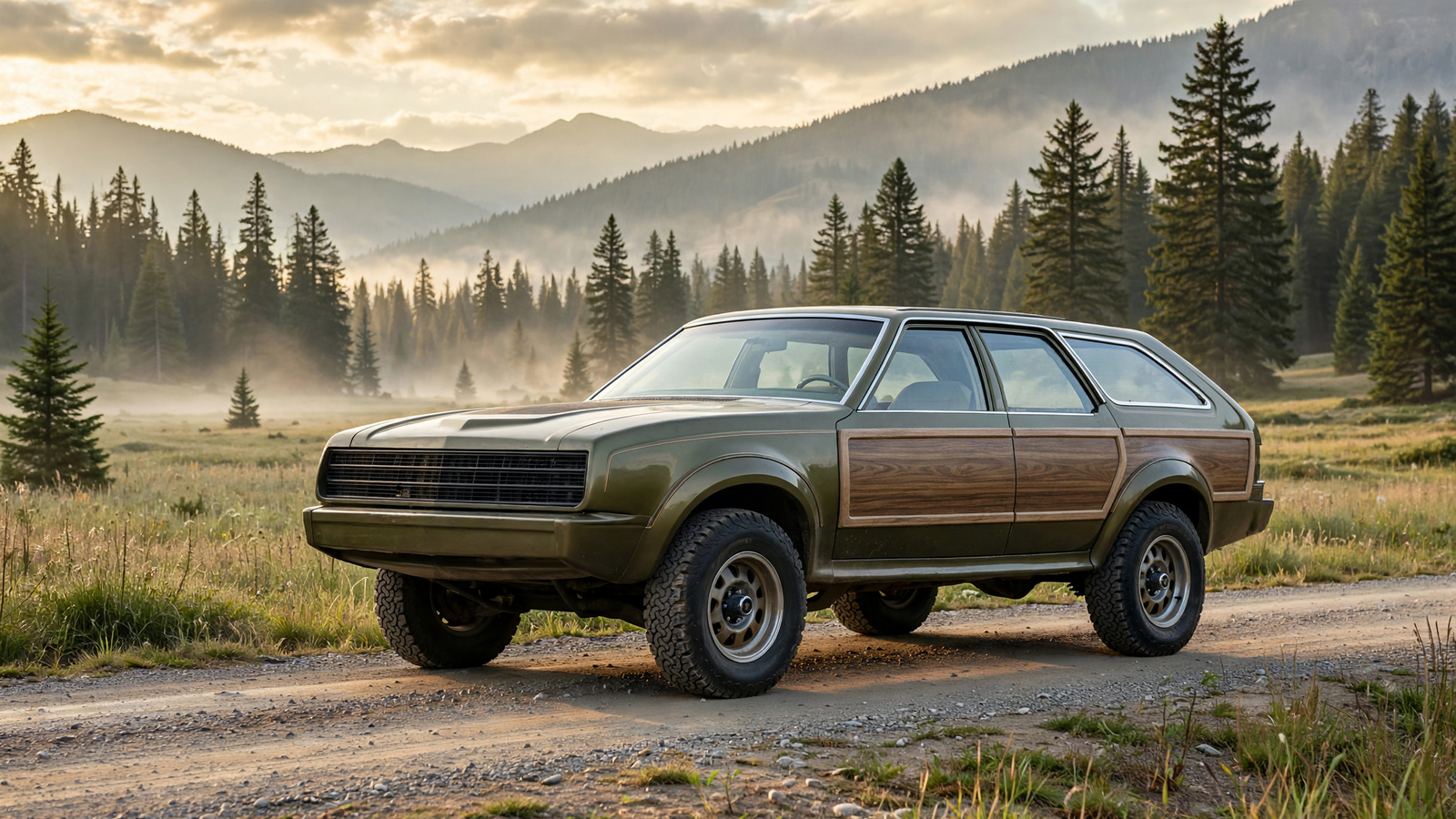
In 1979, however, it was a remarkably unusual proposition. American Motors Corporation, the smallest of Detroit’s major automakers, introduced the AMC Eagle—a family car with four-wheel drive, increased ground clearance, and a shape that still looked more like a sedan or station wagon than a truck.
The Eagle did not invent every ingredient later associated with the crossover. Four-wheel-drive passenger vehicles already existed, and station wagons had been carrying families for generations. But AMC combined those elements in a way that anticipated a new kind of everyday vehicle: not a traditional off-roader, not a conventional car, but something capable of moving between the two worlds.
A Different Kind of American Car
AMC had a long history of making cars that did not fit neatly into Detroit’s usual categories. The company built compact cars when larger manufacturers were still focused on size, experimented with unusual body styles, and maintained a close relationship with Jeep after acquiring Kaiser’s Jeep operations in 1970.
That combination gave AMC something its larger competitors often lacked: a reason to look at the passenger car and the off-road vehicle as parts of the same design problem.
The company’s conventional passenger-car lineup included the Concord, a compact-to-midsize sedan and wagon, and the Spirit, a smaller two-door model. Underneath, these cars offered a useful starting point for a new project. AMC engineers could add four-wheel-drive hardware and raise the body without creating an entirely new vehicle from scratch.
The result was the Eagle, introduced for the 1979 model year in several body styles, including a two-door coupe, four-door sedan, and station wagon. Later versions broadened the range further. Its proportions were familiar enough for daily suburban use, but its increased ride height and driven front wheels gave it a different relationship with bad weather, rough roads, and unpaved surfaces.
That was the central idea: drivers did not have to buy a conventional Jeep to gain additional traction, and they did not have to accept the manners of a truck to get a measure of off-road confidence.
The Engineering Was More Important Than the Styling
From a distance, the Eagle could look like an ordinary AMC passenger car that had been raised slightly. Its importance was beneath the sheet metal.
The car used a full-time four-wheel-drive system rather than requiring the driver to stop and manually engage the front axle whenever conditions worsened. A viscous coupling helped manage differences in wheel speed between the front and rear axles, allowing the system to operate on ordinary pavement as well as snow, mud, gravel, and other low-traction surfaces.
This mattered because many four-wheel-drive vehicles of the period were designed primarily for work or recreation. They could be noisy, heavy, stiff-riding, and inconvenient as daily transportation. The Eagle approached the problem from the opposite direction. It began with the expectations of a passenger car and added capability without asking the owner to live with a truck every day.
The system was not magic. The Eagle was not a rock crawler, and its additional hardware increased weight and complexity. But it was a practical solution to a practical problem. A driver in a snowy northern town, a rural community, or a place with rough seasonal roads could use the vehicle year-round without treating every journey as an expedition.
AMC also gave the Eagle a degree of visual restraint. It had protective body cladding, a raised stance, and a rugged appearance, but it was still recognizably related to AMC’s regular cars. That balance helped make the concept less intimidating than a traditional utility vehicle.
Why the Timing Was So Difficult
The Eagle arrived during one of the most challenging periods in the American auto industry. Fuel prices were high, emissions and safety rules were reshaping vehicle development, and buyers were increasingly attentive to economy. AMC was operating with fewer financial resources than General Motors, Ford, or Chrysler, which limited how many clean-sheet products it could afford to develop.
The Eagle was therefore both an engineering achievement and an exercise in resourcefulness. AMC adapted existing components and production knowledge instead of trying to create an entirely new category from the ground up.
That approach also created compromises. The Eagle was heavier than its two-wheel-drive relatives, and its four-wheel-drive hardware affected fuel economy. Its ride height and suspension changes gave it useful clearance, but they did not transform it into a dedicated off-road machine. Its styling could seem awkward when compared with the sleek cars of the era.
Yet the compromises were part of the point. The Eagle was not meant to replace a Jeep for difficult trail work. It was meant to make ordinary life less dependent on perfect pavement and perfect weather.
The Station Wagon That Saw the Future
The station wagon version may have been the clearest expression of the idea. It offered room for passengers and cargo, a long roof, and the practical shape families already understood. But unlike a conventional wagon, it could send power to all four wheels whenever needed.
For modern eyes, that combination looks almost obvious. A raised wagon with all-wheel drive now appears in showrooms around the world, often marketed as an alternative to a sport-utility vehicle. In the late 1970s, however, the market had not yet settled on the idea that many drivers wanted capability without sacrificing car-like comfort.
The Eagle helped demonstrate that such a vehicle could be useful outside a narrow enthusiast audience. It could serve commuters, families, rural drivers, and people who simply wanted greater confidence on winter roads. Its appeal was not based on extreme performance. It was based on reducing the number of conditions that could make a normal trip difficult.
That is a quieter form of innovation than a record-breaking engine or a dramatic concept car, but it is often the kind that lasts. The Eagle addressed a recurring daily inconvenience and gave it a mechanical solution.
A Small Company’s Big Influence
The AMC Eagle remained in production through the 1987 model year, by which time AMC’s corporate story had changed dramatically. Renault had taken a major stake in the company, and Chrysler acquired AMC in 1987, gaining the Jeep brand and other assets. The Eagle name disappeared, but the basic idea did not.
During the 1980s and 1990s, manufacturers increasingly explored vehicles that blended car-like construction, higher seating positions, and four-wheel or all-wheel drive. The Jeep Cherokee helped define the modern sport-utility vehicle, while later models from Subaru, Toyota, Honda, Volvo, and many others made the raised wagon and compact crossover familiar worldwide.
Those later vehicles were not simply copies of the AMC Eagle. Automotive ideas rarely travel in a straight line. Different companies developed different systems, bodies, and markets. Still, the Eagle occupies an important place in that lineage because it made the combination visible early: a vehicle could be civilized enough for daily errands and capable enough for roads that did not behave like roads.
Its influence is easiest to see not in a single direct descendant, but in the enormous number of vehicles that now follow its broad logic.
Why the Eagle Still Matters
The AMC Eagle is also a reminder that innovation does not always come from the largest company or the most powerful market segment. AMC did not have the resources to dominate the industry. It had to identify overlooked opportunities and make the most of existing tools.
That constraint encouraged a useful kind of creativity. Instead of asking whether a family car or a Jeep was the better product, AMC asked whether drivers might want parts of both. Instead of treating four-wheel drive as something reserved for work and recreation, the company treated it as a convenience that could make everyday travel more dependable.
The answer took the form of an ungainly, clever, slightly improbable automobile. It was not a sales sensation on the scale of the Mustang, nor did it immediately change the industry. But it arrived with a concept that eventually became central to the global car market.
When a modern driver chooses a vehicle with a raised seating position, a roomy wagon-like body, and all-wheel-drive confidence, that decision feels ordinary. The AMC Eagle belongs to the period when it was not ordinary at all—when an American automaker looked at a family car, a Jeep, and a difficult road, then decided they did not have to remain separate.