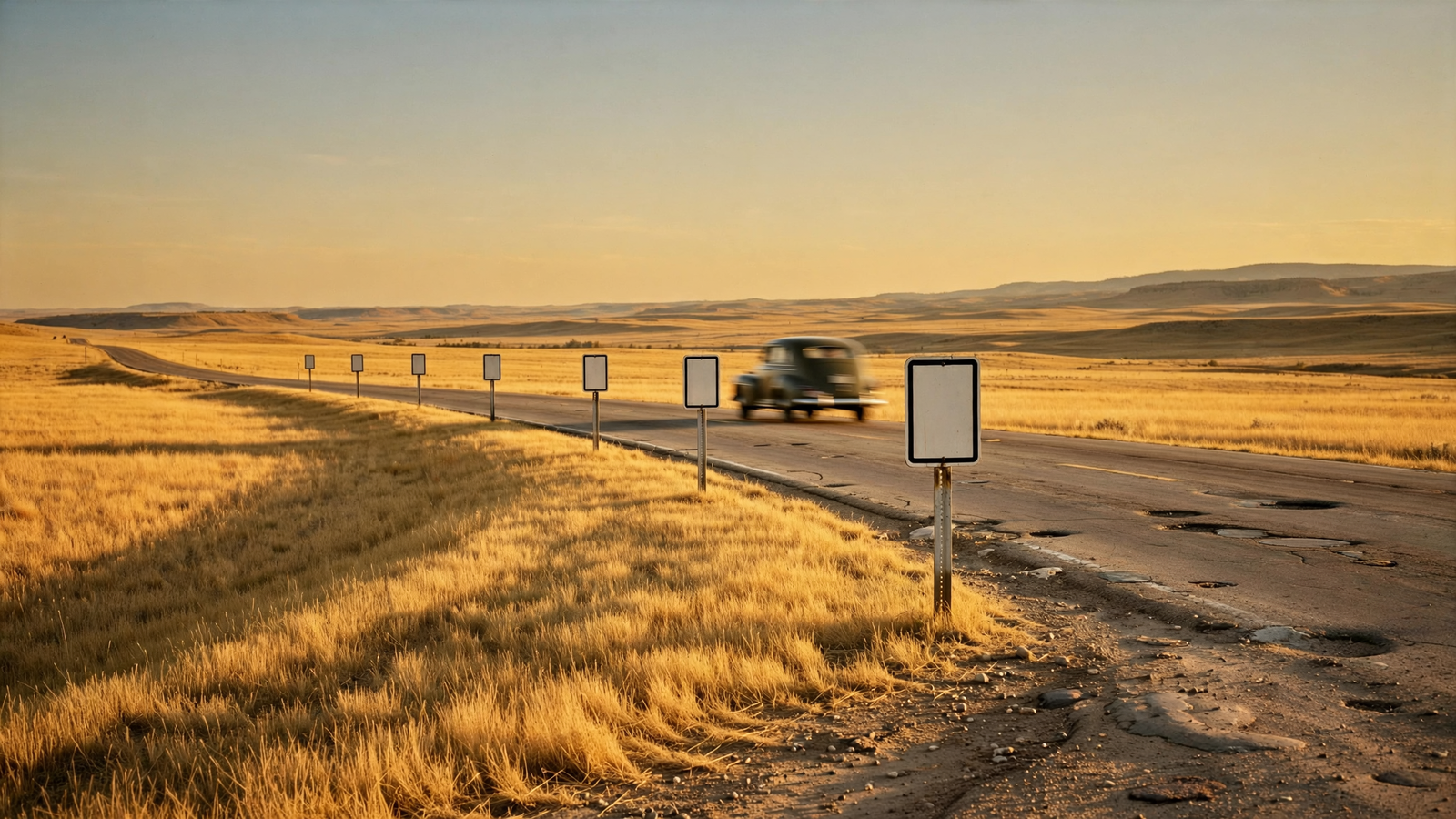
Long before smartphones filled the pauses between destinations, an American road trip offered a different kind of entertainment: a line of small red signs, spaced along the roadside, waiting to be read in sequence.
The first sign might pose a question. The next would add a warning. A third would supply the joke. By the time a driver reached the final panel, the advertisement had delivered its product name—and usually a rhyme that lingered longer than the journey.
Those signs belonged to Burma-Shave, a brushless shaving-cream brand whose advertising became one of the most recognizable features of 20th-century American highways. The company did not simply buy space beside the road. It turned distance itself into a medium.
A product looking for a new way to be seen
Burma-Shave was developed in the 1920s by the Odell family, whose company was based in Minneapolis. The name was an early piece of marketing theater: the product contained no ingredients from Burma, but its creators believed the name suggested exotic spices and an unusual formula.
At a time when shaving cream was commonly associated with a brush and mug, Burma-Shave promoted a simpler alternative. Its brushless cream could be spread directly on the face, an idea that made convenience part of the product’s identity.
The difficulty was getting that identity in front of customers. National magazines and urban billboards were expensive, while a small manufacturer needed a way to reach people where shaving products were actually purchased. The answer emerged in 1925, when the company began experimenting with a sequence of roadside signs.
Instead of placing one large advertisement in a single location, Burma-Shave installed several narrow panels in a row. Drivers encountered the message one piece at a time. The signs were inexpensive compared with many conventional advertising formats, but their arrangement created something more valuable: anticipation.
The road became the reading order
Sequential advertising was not entirely new, but Burma-Shave made it unusually clear, compact and repeatable. Each sign carried only a few words. The space between panels supplied the pauses, and the moving car supplied the rhythm.
A typical series could build toward a punchline about shaving, courtship or personal appearance. Other sets offered safety advice, especially around schools, railroad crossings and cautious driving. The product was always waiting at the end, but the route to the product often felt like a tiny roadside poem.
One of the most famous safety-oriented messages began with a reminder to slow down near schools and ended with the phrase “let the little shavers grow.” Its humor depended on the brand name, but its underlying instruction was serious: drivers had to share the road with children.
That combination helped distinguish Burma-Shave from a standard sales pitch. The signs were commercial, yet they also became part of the visual culture of travel. People looked for them. Families read them aloud. Children watched for the next panel and tried to guess the ending.
Small signs, national recognition
The campaign spread beyond Minnesota during the late 1920s and 1930s. Burma-Shave sign sets appeared along roads in many parts of the United States, generally on secondary highways rather than in dense city centers. Their placement mattered: the signs needed enough space for drivers to encounter each line without missing the sequence.
The company’s advertising department reportedly selected verses with care. A good set had to be short enough to read safely, clear enough to understand at speed and memorable enough to survive the next mile. The language was plain, the jokes were broad, and the final panel usually made the commercial purpose unmistakable.
That restraint was part of the design. A driver did not need to stop, enter a store or study a complex illustration. The message arrived in seconds, delivered by the road itself. In an era when most long-distance travel happened at ground level, the signs occupied a perfect band of attention between the windshield and the horizon.
Advertising that behaved like folklore
Burma-Shave’s best slogans circulated beyond the signs. Some became part of family memory; others were recalled imperfectly, like fragments of old jokes. The campaign worked because it invited participation. A traveler could repeat the rhyme, wait for the punchline or compare one set with another.
In that sense, the signs occupied an unusual space between advertising and folk culture. They were produced to sell shaving cream, but their compact verses could be remembered independently of the product. Their visual form also made them distinctive: small panels, often painted in the brand’s familiar red-and-white palette, lined up in open country.
The signs gave commercial language a physical location. A slogan was no longer only something printed in a magazine. It was something a traveler encountered between towns, beside a farm field or near a bend in the road. The message became attached to movement and place.
Why the system eventually disappeared
Burma-Shave’s roadside network reached its height in the middle decades of the 20th century. But the same changes that transformed American travel also weakened the campaign.
Limited-access highways altered the relationship between drivers and roadside businesses. Higher speeds made small sequential signs harder to read, while controlled-access roads left fewer locations where a company could install them. The spread of larger, more conventional billboards offered advertisers a different way to claim attention.
Changing ownership and competition in the shaving market also affected the brand. By the early 1960s, the roadside sign program was winding down. The signs had not failed because people stopped finding them amusing. They belonged to a road system that was disappearing beneath a faster, more standardized version of American mobility.
Interstate travel promised efficiency, but it reduced the small surprises of the older two-lane journey. A sequence of five signs depended on time, visibility and an unhurried relationship with the roadside. Once the trip became a controlled passage between interchanges, Burma-Shave’s original stage was largely gone.
A campaign preserved in memory
Although the signs left the highways, the idea never completely vanished. Reproductions have appeared in museums, private collections and historical displays. Vintage sign sets are now treated as artifacts of advertising history and road culture, not merely as packaging for an old shaving product.
Their survival says something about what people remember from commercial life. Most advertisements disappear as soon as they have been seen. Burma-Shave’s signs were different because they formed a small event. They interrupted the trip without stopping it, asked the traveler to pay attention and rewarded that attention with a line of verse.
They also reveal how much advertising once depended on the shape of everyday life. The campaign was built for a world of long drives, open roads and drivers who could encounter the same sign series repeatedly. It used no moving images, no recorded voices and no digital targeting. Its technology was spacing.
That spacing turned a road into a sentence. The car supplied the pace; the signs supplied the syntax. A product that might otherwise have been one more shaving cream on a store shelf became attached to the experience of going somewhere.
The lasting lesson of the roadside poem
Burma-Shave’s signs are often remembered as charming relics, and they certainly had charm. But their importance goes beyond nostalgia. They demonstrated that an advertisement could be designed around attention rather than simply placed in front of it.
The company understood that travelers had time between destinations but little patience for long explanations. A five-panel rhyme solved the problem. It broke the message into readable pieces, made the audience curious about the next line and transformed repetition into recognition.
Modern advertising has more sophisticated tools, but the basic insight remains familiar: people remember messages that give them something to do. Burma-Shave asked drivers to read, anticipate and complete a joke. The reward was modest—a smile, a remembered phrase, perhaps a decision at the next store—but the experience was unusually durable.
Today, the open road is covered with different messages, and many journeys move too quickly for the old format. Yet the red-and-white sign series still feels remarkably vivid. It captured a moment when an American commercial could be part of the landscape without overwhelming it, and when a brand could become known not through a single image, but through a rhyme unfolding one roadside panel at a time.