In the early twentieth century, a newspaper could be more than a record of what had happened. It could be a map, a warning, a source of legal knowledge, and a voice carried across state lines.
For millions of Black Americans living under segregation and racial violence, The Chicago Defender became all of those things. Founded in Chicago in 1905 by Robert S. Abbott, the paper helped its readers imagine a life beyond the restrictions of the Jim Crow South—and then offered practical information about how to pursue it.
Its pages did not simply describe the Great Migration. They helped make the movement legible. Through news reports, editorials, letters, employment notices, train information, and stories about Black life in Chicago, the paper connected people who were often separated by hundreds of miles but shared the same national conversation.
A newspaper built from a small beginning
Robert Sengstacke Abbott was born in Georgia in 1870, the son of formerly enslaved parents. He studied printing and law before settling in Chicago, a city that was already becoming an important center of Black business, politics, religion, and culture.
In May 1905, Abbott began publishing The Chicago Defender. The first issues were modest. The paper was initially produced with limited resources and circulated within Chicago’s Black community. But Abbott understood that a newspaper’s influence did not depend only on its size or its printing plant. It depended on whether readers believed the paper understood their lives.
The Defender reported on racial discrimination, violence, labor, education, housing, and politics. It also covered subjects that mainstream newspapers often ignored or treated through stereotypes: Black businesses, Black churches, social organizations, entertainers, athletes, and everyday community achievements.
That combination gave the paper a distinctive authority. It was both a publication and a shared institution—one that could tell readers what was happening, explain why it mattered, and suggest what they might do next.
The newspaper that traveled by train
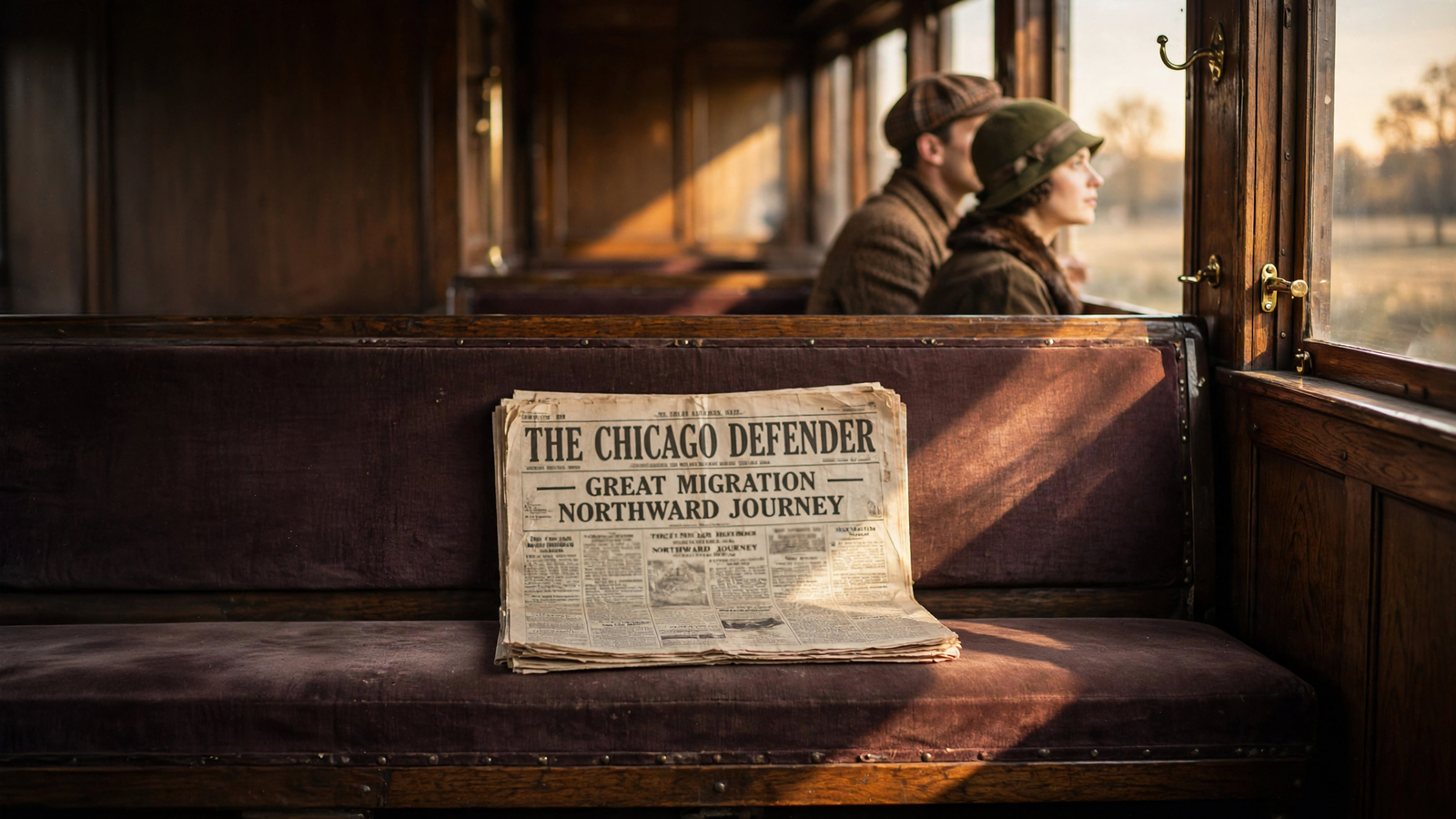
The Defender’s influence reached far beyond Chicago. Copies were distributed throughout the Midwest and transported into the South, often by Pullman porters and railroad workers. These men moved regularly between cities and could carry newspapers to readers who had few other ways to encounter Black journalism from outside their immediate communities.
In many Southern towns, the paper was read communally. A single copy might pass through several hands, be read aloud, or be discussed in barbershops, churches, homes, and workplaces. Its circulation figures therefore did not tell the entire story of its reach.
The paper’s distribution network mattered because the South’s racial order was not only enforced through law. It was also reinforced by isolation. Local newspapers frequently reflected the priorities of white-owned institutions, while Black residents faced censorship, intimidation, and violence when they challenged those structures. A newspaper arriving from Chicago could introduce different information—and a different sense of what was possible.
The Defender’s readers could learn about jobs in Northern cities, schools and neighborhoods, political developments, and the experiences of people who had already left. The paper made migration more than an individual leap into the unknown. It turned it into a subject that could be investigated, discussed, and planned.
Writing about a way out
During the years of the Great Migration, especially from the 1910s through the 1930s, millions of Black Americans moved from the South to cities such as Chicago, Detroit, Cleveland, New York, Philadelphia, and Los Angeles. They were drawn by industrial employment, educational opportunities, family networks, and the possibility—never guaranteed—of escaping the most restrictive features of the Jim Crow system.
The Defender strongly encouraged this movement. Its coverage presented Northern life as an alternative to the political and economic limits imposed in the South. The newspaper published accounts of work and housing, promoted the value of leaving, and urged readers to consider the future beyond the places where they had been born.
That advocacy could be powerful because it was grounded in a network of personal testimony. Readers did not encounter only abstract arguments. They encountered names, neighborhoods, workplaces, churches, and letters from migrants. The North was described through the experiences of people who had already made the journey.
But the paper’s message was not a simple promise of easy success. Black migrants in Northern cities faced overcrowded housing, employment discrimination, segregation, racial violence, and unequal access to services. The 1919 Chicago race riot demonstrated that geographic movement did not end racism; it changed its setting.
The Defender’s role is therefore best understood not as the promotion of a flawless destination, but as the creation of a public argument. It insisted that Black Americans had the right to seek safety, work, education, political participation, and control over their own futures—even when the places they moved to failed to provide those rights fully.
News as organizing
Abbott’s newspaper was not neutral in the narrow sense. It openly campaigned against racial injustice and used its editorial pages to pressure public officials and institutions. That position reflected a broader tradition in the Black press, where journalism often had to perform work that white-owned newspapers treated as outside the newsroom’s responsibilities.
A Black newspaper might report a discriminatory practice, identify those responsible, provide legal or political context, and encourage readers to respond. It could publicize meetings, support boycotts, challenge police conduct, and draw attention to cases that otherwise might have remained local and invisible.
The Defender also helped strengthen a national Black public sphere. Its readers were not merely members of separate city neighborhoods or rural communities. They were part of a connected audience with common concerns and the capacity to act collectively.
This connection became especially important during World War I and its aftermath, when questions about military service, citizenship, labor, migration, and democracy were being debated across the country. Black Americans were being asked to support a democratic nation while facing segregation and disenfranchisement at home. The Black press gave those contradictions a place to be examined in public.
A cultural institution as well as a political one
The Defender’s importance cannot be reduced to its editorials about migration. Like other major Black newspapers, it helped build a record of Black modern life.
Its pages covered musicians, writers, athletes, educators, ministers, entrepreneurs, and community leaders. In doing so, the paper challenged the idea that Black life belonged only in stories about oppression. It documented achievement, ambition, disagreement, creativity, and ordinary pleasure.
That cultural work was political in its own way. A newspaper that consistently represented Black people as full participants in American life was disputing the narrow images circulated by much of the mainstream press. It gave readers a place to see themselves not as a problem to be managed, but as citizens, consumers, workers, parents, artists, voters, and neighbors.
The paper also helped make Chicago itself a center of Black cultural life. As migrants arrived, they encountered institutions that had been strengthened by earlier arrivals. Newspapers, churches, businesses, clubs, schools, and political organizations formed an urban network that could support newcomers even while the city’s inequalities remained severe.
The Defender’s longer legacy
The newspaper continued to evolve as the country changed. Its influence was greatest during the decades when print was the primary mass medium, but its central questions remained durable: Who gets to tell the story of a community? Which injustices receive sustained attention? How can information become a form of protection or collective power?
The Defender belongs to the history of American newspapers, but it also belongs to the history of American movement. Its readers used information to make decisions about where to live, how to work, whom to trust, and when to organize. The newspaper helped transform private hopes into a shared public vocabulary.
That is why its significance reaches beyond the history of one publication. The Great Migration changed the demographic, political, economic, and cultural shape of the United States. The Defender did not cause every part of that transformation, and it could not remove the dangers migrants encountered. But it helped people understand the movement while it was happening—and helped create the connections that made a dispersed population feel like a public.
In an era when news now travels instantly across phones and networks, the paper’s story offers a reminder of what journalism can mean when readers depend on it for more than information. A newspaper can be a meeting place. It can preserve memory, challenge power, carry news across barriers, and give people language for a future they have not yet reached.