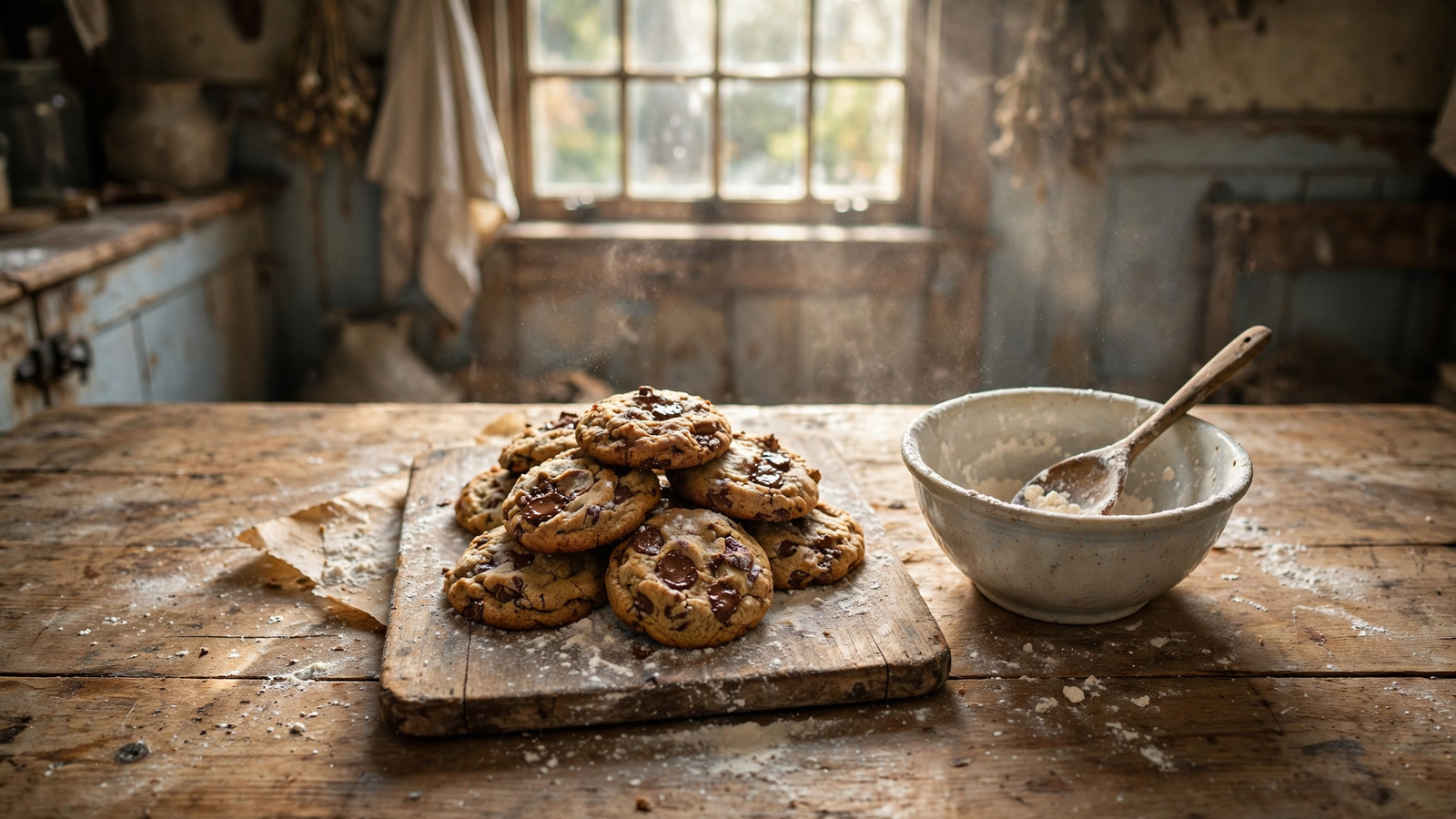
Few American foods are as immediately legible as the chocolate chip cookie: a golden edge, a soft or crisp center, and small pockets of chocolate distributed through every bite. It feels less like an invention than a permanent part of the kitchen. Yet the cookie has a precise beginning in the public record, and that beginning leads to a Massachusetts inn, a cookbook, and a practical act of culinary improvisation.
The woman most closely associated with the cookie was Ruth Graves Wakefield, who ran the Toll House Inn in Whitman, Massachusetts, with her husband, Kenneth. The inn was not a factory or a laboratory. It was a hospitality business known for home cooking, the sort of place where a recipe could be refined through repetition and judged by hungry travelers.
In the late 1930s, Wakefield added chopped pieces of semisweet chocolate to a butter cookie mixture. The result did not melt into the dough as completely as unsweetened baker’s chocolate would have done. Instead, it remained in distinct pieces after baking. That texture—crisp or tender dough surrounding softened chocolate—became the essential idea behind the chocolate chip cookie.
A roadside inn becomes a testing kitchen
The Toll House story begins before the cookie itself. Ruth and Kenneth Wakefield purchased and opened the Toll House Inn in 1930, adapting an older building on the road between Boston and New Bedford. The name referred to the colonial-era tollhouses that once stood along the route, though the Wakefields’ business was a modern restaurant and lodging house rather than an operating toll station.
Ruth Wakefield had studied household arts and understood food as both craft and business. At the inn, meals were part of the experience. Guests expected food that seemed familiar but still worth remembering, and the kitchen’s reputation depended on dependable recipes that could be produced for a changing stream of diners.
That setting matters because the chocolate chip cookie was not simply a lucky accident in a home kitchen. It emerged from a professional cooking environment, where ingredients were selected, tested, and written down. Wakefield was already a cookbook author when the cookie became widely known. Her book, Tried and True Recipes, appeared in 1931 and helped establish her as a public authority on practical cooking.
The recipe enters print
The first widely documented version of the cookie appeared in Wakefield’s 1938 cookbook, Toll House Tried and True Recipes. The recipe was called “Toll House Chocolate Crunch Cookies.” It used butter, brown sugar, white sugar, eggs, flour, baking soda, salt, nuts, and chopped semisweet chocolate.
The recipe’s structure looks familiar, but its chocolate was not. Modern bakers generally reach for bags of small morsels. Wakefield’s instructions called for a bar of semisweet chocolate to be cut into small pieces. Those irregular fragments produced a less uniform cookie, with some bites receiving a large piece and others only a thin streak.
The recipe also demonstrates why the cookie spread so effectively. It did not depend on a rare technique or specialized equipment. A household baker needed an oven, a mixing bowl, ordinary pantry ingredients, and a chocolate bar. Its appeal was achievable rather than ornamental: a familiar cookie made more exciting by an ingredient associated with candy and celebration.
Why the chocolate stayed in pieces
A popular version of the story says Wakefield was making chocolate cookies, ran out of baker’s chocolate, and substituted a Nestlé semisweet chocolate bar. According to the tale, she expected the chocolate to melt into the dough but discovered that it retained its shape.
The historical record is more restrained than the legend. Wakefield did use Nestlé chocolate in the recipe, and the published cookie clearly established the idea of chocolate pieces in a butter-based dough. But there is no need to rely on an accidental-discovery story to explain the cookie’s importance. The recipe’s real achievement was recognizing that partially melted chocolate could be a desirable texture in its own right.
In other words, the cookie worked because it occupied a useful middle ground. The chocolate softened in the oven, but it did not disappear. It became neither a plain biscuit nor a chocolate cake. Each cookie carried a small pattern of contrast: browned dough, fragrant butter, sugar, and pockets of chocolate.
From cookbook recipe to packaged ingredient
The recipe’s relationship with Nestlé helped move it beyond the Toll House kitchen. Wakefield and Nestlé reached an arrangement that allowed the company to use the Toll House name in connection with the recipe. Nestlé later printed the recipe on its chocolate packaging and developed chocolate morsels specifically suited to this style of baking.
That change was significant. Chopping a chocolate bar was manageable, but a packaged ingredient made the recipe faster and more consistent. The new morsels also gave shoppers a visual prompt: a bag of chocolate pieces was no longer merely candy-making material. It was an invitation to bake cookies.
By the 1940s, the recipe was circulating through newspapers, cookbooks, and home kitchens. The cookie’s popularity grew during a period when Americans were cooking under wartime constraints, yet it remained adaptable. Bakers could adjust the amount of nuts, vary the texture, or make smaller batches. The basic formula survived changes in brands, ovens, and household habits.
A wartime cookie travels far from Massachusetts
During the Second World War, chocolate chip cookies acquired another layer of meaning. Families sent baked goods to relatives and friends serving overseas, and cookies were practical care-package foods: portable, familiar, and comforting. The chocolate chip cookie was not created as a military ration, but its durability and emotional associations made it a natural part of wartime baking.
That circulation helped transform a regional specialty into a national one. A recipe learned in one household could be mailed to another. A soldier could taste a cookie that reminded him of home, while a family could bake a familiar food using the same recipe printed on a package or in a newspaper.
Food traditions often spread through exactly these modest channels. They do not require a grand restaurant or a national campaign. A recipe travels because someone copies it, shares it, changes it, and makes it again. The chocolate chip cookie became American partly because it fit the country’s expanding networks of supermarkets, packaged ingredients, magazines, military families, and home ovens.
The cookie outgrows its original name
The Toll House label remains attached to the cookie, but most people now think of it simply as a chocolate chip cookie. That shift reflects how thoroughly the recipe entered everyday life. Once the basic pattern became familiar, bakers began treating it as a platform.
Some versions favor a thin, crisp snap. Others are thick and soft. Recipes may include walnuts or pecans, oats, browned butter, sea salt, espresso powder, or different kinds of chocolate. Bakeries sell oversized versions; home cooks freeze dough for later; food companies produce ready-to-bake varieties. The variations keep multiplying because the central idea is stable enough to withstand experimentation.
The cookie’s continued popularity also comes from its balance between precision and forgiveness. A baker can follow the recipe closely, but small differences in flour, butter temperature, mixing time, or baking length can create a new texture without destroying the result. It is an accessible lesson in how cooking works: the same ingredients can produce different experiences through small changes in method.
A recipe as a piece of American memory
Ruth Wakefield’s achievement was not just combining chocolate and cookie dough. It was recognizing a form that people wanted to repeat. The Toll House cookie could be served at an inn, baked in a family kitchen, mailed across the country, or made by a child learning to measure flour. It belonged to hospitality, but it also belonged to ordinary Tuesday afternoons.
That may be why the chocolate chip cookie has endured more completely than many trendier American foods. It carries a specific history without feeling historical. Its origin can be traced to a Massachusetts inn and a 1938 cookbook, yet every household has room to make the recipe its own.
The cookie’s story is therefore larger than a question of who invented it. It is a story about how food becomes culture: a professional cook develops an idea, a printed recipe gives it a durable form, a manufacturer makes the ingredients easier to find, and generations of bakers add their own habits. What began as chopped chocolate in cookie dough became one of the country’s most portable and recognizable forms of welcome.