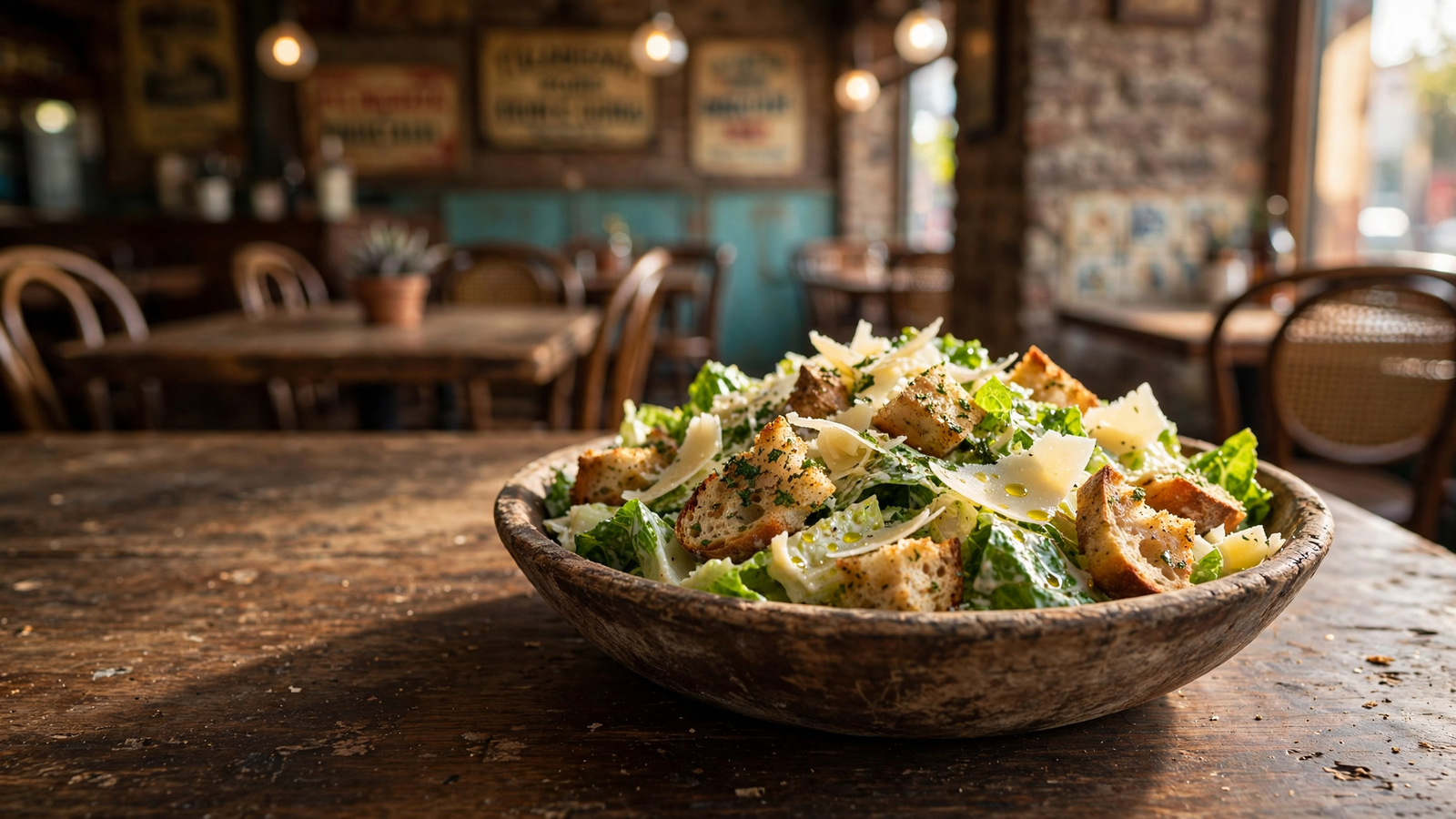
It arrives in a wooden bowl or a chilled glass, familiar almost anywhere: crisp romaine, a creamy dressing, toasted croutons, Parmesan, and a name borrowed from ancient Rome. Yet the Caesar salad is not Roman, and its most often credited birthplace is not the United States. It is Tijuana, Mexico—a border city whose restaurants once served travelers looking for a lively alternative to Prohibition-era America.
The salad’s story is a reminder that food rarely belongs to a single nation in a simple way. The Caesar is Mexican by birthplace, Italian-American by family history, American by global popularity, and endlessly adaptable wherever people have access to lettuce, bread, cheese, and a little culinary confidence.
A border-city beginning
The standard account places the salad at Caesar’s Restaurant, opened in Tijuana by Italian-born restaurateur Caesar Cardini. Cardini had worked in the restaurant business in the United States before Prohibition helped make Tijuana an attractive destination for American visitors. The city was close enough to reach from Southern California but beyond the direct reach of American alcohol restrictions, and its restaurants, hotels, and entertainment venues benefited from the cross-border traffic.
According to the Cardini family’s longstanding account, the salad emerged during a crowded service in 1924. Supplies were running low, so Cardini assembled what he had: romaine lettuce, eggs, olive oil, Parmesan, bread, garlic, and seasonings. Rather than chopping everything into a conventional mixed salad, he reportedly served the romaine leaves whole, allowing guests to pick them up with their fingers.
The date is often given as July 4, 1924, but the neatness of that detail should not be confused with absolute proof. Food history is frequently preserved through family memory, restaurant tradition, and later publicity rather than a single surviving document. The broad claim—that Cardini’s Tijuana restaurant was central to the salad’s early history—is widely accepted. The precise moment and exact first recipe remain less certain.
Why the story has never been completely settled
Caesar Cardini was not the only person associated with the dish. His brother, Alex Cardini, was also involved in the restaurant business and later received credit for developing a version known as the Aviator’s Salad. Other former employees and nearby restaurateurs have been named in competing accounts. Some stories suggest that the recipe grew out of a family dish; others argue that similar combinations were already circulating in restaurants.
That uncertainty does not make the Caesar’s origin meaningless. It shows how a restaurant dish becomes part of public culture. A recipe that begins as an improvised service item can be adjusted by cooks, remembered differently by employees, promoted by owners, and eventually printed in cookbooks under a single memorable name.
The Cardini version also differed from many modern restaurant Caesars. The original presentation emphasized whole leaves and tableside preparation. The dressing was not necessarily the thick, bottled-style mixture now associated with the salad. Anchovies, for example, are a frequent source of debate. Cardini family accounts have often said that anchovy flavor came from Worcestershire sauce rather than anchovy fillets, while many later recipes include anchovies directly.
The ingredients that made it travel
The Caesar succeeded because its structure was both distinctive and understandable. Romaine supplied crunch. A sharp dressing brought together oil, acid, egg, garlic, and savory seasoning. Toasted bread added texture and thrift, turning a bowl of leaves into something more filling. Parmesan contributed salt and depth without requiring a large quantity.
None of those ingredients was exotic to North American restaurant kitchens. That mattered. The salad felt more special than a simple green salad, but it did not require an unfamiliar cooking technique or a difficult shopping list. Its drama came from the combination—and, in early versions, from watching the dressing come together at the table.
Tableside preparation also gave the dish a small performance. A server could rub garlic into a bowl, whisk in the dressing, toss the leaves, and finish the salad in front of the guests. In an era when restaurant service was part of the evening’s entertainment, that ritual helped turn a recipe into an experience.
From Tijuana to the American menu
The Caesar’s route north was helped by travelers who had eaten it in Tijuana and by restaurant professionals who carried the idea elsewhere. Its popularity grew in Southern California and then spread through hotels, cafés, steakhouses, and home kitchens.
By the middle of the twentieth century, the salad had become a standard on American menus. Bottled dressings made it easier to reproduce, while packaged croutons and pre-grated cheese reduced preparation time. The dish could be served as a starter, a side, or—once grilled chicken, shrimp, salmon, or other proteins were added—as a full meal.
That expansion changed the Caesar, but it did not erase its basic identity. The essential formula remained: a sturdy green, a creamy savory dressing, something crisp, and a hard cheese. The salad was flexible enough for a neighborhood diner and polished enough for a hotel dining room.
The Caesar at home
A home cook does not need to recreate a disputed 1920s formula to understand why the salad works. The most important principles are balance and texture.
- Use sturdy lettuce. Romaine can stand up to a flavorful dressing without collapsing immediately.
- Build contrast. Keep some leaves cold and crisp, and make the croutons properly toasted rather than merely dry.
- Add acidity carefully. Lemon juice or another acidic ingredient keeps the dressing from becoming heavy.
- Treat the cheese as seasoning. Parmesan should sharpen the salad, not bury it.
- Dress just before serving. The Caesar is at its best when the leaves are coated but still crunchy.
A traditional-style dressing may use a coddled egg or egg yolk, oil, lemon, garlic, Worcestershire sauce, Parmesan, and black pepper. Modern cooks often use mayonnaise as a convenient substitute for the egg base. Anchovies can be added for a deeper savory flavor, even if they were not part of the earliest Cardini family recipe. Vegetarian versions can use capers, miso, or additional Worcestershire-free seasonings, depending on the cook’s preferences.
The point is not to create a museum replica. It is to preserve the salad’s original logic: a modest collection of ingredients transformed through emulsion, timing, and texture.
A Mexican birthplace, an American afterlife
The Caesar salad is sometimes described as an American dish because the United States made it famous. That description leaves out the importance of Tijuana, whose border position helped create the circumstances in which the recipe could flourish. It also overlooks the Italian immigrant family at the center of the most widely accepted account.
Its identity is better understood as layered. The salad was created in a Mexican city for an international clientele. Its creator had Italian roots and American restaurant experience. Its ingredients reflected a transnational pantry. Its later popularity was driven by American dining culture, then carried around the world by restaurants, packaged foods, cookbooks, and travelers.
That is what makes the Caesar an especially revealing piece of Americana. It is not a dish that stayed fixed in one place or belonged neatly to one tradition. It became recognizable by moving—across a border, between professional kitchens and home tables, and from a restaurant specialty into everyday food culture.
Nearly a century after its disputed debut, the salad still works because it offers a small lesson in culinary invention. A crowded kitchen, a limited supply shelf, and a willingness to improvise can produce something that outlives the circumstances that created it. The Caesar began as a restaurant’s solution to a particular evening. It became a shared language for a certain kind of meal: crisp, savory, quick to assemble, and just theatrical enough to feel like an occasion.