For decades, medicine has largely approached childhood deafness with tools that work around a damaged or missing part of the hearing system. Hearing aids amplify sound. Cochlear implants translate sound into electrical signals that stimulate the auditory nerve. Both can be transformative, but neither repairs the genetic fault that caused hearing loss in the first place.
That distinction is becoming important in a small but significant group of clinical studies. Researchers are testing gene therapy for children born with changes in OTOF, a gene needed by the inner ear to transmit sound. Early results suggest that supplying a working copy of the gene can restore measurable hearing in some children who had been profoundly deaf since birth.
The work is still experimental. The studies involve small numbers of patients, and researchers do not yet know how durable the improvements will be or how widely the approach can be applied. But the trials offer a clear demonstration of a new medical possibility: in certain forms of inherited deafness, the biology of hearing may be repairable.
Why the OTOF gene matters
Hearing is not a single event. Sound waves move through the outer and middle ear before reaching the cochlea, a spiral-shaped structure in the inner ear. Inside the cochlea, specialized hair cells convert vibration into signals that can travel through the auditory nerve to the brain.
In children with damaging variants in OTOF, the hair cells can detect the mechanical movement caused by sound, but they cannot efficiently pass that information to the auditory nerve. The problem lies partly in otoferlin, a protein that helps release the chemical signals used for communication between inner hair cells and nerve endings.
This makes OTOF-related deafness an unusually attractive target for gene therapy. The sensory cells may still be present and structurally capable of working. If a functioning gene can be delivered into those cells, researchers hope the missing protein will allow the ear to resume its normal signaling process.
That is different from many other causes of hearing loss, in which hair cells have been destroyed or the auditory nerve itself is severely damaged. A therapy aimed at OTOF will not automatically work for every child with congenital deafness. Genetic diagnosis is therefore central to the treatment, not an optional extra.
How the treatment works
The experimental therapy uses an adeno-associated virus, or AAV, as a delivery vehicle. AAVs are viruses that can be modified so they do not cause the disease associated with their natural relatives. In gene therapy, scientists use them as microscopic carriers for genetic instructions.
Because the complete OTOF gene is too large for some commonly used AAV vehicles, researchers have developed delivery strategies suited to the gene’s size. In the approaches being studied for deafness, the therapeutic material is introduced directly into the cochlea during a surgical procedure. The goal is to reach inner hair cells while limiting exposure elsewhere in the body.
Once inside the target cells, the delivered genetic instructions are intended to produce functional otoferlin. The therapy does not replace the child’s DNA throughout the body, and it is not designed to alter every cell. It is a local attempt to restore a particular molecular function in the inner ear.
The timing may also matter. Children born deaf can have limited access to sound during a period when the auditory pathways are developing. Earlier treatment could, in theory, give the brain more opportunity to learn how to interpret sound. Researchers are still studying how age, the specific mutation, the condition of the inner ear and previous use of hearing technology affect outcomes.
What early trials have shown
In 2024, researchers reported early clinical results from children with OTOF-related congenital deafness. The studies were small and designed primarily to assess safety and look for signs of biological activity, rather than to provide the final evidence needed for routine medical use.
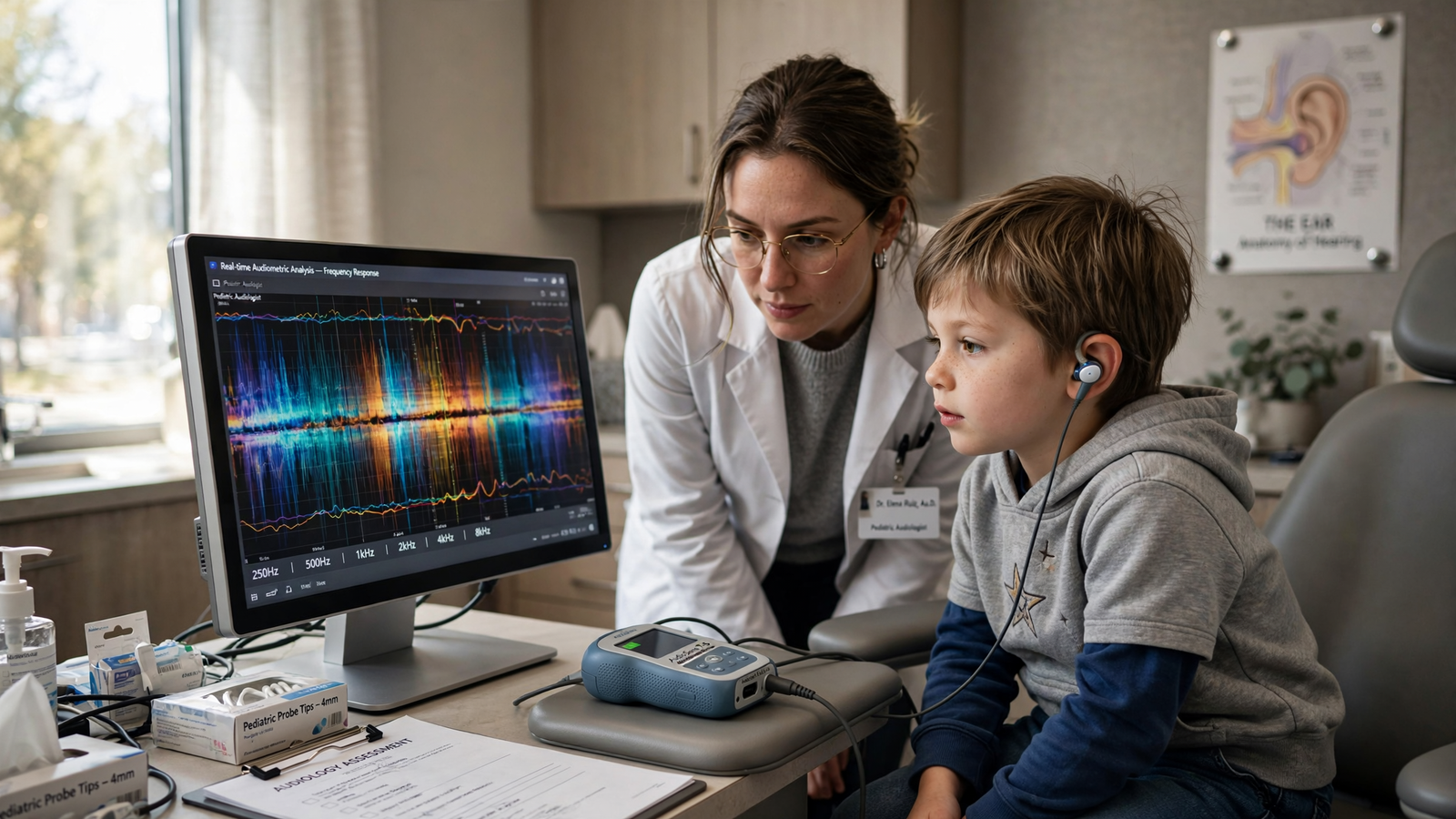
Several treated children developed improvements in hearing thresholds after receiving the therapy. In practical terms, sounds that had previously been too faint to detect became measurable in clinical testing. Some children also showed evidence that they could respond to speech and environmental sounds without relying exclusively on their previous assistive technology.
A team at Children’s Hospital of Philadelphia described the first child treated in a U.S. clinical trial. The child had profound hearing loss linked to an OTOF mutation and received a one-time treatment delivered to the inner ear. Follow-up testing showed improved hearing after treatment, although the researchers emphasized that the result came from one early participant and could not establish how the therapy would perform across a larger population.
At the same time, investigators in China reported results from a small group of children treated with an AAV-based OTOF therapy. The children showed varying degrees of hearing recovery, and the work provided independent evidence that the biological strategy could produce a response in humans.
Those findings are encouraging because they go beyond laboratory models. Animal studies can show that a gene therapy reaches the right cells and produces a protein, but a clinical study must also answer harder questions: Can the therapy be delivered safely? Does the restored protein improve the whole hearing pathway? Can children recognize meaningful sounds, rather than merely detect tones in a booth?
The first results suggest that, for at least some patients, the answer to the second question is yes. They do not yet answer all the others.
A treatment, not yet a cure for deafness
It is important not to describe these trials as a universal cure. Inherited deafness has many causes. Different genes affect different parts of the ear, and some forms involve the loss of hair cells or damage to the auditory nerve. A therapy that replaces OTOF function cannot correct those conditions.
Even among children with the relevant gene variants, response may differ. The amount of remaining inner-ear tissue, the exact genetic change, the age at treatment and the body’s immune reaction to the delivery vehicle may all influence results. A treatment that produces a measurable response in a small early trial may not deliver the same benefit to every patient.
Long-term monitoring is especially important. Researchers need to know whether hearing gains remain stable for years, whether additional treatment is possible, and whether the therapy affects balance or other inner-ear functions. They must also watch for surgical complications and immune reactions. AAV-based therapies have been used in other medical settings, but each organ and delivery route creates its own safety questions.
There is also a difference between hearing a tone and understanding language. Children who receive treatment early may need intensive auditory training and speech-language support as their brains adapt to new information. Families and clinicians will have to measure success in everyday communication, not only in laboratory thresholds.
Why the research matters beyond one gene
The importance of the work is not limited to OTOF-related deafness, which is relatively uncommon. The trials are helping researchers develop a broader toolkit for treating conditions in the inner ear, an organ that has historically been difficult to reach and monitor.
They are also changing the role of genetic testing in hearing care. A child diagnosed only with “congenital hearing loss” may have a condition that looks similar to many others but has a very different treatment opportunity. Identifying the responsible gene can help determine whether a child might qualify for a clinical trial, whether existing technology is likely to work well and what information should be shared with relatives.
More broadly, the approach illustrates how gene therapy is evolving. The goal is not always to replace an entire organ or reverse advanced disease. Sometimes it is to restore one missing molecular step in a small, precisely selected group of patients. If that step is essential, a relatively localized treatment may have effects that can be heard in a child’s daily life.
The next phase will require larger studies, longer follow-up and comparisons with the hearing outcomes children achieve through hearing aids or cochlear implants. Researchers will also need to make the therapy reliable and accessible, because a technically successful treatment has limited public value if only a handful of families can reach it.
For now, the evidence supports a measured conclusion rather than a sweeping promise. Gene therapy has not solved childhood deafness. But in children whose hearing loss is caused by a missing piece of the OTOF pathway, scientists have begun to show that the inner ear may be able to receive and use a genetic repair. That is a meaningful change in what medicine can attempt.