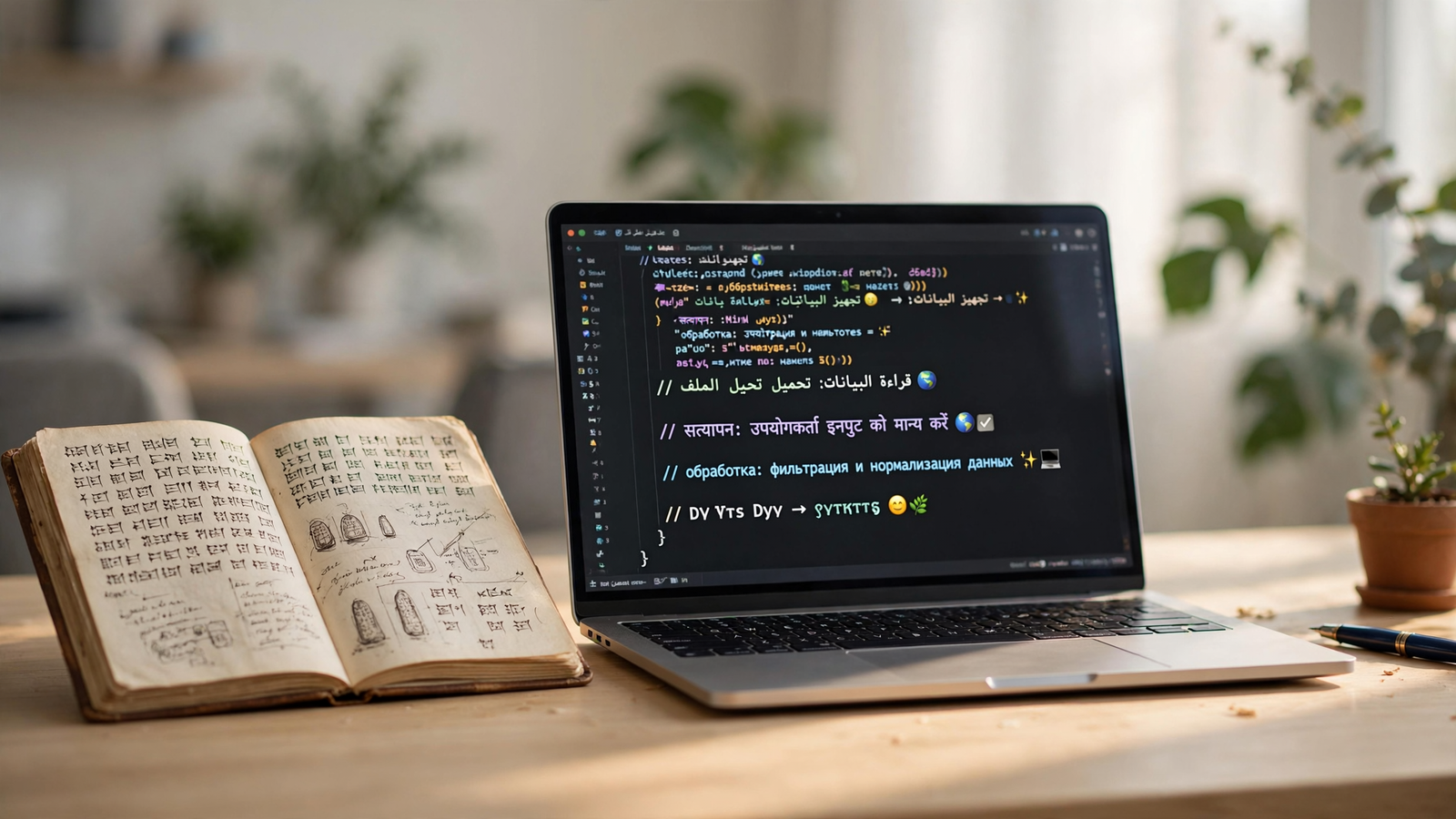
Every time a message moves from one device to another, it carries more than words. It carries decisions about identity: whether a character is Latin, Arabic, Devanagari, Han, Cherokee, or something else; whether an accent belongs to a letter; whether an emoji will arrive as intended; and whether a text written on one continent will remain readable on another.
For much of computing’s early history, those decisions were made locally. A computer in one country might assign a number to a character that meant something entirely different on another machine. The result was a digital version of crossed wires: garbled text, missing symbols, and documents that could not travel reliably across languages.
Unicode changed that. It created a shared system for identifying characters from the world’s writing traditions, allowing different operating systems, websites, applications, and devices to refer to the same character in the same way. It is one of the quiet foundations of global communication—not a messaging app or a network, but a common agreement about what messages contain.
The problem before Unicode
Early computers were usually designed around the needs of a particular institution, country, or language. The American Standard Code for Information Interchange, better known as ASCII, became a powerful early standard for English-language computing. It used seven bits to represent 128 values, including Latin letters, numbers, punctuation, and control instructions.
ASCII was efficient, but its assumptions were narrow. It did not have room for most of the world’s writing systems. As computing spread, different regions developed or adopted their own character encodings. These systems could support local scripts, but they did not necessarily agree with one another.
A byte sequence that represented a character in one encoding could represent a different character—or no meaningful character at all—in another. Moving a document between systems could turn readable text into a string of replacement symbols. Email, databases, websites, and software all faced versions of the same problem.
The difficulty was not simply that computers needed more characters. They needed a consistent way to identify them.
A digital address for every character
Unicode’s central idea is to assign a stable number, called a code point, to each character. The code point is an abstract identity. It says which character is intended without dictating exactly how that character must be stored or drawn.
That distinction matters. A character is not the same thing as its typeface, visual shape, or byte sequence. The letter “A” can appear in many fonts, but its identity remains the same. Similarly, a character such as an accented letter may be represented in more than one technically valid way, which is why software also needs rules for normalization and comparison.
Unicode separates these layers so that different technologies can cooperate. A database can store text, a web browser can interpret it, and a font can display it, while each part performs a different job.
The Unicode Consortium, a nonprofit organization formed in the early 1990s, develops and maintains the Unicode Standard. Its work is closely aligned with the international character-encoding standard ISO/IEC 10646. The project has expanded from the alphabets and symbols most familiar to early personal computers to thousands of scripts and writing systems.
Why encoding still matters
People often encounter Unicode through a visible symbol, but the more important achievement is usually invisible. Modern systems commonly use Unicode Transformation Format 8, or UTF-8, to turn Unicode code points into sequences of bytes that computers can store and transmit.
UTF-8 has a practical advantage: it preserves compatibility with the original ASCII character set while supporting the full range of Unicode code points. Common English characters take one byte, while other characters use longer sequences. This variable-length design helped Unicode move from an ideal standard into the working infrastructure of the web.
The Internet Engineering Task Force standardized UTF-8 for Internet protocols in RFC 3629. The World Wide Web Consortium also treats character encoding as a basic part of interoperable web content. When a web page declares and handles its encoding correctly, browsers in different countries can interpret the same underlying data instead of guessing.
That reliability is easy to overlook because successful text transmission produces no visible event. A user types a message, presses send, and the recipient sees the intended words. The smoothness is the result of standards doing their work in the background.
More than modern alphabets
Unicode’s scope reaches beyond the major scripts that dominate international software. The standard includes characters used in writing systems such as Greek, Hebrew, Arabic, Ethiopic, Thai, Tamil, Mongolian, and many others. It also supports historic and scholarly scripts, mathematical symbols, technical marks, punctuation, and emoji.
Adding a script is not merely a matter of drawing its characters. Experts must determine how the writing system works: the order in which text is read, how characters combine, how they behave in different contexts, and how they should be sorted or searched. Some scripts require complex shaping, in which a sequence of characters changes appearance depending on its position or neighboring characters.
Unicode therefore functions as both a catalog and a framework. It identifies characters, records important properties, and provides rules that help software process text consistently. Fonts and rendering systems still have to do their own work, but they can build on a shared foundation.
The human meaning of machine-readable text
Technical standards can sound neutral, yet character encoding has direct cultural consequences. If a language cannot be represented reliably in software, its speakers face practical barriers in education, government services, publishing, search, commerce, and everyday conversation.
Unicode does not automatically solve those barriers. A script may be encoded but still lack good fonts, keyboard tools, speech technology, optical character recognition, or local digital content. Some communities also face difficult decisions about how their language should be represented in a global standard.
Still, a common encoding removes one major obstacle. It gives developers a way to build tools that can handle many languages without creating a separate, incompatible foundation for each one. It also makes it possible for digital archives and cultural institutions to preserve text in forms that are more likely to remain usable across generations of software.
The same principle applies to minority and historic scripts. When a writing system receives standardized digital support, researchers can catalog documents, communities can create keyboards, and educators can produce learning materials that work beyond a single computer or platform.
Emoji revealed the standard’s reach
Emoji made Unicode visible to a mass audience. What began as a set of pictorial characters associated with Japanese mobile communication became part of ordinary digital conversation around the world. Unicode assigns standardized identities to emoji, while platforms decide how those characters look in their own designs.
That division explains why the same emoji can appear differently on different phones while remaining recognizable as the same underlying character. It also explains why emoji sequences can be more complicated than they seem. Some visible symbols are created by combining multiple code points, such as a base character with a variation selector, skin-tone modifier, gender indicator, or zero-width joiner.
The system has limits. A code point does not guarantee that every device will display a symbol, and a character’s appearance can vary by font, platform, or cultural context. Unicode provides shared identity, not universal agreement about visual design or meaning.
A standard built for an expanding world
Unicode is still evolving. New versions add characters and scripts, refine properties, and respond to requests from communities, researchers, governments, and technology developers. The process requires technical review because once a character is encoded, its identity becomes part of a long-lived digital environment.
That permanence is one reason the standard is deliberately cautious. Encoding a character is not the same as approving a font or declaring that every visual variation deserves a separate code point. The goal is to represent the information needed for reliable text processing while avoiding unnecessary fragmentation.
The result is not a perfect universal language. Unicode does not translate, teach pronunciation, settle spelling disputes, or ensure that every language receives equal technological attention. It does something more fundamental: it allows writing systems to coexist inside the same computational world.
Modern communication depends on many visible inventions—fiber networks, satellites, smartphones, browsers, and messaging services. Beneath them is a quieter achievement. Unicode gave those systems a shared way to recognize the world’s written expression, from the oldest surviving scripts to the newest symbols of online life.
Every successful multilingual search, digital archive, international email, and cross-border conversation is a small demonstration of that agreement. The message may travel through thousands of machines, but its characters can arrive with their identities intact.
Use: Background on Unicode, characters, code points, scripts, and the purpose of the standard.
Use: Historical background on the development of Unicode and the Unicode Consortium.
Use: Authoritative reference for the standard’s scope, versioning, and technical structure.
Use: Technical reference for UTF-8 and its role in Internet protocols.
Use: Web-standard guidance on character encodings and interoperable multilingual content.
Unicode Consortium — Unicode Standard and FAQ — https://home.unicode.org/basic-info/faq/ — Background on Unicode, characters, code points, scripts, and the purpose of the standard.
Unicode Consortium — Unicode History — https://home.unicode.org/history/ — Historical background on the development of Unicode and the Unicode Consortium.
Unicode Consortium — Unicode Standard, Version 16.0.0 — https://www.unicode.org/versions/Unicode16.0.0/ — Authoritative reference for the standard’s scope, versioning, and technical structure.
Internet Engineering Task Force — RFC 3629: UTF-8, a transformation format of ISO 10646 — https://www.rfc-editor.org/rfc/rfc3629 — Technical reference for UTF-8 and its role in Internet protocols.
W3C Internationalization — Character Encodings — https://www.w3.org/International/questions/qa-choosing-encodings — Web-standard guidance on character encodings and interoperable multilingual content.