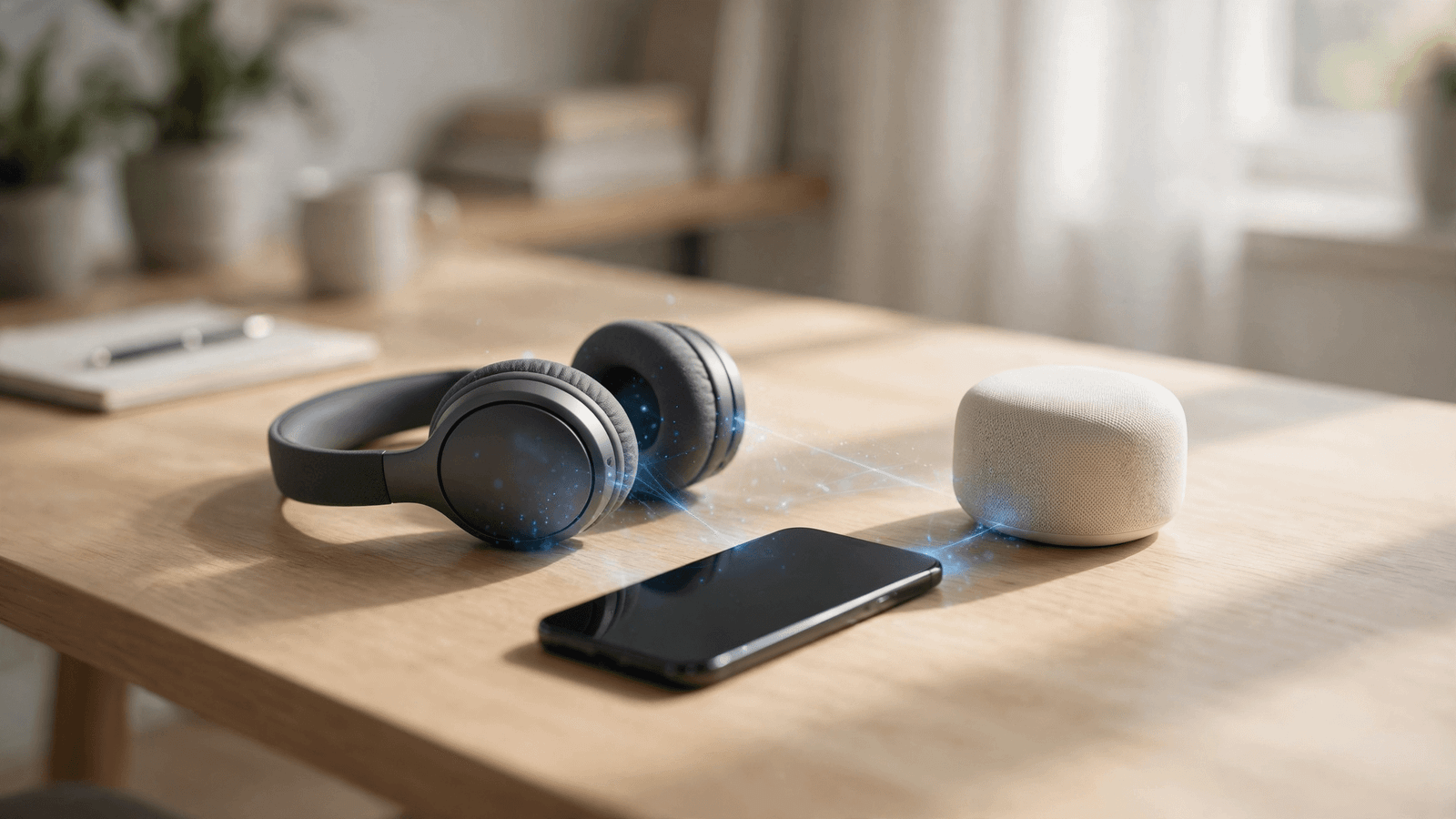
Some of the most important communications technologies announce themselves with astonishing modesty. Bluetooth often begins with a soft chime, a small icon, or a brief message asking whether two devices may connect.
Behind that ordinary moment is a remarkable piece of engineering. Bluetooth allows devices made by different companies to exchange information over short distances without a cable, a cellular subscription, or a shared Wi-Fi network. It connects a watch to a phone, a keyboard to a tablet, earbuds to a laptop, and a car to the people inside it.
Its greatest achievement may be easy to overlook: Bluetooth made cooperation between competing manufacturers feel routine.
A cable problem looking for a radio solution
The idea emerged at Ericsson in Sweden during the 1990s, when engineers were exploring ways to connect phones and accessories without the increasingly inconvenient tangle of cables. A wireless link could make mobile devices easier to use, but only if it was inexpensive, consumed little power, and worked across products from different companies.
That last requirement was crucial. A proprietary wireless system might work beautifully inside one company’s product family, but it would not create a broad communications standard. For a phone to communicate with a computer, headset, printer, or car made by another manufacturer, the devices needed a common set of rules.
In 1998, Ericsson joined IBM, Intel, Nokia, and Toshiba to establish what became the Bluetooth Special Interest Group, or Bluetooth SIG. The group’s purpose was to develop and promote an open specification that companies could use to build interoperable products. More companies joined as the project developed.
The name came from Harald “Bluetooth” Gormsson, a 10th-century Danish king associated with bringing parts of Scandinavia together. Intel engineer Jim Kardach proposed the reference as a temporary project name, but it remained. The familiar Bluetooth symbol combines two runes associated with Harald’s initials.
The small radio inside the idea
Bluetooth works in the unlicensed 2.4-gigahertz industrial, scientific, and medical radio band. This is the same broad neighborhood used by several other wireless technologies, so Bluetooth had to be designed to share a crowded environment.
One of its early answers was frequency hopping. Instead of staying on one radio channel, classic Bluetooth rapidly moved among many narrow channels. If another signal created interference on one channel, the connection could continue elsewhere. The technique did not make interference disappear, but it helped a low-power device maintain a usable link in a busy radio environment.
Bluetooth also divided communication into carefully defined layers. Radios handled the physical transmission. Other parts of the specification managed discovery, pairing, security, data exchange, and the behavior of particular device types. This layered approach meant that a manufacturer could build a mouse, headset, phone, or sensor while relying on a shared communications foundation.
Early Bluetooth devices were not always effortless. Pairing could be confusing, connection profiles were limited, and different products sometimes behaved unpredictably. But the underlying concept was powerful: a device did not need to know the internal design of another device. It needed to understand the common rules.
From a phone accessory to a general-purpose link
The first wave of Bluetooth products focused on replacing short cables. Wireless headsets became an obvious demonstration, allowing people to take calls without holding a phone to their ear. Phones and computers could exchange files. Laptops could use wireless mice and keyboards. Cars could communicate with mobile devices for hands-free calling.
Bluetooth’s usefulness expanded as manufacturers developed profiles for different jobs. A headset needs a different kind of connection from a keyboard. A health sensor sends small, regular measurements rather than a continuous stream of high-quality audio. A car may need to manage calls, contacts, media, and control information.
These profiles helped turn a general radio into a family of practical tools. They also exposed one of the less visible challenges of standards work: “wireless” is not one use case. A technology must define how devices discover one another, establish trust, conserve energy, recover from interruptions, and interpret the data they exchange.
Bluetooth Low Energy, introduced as part of the Bluetooth 4.0 generation, changed the scale of the technology. It was designed for devices that might run for months or years on small batteries, or that might need to operate from harvested or very limited power. Sensors, fitness trackers, beacons, medical equipment, locks, and other small devices could send brief packets of information without maintaining the same kind of continuous connection expected by classic Bluetooth.
That distinction matters. A wireless speaker needs sustained bandwidth. A temperature sensor may need to report only a number every few minutes. Bluetooth Low Energy made the second problem far more practical.
Why interoperability became the real breakthrough
Bluetooth is sometimes described as a convenience technology, and convenience is certainly part of its appeal. But its deeper significance lies in standardization.
A standard is an agreement about how communication should work. It is not merely a technical document; it is an invitation to an ecosystem. Once enough companies accept the same rules, consumers can choose devices for their features rather than asking whether each product belongs to a single manufacturer’s private system.
That does not mean Bluetooth compatibility is perfect. Devices may support different versions, profiles, codecs, security features, or optional capabilities. Some connections remain frustrating. Batteries run down. Pairing can still fail. But the default expectation has changed. People generally assume that a phone and a pair of headphones from different companies have at least a chance of communicating.
That expectation is a sign of technical success. The complexity has moved behind the interface.
Audio is entering another chapter
Bluetooth’s recent development has focused heavily on audio. Bluetooth Low Energy Audio introduced a new audio architecture intended to improve efficiency and flexibility. It uses the Low Complexity Communications Codec, or LC3, and supports features that go beyond the traditional one-device-to-one-headset model.
One of the most notable ideas is Auracast broadcast audio. Instead of sending audio only to one paired device, a transmitter can make an audio stream available for compatible receivers nearby. In principle, that could support shared listening in public places, assistive listening in venues, television audio in a public space, or multiple listeners using their own earbuds.
The practical value will depend on deployment, device support, accessibility design, and clear public information. A standard does not automatically create a service. But the concept shows how Bluetooth continues to evolve: from replacing a cable between two objects toward helping many nearby objects participate in the same communication space.
A quiet infrastructure for ordinary life
Bluetooth does not carry the world’s largest volumes of data. It is not a replacement for fiber-optic networks, cellular systems, or Wi-Fi. Its strength is more intimate. It handles the small, local connections that make larger systems easier to use.
A wearable can pass readings to a phone. A hearing device can receive sound. A car can recognize a driver’s handset. A computer can accept input without a physical port. A small sensor can report a condition without a dedicated wired installation.
Those interactions are easy to dismiss because they are short-range and often nearly invisible. Yet communications networks are built from many scales. Global links move information between continents; local links connect the objects in a room, a vehicle, a clinic, or a person’s pocket.
Bluetooth became important by making that local layer broadly shared. Its history is a reminder that technological progress does not always come from transmitting farther or faster. Sometimes it comes from agreeing on a small set of rules so that more things can understand one another.
The result is a communications system that has largely disappeared into daily life. When it works, there is no dramatic signal, no visible infrastructure, and no sense of distance being conquered. There is only a device that connects.
Use: Background on Bluetooth’s origins, founding companies, naming, and development.
Use: Technical background on Bluetooth Classic, Bluetooth Low Energy, interoperability, and applications.
Use: Information on Low Energy Audio, LC3, broadcast audio, and Auracast.
Use: Historical context on Ericsson’s role and the early development of Bluetooth.
Use: Independent technical and historical context on Bluetooth’s evolution and radio design.
Bluetooth SIG — The History of Bluetooth Technology — https://www.bluetooth.com/about-us/bluetooth-origin/ — Background on Bluetooth’s origins, founding companies, naming, and development.
Bluetooth SIG — Bluetooth Technology Overview — https://www.bluetooth.com/learn-about-bluetooth/tech-overview/ — Technical background on Bluetooth Classic, Bluetooth Low Energy, interoperability, and applications.
Bluetooth SIG — LE Audio — https://www.bluetooth.com/learn-about-bluetooth/feature-enhancements/le-audio/ — Information on Low Energy Audio, LC3, broadcast audio, and Auracast.
Ericsson — Bluetooth: Connecting the World Wirelessly — https://www.ericsson.com/en/about-us/history/company/timeline/bluetooth — Historical context on Ericsson’s role and the early development of Bluetooth.
IEEE Spectrum — Bluetooth’s Long, Strange Trip — https://spectrum.ieee.org/bluetooth — Independent technical and historical context on Bluetooth’s evolution and radio design.