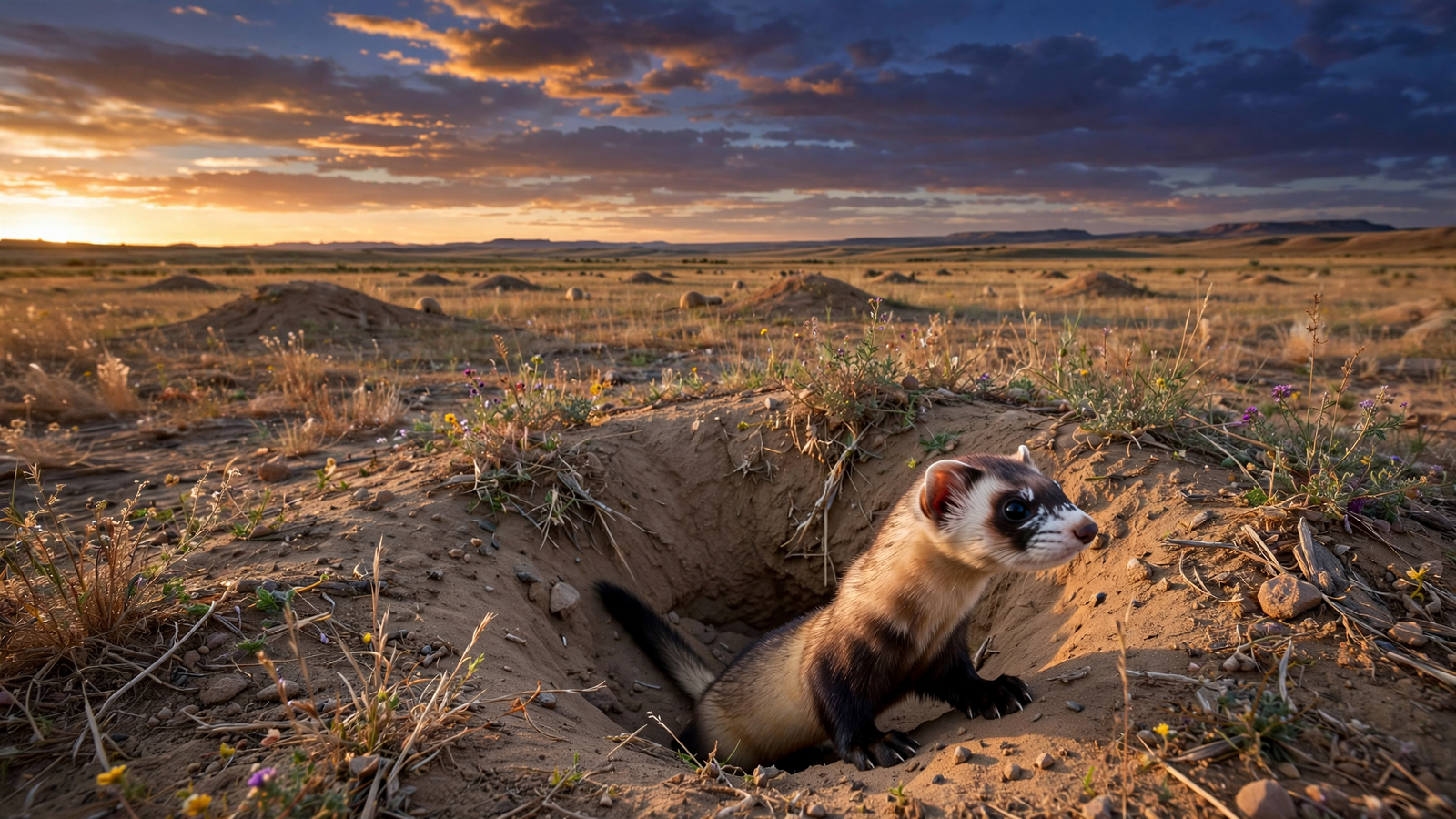
After sunset in northern Arizona, the prairie can look empty. The grasslands around Aubrey Valley stretch beneath a wide sky, and the most visible movement may be a rabbit slipping through the brush or a hawk crossing the horizon. But underground, in the burrows of black-tailed prairie dogs, another world is active. For related reading, see The Sonoran Pronghorn: How Arizona Helped a Desert Runner Find Its Way Back.
That is where biologists look for one of North America’s rarest mammals: the black-footed ferret. For related reading, see The Black-Footed Ferret Is Getting a Second Chance on the Great Plains.
About the size of a small house cat but much slimmer, the black-footed ferret is a nocturnal predator with a dark mask, black feet and a pale body. It spends much of its life in prairie dog towns, using their burrows for shelter and hunting the animals that built them. The relationship is so close that the ferret’s future depends on the health of the prairie ecosystem beneath the grass. For related reading, see The Green Book: How a Road Guide Helped Black Travelers Find Their Way.
Arizona has become an important part of that future. Through releases, monitoring, disease control and habitat management, conservationists have helped establish a free-ranging population in the Aubrey Valley. The work is not finished, and the animal remains endangered. But its return is one of the clearest examples of conservation moving beyond rescue and toward restoration.
A predator that nearly disappeared
Black-footed ferrets once occupied a broad belt of prairie from the Canadian border to Texas and from the Rocky Mountains eastward across the Great Plains. Their range followed prairie dog colonies, which provided both food and shelter.
As native grasslands were converted, prairie dog colonies were reduced by habitat loss, poisoning and disease. The decline of prairie dogs removed the ferret’s food supply and underground refuge at the same time. By the middle of the 20th century, scientists feared the species had vanished.
That conclusion appeared to be correct until 1981, when a small population was found near Meeteetse, Wyoming. The discovery changed the conservation strategy. Instead of trying to recover a species from museum specimens or distant relatives, biologists had a living population—but one vulnerable to disease and genetic loss.
After an outbreak of canine distemper killed many of the remaining animals, conservationists captured the last wild ferrets in the Meeteetse population. Eighteen became the founders of a carefully managed captive-breeding program, according to the U.S. Fish and Wildlife Service.
That number was extraordinarily small for rebuilding a species. Every animal mattered. Breeding programs had to preserve as much genetic diversity as possible, while researchers also learned how to raise ferrets that could eventually survive outside human care.
Why the prairie dog town matters
The black-footed ferret is sometimes described as a species that depends on prairie dogs. That is true, but the relationship is more complete than a simple predator-and-prey arrangement.
Prairie dog burrows provide protection from extreme temperatures and predators. A single prairie dog town can contain an interconnected network of tunnels, giving ferrets places to rest, raise young and escape danger. Prairie dogs also shape the vegetation around their colonies by grazing and clipping plants, creating a distinctive patchwork within the larger grassland.
That patchwork supports a wider community of animals. Burrowing owls can use abandoned burrows. Insects and birds respond to the shorter vegetation. Pronghorn, badgers and other grassland species move through the same landscape. Protecting black-footed ferrets therefore means preserving a functioning prairie process, not simply placing a rare animal in a fenced enclosure.
In Aubrey Valley, the conservation effort has centered on that larger system. The site contains extensive black-tailed prairie dog habitat, making it suitable for ferret releases and long-term monitoring. Arizona Game and Fish Department, the Fish and Wildlife Service and conservation partners have worked together to release captive-bred ferrets, track their survival and watch for reproduction.
Learning to live wild again
A captive-bred ferret cannot simply be placed on the prairie and expected to understand its new surroundings. Before release, animals are prepared for conditions they will encounter in the wild. They must learn to hunt, avoid danger and use burrows.
Some releases use acclimation pens, allowing ferrets to adjust to local conditions before they are fully free. Biologists can then monitor the animals as they move through the prairie dog colony. At night, researchers may use spotlight surveys or other methods to identify ferrets by their markings and determine where they are living.
Monitoring is especially important because black-footed ferrets are difficult to see. They are mostly active after dark and spend much of the day underground. Evidence of success may come from repeated sightings, tracks, camera images or the discovery of young animals rather than from a large, obvious herd.
Wild-born kits are among the most encouraging signs. When released animals reproduce, the project is no longer only replacing individuals lost from the landscape. It is helping restore a population capable of renewing itself.
The disease that changed the recovery plan
Even with good habitat, black-footed ferrets face a powerful obstacle: sylvatic plague. The disease, caused by the bacterium Yersinia pestis, can move through prairie dog colonies and kill large numbers of animals. Ferrets can die from the disease directly, and they can also suffer when plague removes their prey and collapses the colony around them.
Because plague can spread through fleas, conservationists have developed several ways to reduce its impact. One approach is dusting prairie dog burrows with insecticide to kill infected fleas. Another is vaccination.
Researchers with the U.S. Geological Survey and partner organizations developed an oral plague vaccine that can be placed in bait. The vaccine is designed to reach prairie dogs in the places where they live, rather than requiring biologists to capture and inject every animal in a colony. Field studies have shown that the method can help protect prairie dogs, giving ferrets a more secure food base.
The vaccine is not a single solution. It must be deployed over large areas, and disease management requires repeated work. But it illustrates an important shift in endangered-species conservation: scientists are treating the ecological conditions that threaten a species, not only the animal itself.
A recovery measured in relationships
Black-footed ferret conservation is also a reminder that endangered species rarely recover in isolation. A ferret project needs prairie dogs. Prairie dogs need open grassland. Grasslands need management that maintains habitat while accommodating ranching, wildlife and changing climate conditions.
That makes recovery more complicated than counting how many ferrets have been released. A release can be a milestone, but long-term success depends on whether the animals survive, reproduce and remain connected to suitable habitat.
The Fish and Wildlife Service continues to classify the black-footed ferret as endangered, and the species still occupies only a fraction of its historical range. Conservation sites across the West vary in their results. Some populations have struggled with disease, habitat changes or low genetic diversity.
Yet the species is no longer represented only by a handful of animals in captivity. Black-footed ferrets now live at multiple reintroduction sites, and Arizona’s Aubrey Valley is part of that broader network of hope. Each site provides a place where researchers can test methods, learn what the animals need and build experience for future releases.
What Arizona’s ferrets make visible
The return of the black-footed ferret does not transform the desert into a different landscape. It makes an existing landscape easier to understand.
A prairie dog colony may look like a collection of low mounds and scattered openings. To a black-footed ferret, it is a home, pantry and network of escape routes. To conservationists, it is also a measure of whether a grassland is still functioning.
That is the hopeful part of the Arizona story. The recovery effort is not based on recreating a vanished wilderness in perfect form. It is based on finding workable ways for a native predator, its prey and the people who manage the land to share a future.
For now, the ferrets remain difficult to spot. A visitor may spend hours in Aubrey Valley without seeing one. But after dark, a pale body may slip from a burrow, cross a patch of short grass and disappear underground again.
That brief movement represents decades of careful breeding, field science and cooperation. It also shows what conservation can accomplish when it protects the relationships that make a species possible.
Use: Species history, endangered status, habitat, recovery and the Meeteetse population.
Use: Captive breeding, reintroduction work and conservation-center background.
Use: Arizona reintroduction and Aubrey Valley context.
Use: Sylvatic plague, prairie dog impacts and oral-vaccine research.
Use: Natural history, behavior and the species’ dependence on prairie dog colonies.
U.S. Fish and Wildlife Service — Black-Footed Ferret — https://www.fws.gov/species/black-footed-ferret-mustela-nigripes — Species history, endangered status, habitat, recovery and the Meeteetse population.
U.S. Fish and Wildlife Service — National Black-Footed Ferret Conservation Center — https://www.fws.gov/national-black-footed-ferret-conservation-center — Captive breeding, reintroduction work and conservation-center background.
Arizona Game and Fish Department — Black-Footed Ferret — https://www.azgfd.com/wildlife/management/black-footed-ferret/ — Arizona reintroduction and Aubrey Valley context.
U.S. Geological Survey — Plague and Black-Footed Ferrets — https://www.usgs.gov/centers/nwhc/science/plague-and-black-footed-ferrets — Sylvatic plague, prairie dog impacts and oral-vaccine research.
Smithsonian’s National Zoo and Conservation Biology Institute — Black-Footed Ferret — https://nationalzoo.si.edu/animals/black-footed-ferret — Natural history, behavior and the species’ dependence on prairie dog colonies.