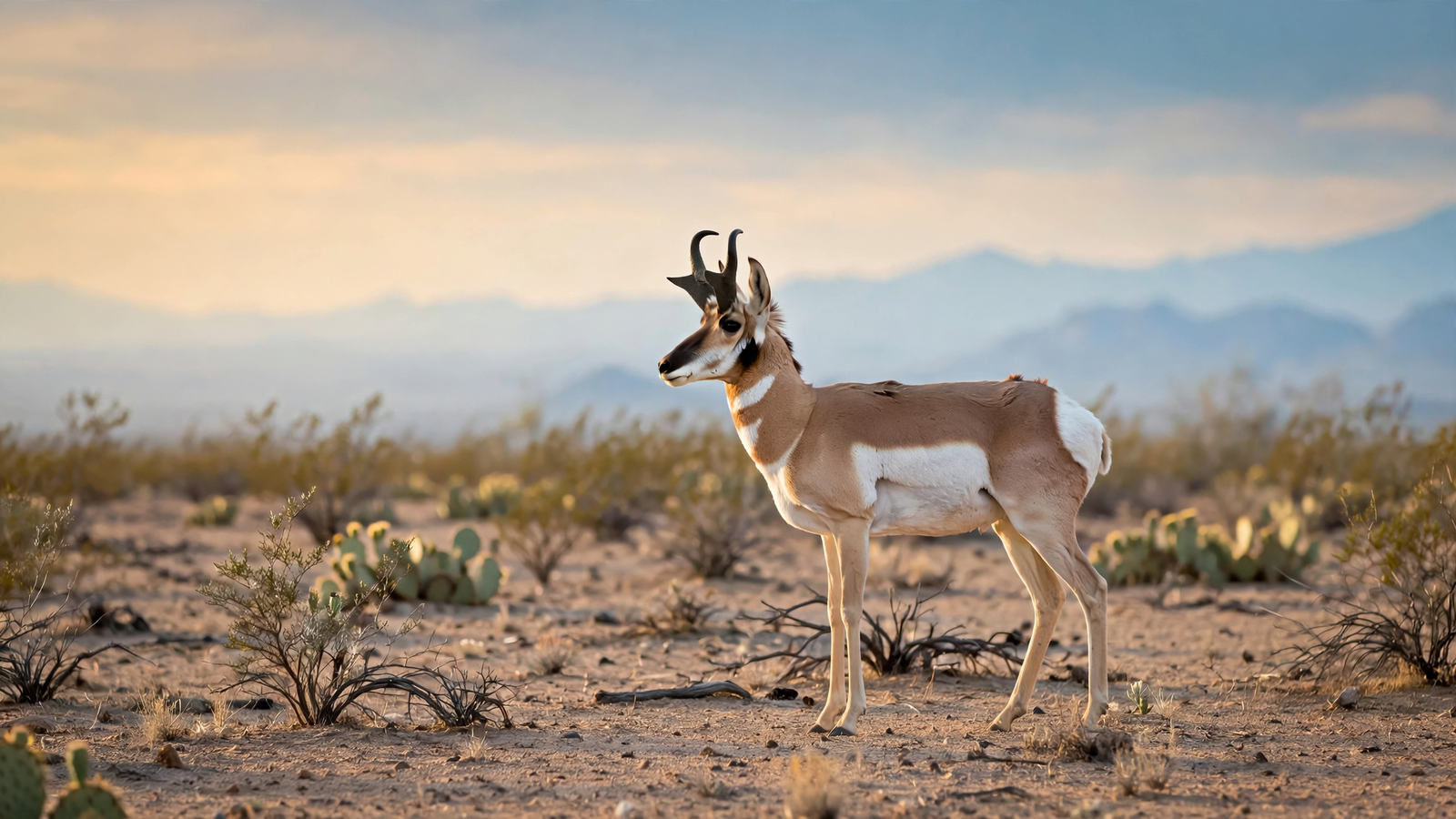
At first glance, the Sonoran pronghorn seems almost too delicate for the desert it inhabits. Its long legs are narrow, its coat is the color of dry grass, and its body appears built for speed rather than endurance. Yet this unusual mammal has evolved to live across one of the hottest and most water-scarce regions of North America. For related reading, see The Black-Footed Ferret: How Arizona’s Prairie Dogs Helped Bring Back a Native Predator.
For decades, that way of life was disappearing. By 2002, only 21 Sonoran pronghorn were known to remain in the United States. The population had been squeezed by drought, habitat changes, roads, fences, human disturbance and the loss of natural movement routes across the borderlands. For related reading, see The North Aral Sea: How a Small Dam Helped a Lost Lake Find Its Way Back.
Today, the picture is substantially different. Through captive breeding, carefully planned releases, habitat protection and cooperation between American and Mexican conservation programs, Sonoran pronghorn have returned to the hundreds in the United States. The species is still endangered and far from secure, but the recovery has transformed a population that once seemed perilously close to vanishing. For related reading, see The Green Book: How a Road Guide Helped Black Travelers Find Their Way.
A pronghorn built for open country
Sonoran pronghorn are a distinct subspecies of pronghorn, North America’s only surviving member of the family Antilocapridae. They are not true antelope, despite the common nickname “American antelope.” Their closest living relatives are found only in North America, and their evolutionary history stretches back millions of years.
The animals are famous for speed. A pronghorn can run at roughly 55 miles per hour, making it the fastest land mammal in North America. Unlike a cheetah, however, it is designed to sustain speed over open ground. That ability once helped pronghorn escape now-extinct predators, including the American cheetah.
The Sonoran subspecies occupies desert grasslands, creosote flats, broad valleys and mountain foothills in southwestern Arizona and northwestern Sonora, Mexico. In Arizona, important habitat includes parts of the Cabeza Prieta National Wildlife Refuge, Organ Pipe Cactus National Monument and the Barry M. Goldwater Range.
These landscapes may look empty to human visitors, but they provide a seasonal menu of grasses, shrubs, herbs and other desert plants. Pronghorn also depend on scattered water sources, especially during the hottest and driest periods. Their survival is tied to the condition of an entire desert system rather than to one isolated patch of land.
Why the population fell
Sonoran pronghorn evolved to move. They travel across large home ranges in search of forage and water, and their survival depends on being able to respond when one part of the desert becomes especially dry.
That flexibility became harder as the landscape changed. Roads, development and fencing divided open habitat. Some fences were difficult for pronghorn to cross or pass beneath. Vehicles and military activity added disturbance in parts of their range. Livestock grazing and competition for water could further reduce the resources available to wild animals.
Drought was an especially serious pressure. In the Sonoran Desert, a sequence of dry years can shrink the supply of green plants and leave natural water sources unreliable. Pronghorn are adapted to aridity, but adaptation has limits. A population already reduced by habitat fragmentation has less room to absorb another severe drought.
The decline was not a single-event disaster. It was a slow narrowing of options. Each lost corridor, dry season and barrier made it more difficult for the remaining animals to find food, water and one another.
The turning point came with emergency conservation
When biologists documented only 21 Sonoran pronghorn in the United States in 2002, wildlife agencies and conservation partners moved from conventional monitoring to an intensive recovery effort.
One of the most important tools was captive breeding. The goal was not to create a permanent zoo population. It was to produce healthy animals that could be released into suitable desert habitat and strengthen the wild population during periods when natural reproduction could not keep pace with losses.
Facilities operated by the U.S. Fish and Wildlife Service and its partners developed breeding herds, cared for young pronghorn and prepared animals for release. The work required more than simply increasing numbers. Animals had to retain the behaviors necessary for life in the wild, including moving through desert terrain, finding food and responding to seasonal conditions.
Released pronghorn were placed in areas where habitat was available and where managers could monitor their progress. Biologists used radio collars and field surveys to follow movements, survival and reproduction. Those observations helped determine where water improvements, fence modifications or additional releases might be most useful.
The program also benefited from practical changes on the ground. Conservation teams have worked to improve water availability, remove or modify problematic fencing and protect important movement areas. These measures may seem modest compared with a dramatic reintroduction, but they address the daily obstacles that determine whether an animal can cross a landscape successfully.
Recovery is measured in choices, not just numbers
The rise from 21 animals to a population in the hundreds is the most visible sign of progress. But the deeper achievement is that Sonoran pronghorn once again have more options.
More animals means a better chance of finding mates and maintaining genetic diversity. More groups spread across the landscape means a drought or disease event is less likely to affect every animal at once. A larger population can also make natural reproduction a more important part of recovery, reducing the need for constant human intervention.
That does not mean the work is finished. The Sonoran pronghorn remains listed as endangered under the Endangered Species Act. Its range is still fragmented, and climate projections point toward continued heat and drought pressure across the Southwest. A population can grow and remain vulnerable at the same time.
For that reason, managers continue to treat water, connectivity and habitat protection as central parts of the recovery effort. The animals need room to move between feeding areas and refuge from extreme conditions. They also need conservation across an international boundary, because pronghorn do not recognize the line separating Arizona from Sonora.
A recovery shared across a border
The Sonoran pronghorn story is also a reminder that wildlife conservation rarely fits neatly inside one jurisdiction. The same desert ecosystem extends from the United States into Mexico, and the species’ future depends on conditions in both countries.
Mexican conservation programs have protected pronghorn habitat and supported recovery efforts in Sonora. American agencies, meanwhile, have combined federal land management, military-range coordination, wildlife research and captive breeding. Universities, nonprofit groups and field biologists have contributed monitoring and technical expertise.
This kind of cooperation is not as visually dramatic as watching a pronghorn sprint across a desert flat. Much of it involves permits, surveys, fence inspections, veterinary care, data analysis and years of patient follow-up. Yet those are the mechanisms that turn a rescue effort into a functioning conservation program.
The recovery also demonstrates why protecting habitat before a species reaches the brink matters. Once a population falls to a few dozen animals, every threat becomes more consequential and every management decision carries greater risk. Restoring a species afterward can require decades of specialized work.
What the pronghorn’s return tells us
There is no single miracle behind the Sonoran pronghorn’s improvement. The result came from combining old-fashioned field observation with modern wildlife management: count the animals, understand their movements, protect the places they use, breed additional animals when necessary and keep measuring what happens next.
That approach offers a hopeful lesson for other species facing fragmented habitat and a changing climate. Conservation does not always begin with a vast untouched wilderness. It can begin with a repaired fence, a protected spring, a carefully monitored release or a cross-border agreement that keeps a migration route open.
In Arizona’s desert, the Sonoran pronghorn is still living with uncertainty. But uncertainty is different from disappearance. A species once reduced to a final few dozen now has a stronger foothold, more animals on the landscape and a larger community of people committed to keeping its path open.
When a herd moves across the open Sonoran Desert, it carries more than the speed of an ancient survivor. It carries evidence that even in a landscape shaped by heat, drought and human pressure, patient conservation can return choices to wildlife.
Use: Species status, range, threats and recovery information.
Use: Recovery history, captive breeding and conservation efforts.
Use: Natural history, habitat and the species’ importance in the Arizona borderlands.
Use: Arizona population history, wildlife management and field conservation context.
U.S. Fish and Wildlife Service — Sonoran Pronghorn — https://www.fws.gov/species/sonoran-pronghorn-antilocapra-americana-sonoriensis — Species status, range, threats and recovery information.
U.S. Fish and Wildlife Service — Sonoran Pronghorn Recovery — https://www.fws.gov/story/sonoran-pronghorn — Recovery history, captive breeding and conservation efforts.
National Park Service — Sonoran Pronghorn — https://www.nps.gov/cabe/learn/nature/sonoran-pronghorn.htm — Natural history, habitat and the species’ importance in the Arizona borderlands.
Arizona Game and Fish Department — Sonoran Pronghorn — https://www.azgfd.com/wildlife/viewing/sonoran-pronghorn/ — Arizona population history, wildlife management and field conservation context.