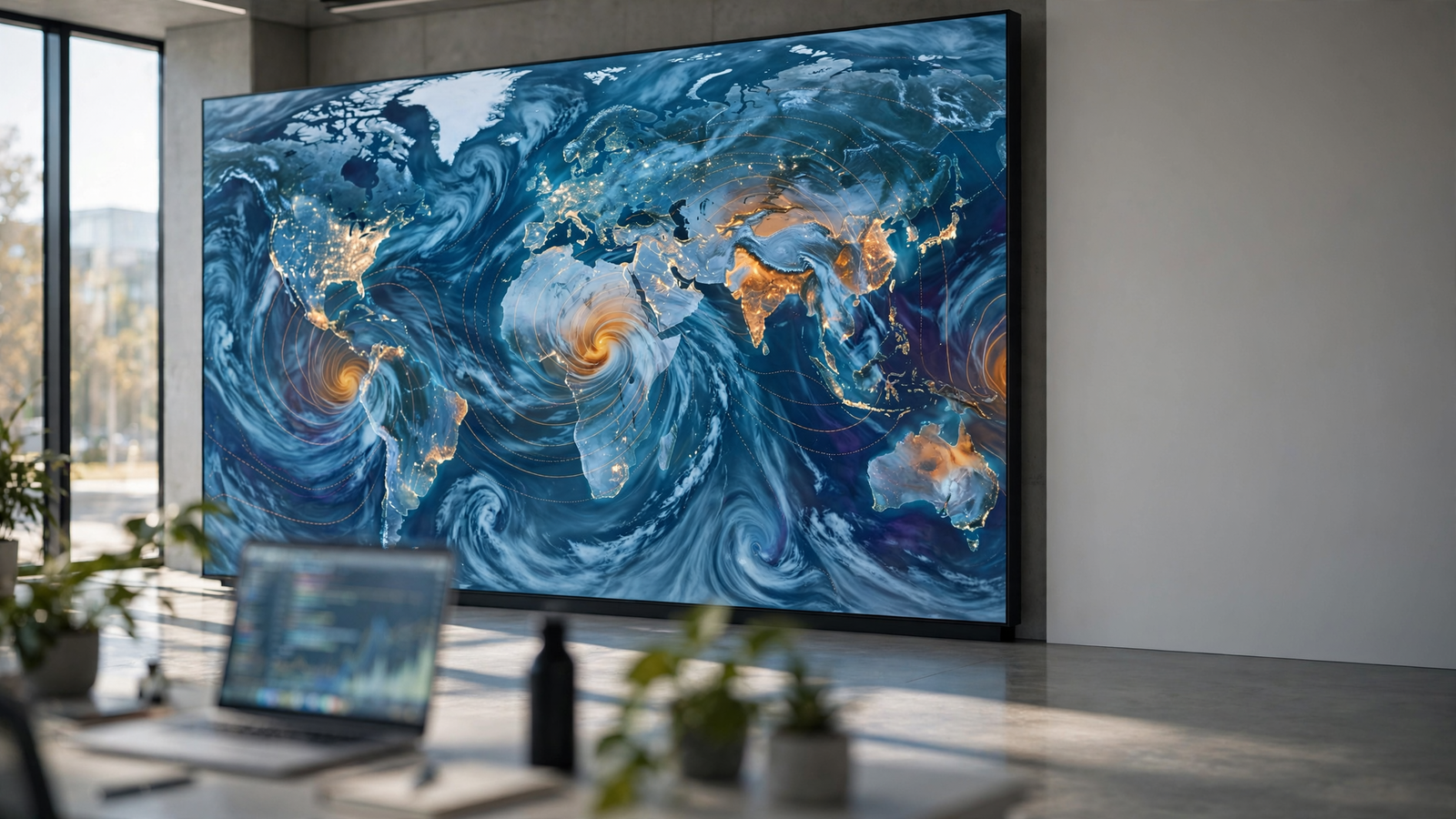
A weather forecast is not a promise. Small differences in the atmosphere can grow over time, so a prediction several days ahead is best understood as a set of possible outcomes—not a single certain future. Google DeepMind’s GenCast was designed around that idea. It uses generative artificial intelligence to produce probabilistic forecasts of global weather up to 15 days ahead.
The model’s significance is not that it makes uncertainty disappear. It is that it offers a different way to represent and calculate it. In research published in Nature, GenCast outperformed the European Centre for Medium-Range Weather Forecasts’ ensemble system on 97.2% of the study’s 1,320 forecast targets. That is a result from a particular research benchmark, not a claim that the model is right 97.2% of the time.
From one forecast to many possible futures
Weather services commonly use ensembles: multiple forecasts produced from slightly different starting conditions or model setups. Comparing those runs helps forecasters judge whether a likely outcome is consistent across the ensemble or whether substantial uncertainty remains. A tight cluster of similar predictions suggests greater confidence; a wide spread signals that several outcomes are plausible.
GenCast also generates an ensemble, but it does so with a machine-learning approach called a diffusion model. In broad terms, diffusion models learn to turn a noisy starting point into a structured output. For GenCast, the output is a possible future state of the global atmosphere. Repeating the process produces a range of plausible forecasts rather than one definitive answer.
The model learned from historical weather data, including the ERA5 reanalysis record. Reanalysis combines observations and modelling to create a consistent account of past atmospheric conditions. GenCast uses that record to learn patterns in how weather systems evolve. It does not reason about storms in the same way a human meteorologist does; it identifies statistical relationships in the data it was trained on.
What the comparison found
The research team compared GenCast with the ECMWF’s operational ensemble forecast system, a major benchmark in global medium-range weather prediction. Across 1,320 combinations of forecast targets—including variables, lead times and pressure levels—GenCast performed better on 97.2% by the study’s chosen accuracy measure.
The number needs its context. It does not mean that 97.2% of GenCast predictions were correct, nor that the model wins for every location, variable or weather event. It summarizes performance across the targets used in the paper’s evaluation. The result is evidence of strong performance in that test, not a universal score for every forecast a weather service might issue.
The researchers also examined cases with practical stakes, including tropical cyclone tracks and episodes of extreme heat, cold and wind. Those tests matter because an average score alone can conceal how a system handles unusual events. Still, forecasting an event is only one step in preparing for it: local observations, impact assessments and communication by public authorities remain essential.
Why speed matters—and what it cannot solve
DeepMind says GenCast can produce a 15-day forecast in minutes on a single Google TPU, a specialized computing chip. That offers a contrast with the heavy computing demands of traditional numerical weather prediction, which calculates how the atmosphere evolves using physical equations. Faster calculations could make it practical to generate or update more forecast possibilities, though the research result by itself does not establish how a weather agency should use the model in daily operations.
GenCast’s forecasts use a global grid at 0.25-degree spacing. That is useful for tracking large-scale weather patterns, but it is not a street-by-street view. Local conditions can depend on terrain, coastlines and other features that a global model may not resolve in detail. A broad prediction of heavy rain, for example, is not the same as a precise forecast of which neighborhood will flood.
There is also a wider distinction between learning from the past and anticipating a changing future. A model trained on historical patterns can be powerful, but its performance needs continued testing as weather observations, climate conditions and forecasting needs change. AI forecasts are not a substitute for measurements, physical understanding or trained forecasters. They are another tool to assess alongside them.
A new member of the forecasting toolkit
GenCast’s larger contribution may be the demonstration that a generative model can produce useful global weather ensembles at medium range. By representing several plausible outcomes, it addresses a question that matters as much as “What will the weather be?”: “How confident should we be, and what else could happen?”
That distinction can help make forecasts more useful. A decision-maker preparing for a storm, a heat event or a disruption needs to understand both the most likely scenario and the range of credible alternatives. GenCast does not make those decisions. Its research shows how AI may help forecasters explore that range more efficiently—and why a good forecast is often better understood as a map of possibilities than a single line into the future.