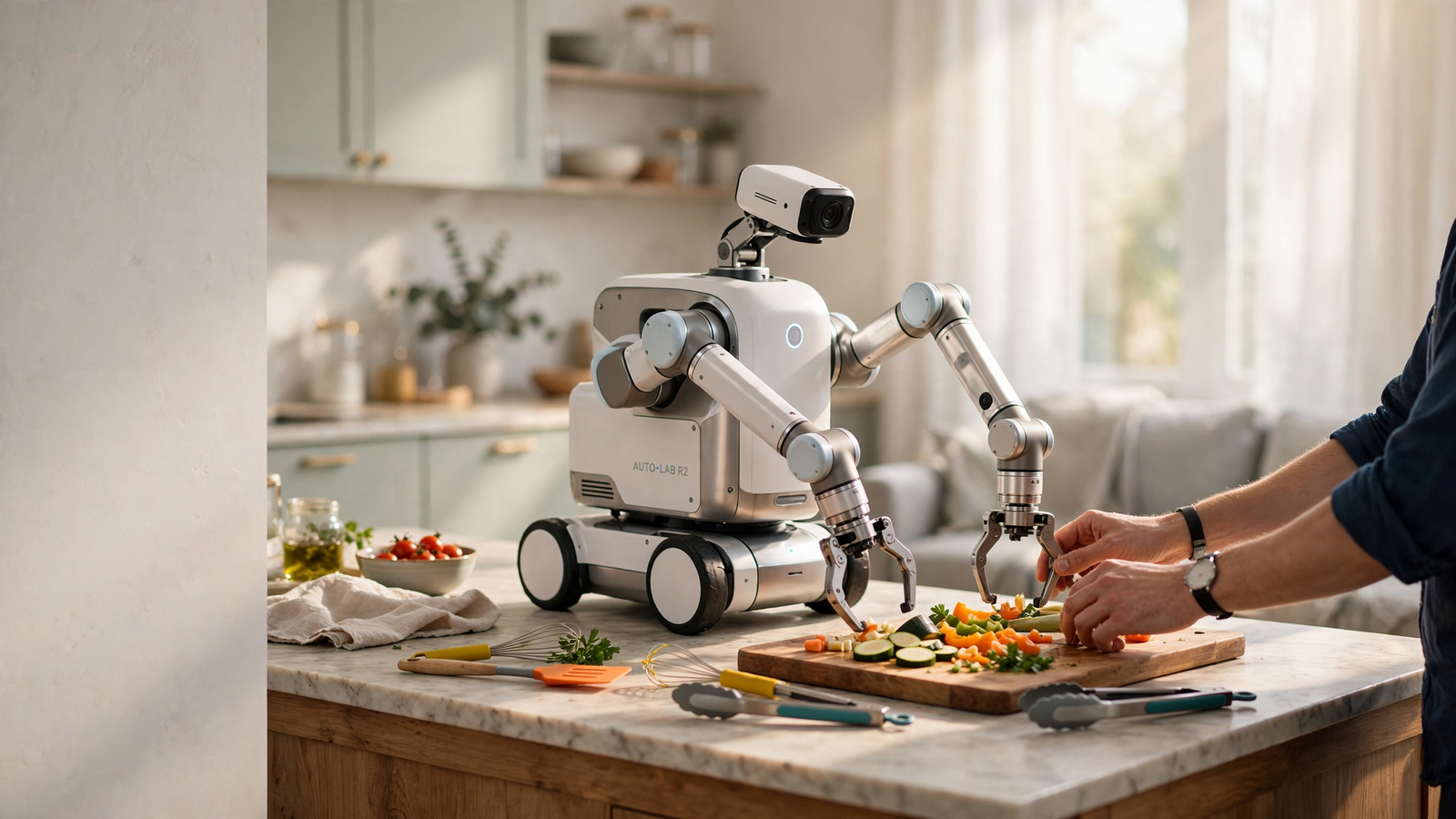
A robot that can open a cabinet, move a pan and work around a kitchen has to solve more than one problem at a time. It must move through the room, coordinate two arms and respond to objects that may not be exactly where it expects. Stanford researchers’ Mobile ALOHA project explores a practical way to teach those skills: let a person demonstrate a task, then train the robot to imitate what it saw.
The project is not a general-purpose housekeeper. It is a research system for learning particular mobile manipulation tasks, and its demonstrations take place in controlled settings. But the idea behind it addresses a central challenge in robotics: how to give a machine useful physical skills without writing a separate, detailed instruction for every movement.
Teaching by demonstration
Mobile ALOHA combines a wheeled base with two robot arms. A human operator controls the system remotely, guiding its movements through a task. Those demonstrations become training examples: the robot’s learning system observes what the operator did and works to reproduce the behavior when asked to perform the task itself.
The researchers’ 2024 paper describes collecting around 50 demonstrations for each task. That number matters because robot demonstrations can be slow and labor-intensive to gather. The project investigates whether a relatively modest collection can go further when paired with data from another robot-learning system, ALOHA, which was designed for tabletop, two-handed tasks.
This is a form of imitation learning. Rather than receiving a full set of hand-coded rules—move the left gripper here, rotate the wrist by this amount, then advance the base—the robot learns a pattern from examples. The approach does not remove programming or engineering. People still build the hardware, set up the demonstrations, choose training methods and evaluate the results. It changes one part of the job: how the robot acquires a sequence of actions.
Why mobility makes the problem harder
A fixed robot arm can work within a defined area. A mobile robot has to bring its body and arms into position as well. Moving across a room while manipulating an object means coordinating the base, both arms and grippers. A small error in one part can make the rest of the sequence fail.
That coordination is why the tasks shown by Mobile ALOHA are more revealing than a simple pick-and-place demonstration. The project tested activities that involve moving around and interacting with household objects, including kitchen work and opening a cabinet. In one example, the robot handles a pan as part of preparing food; in another, it reaches a cabinet and operates its door. These are specific demonstrations, not evidence that the robot can cook any meal or navigate any home.
The research also tests a data-sharing strategy. The team trained Mobile ALOHA using its own mobile demonstrations alongside examples from the original, stationary ALOHA setup. The researchers report that this co-training improved performance on the evaluated mobile tasks. The underlying intuition is useful: examples of how arms handle objects can help even when they were collected on a different platform, while mobile demonstrations teach the system how to move through its environment.
A promising result, with limits
Watching a demonstration is not the same as understanding a task in the human sense. A robot trained this way may reproduce a learned sequence in familiar conditions but struggle when an object, room layout or starting position changes. The research therefore should not be read as a claim that a robot can safely take over everyday household work without supervision.
Robots also need to operate around people, pets and fragile objects. A system that performs a task in a research setup still has to prove that it can do so reliably across varied environments and respond safely when something unexpected happens. Mobile ALOHA’s demonstrations show what the platform learned under test conditions; they do not settle those broader questions.
Cost is another part of the project’s context. The researchers describe the system as a comparatively low-cost platform for mobile manipulation research, but it remains a specialized research robot—not an inexpensive consumer appliance. Its value is in giving researchers a way to study how mobile robots can be trained and tested.
Making robot skills easier to teach
The broader significance of Mobile ALOHA is less about any one kitchen task than about the training process. If people can teach a robot a useful behavior through demonstrations, and researchers can reuse learning across related platforms, it may become easier to build a library of skills. A future robot could potentially learn a new sequence without engineers having to program every joint movement from scratch.
That possibility is still a research direction, not a promise of near-term home robots that can do anything they are asked. The system’s boundaries—limited demonstrations, carefully arranged tests and task-specific learning—are important. So is the progress: the work shows how combining human examples with shared robot data can help a mobile machine coordinate movement and manipulation.
For robotics, the question is not simply whether a machine can copy a person once. It is whether it can learn a behavior efficiently, repeat it dependably and adapt when the world changes. Mobile ALOHA offers one experimental answer to the first part, while making clear how much work remains on the others.