Dog food bags and cans offer a useful starting point for portion sizes, but the printed amount is not a custom prescription for every dog. Age, activity, health, treats and the food’s calorie content all matter.
This guide shows how to turn a feeding chart into a consistent daily routine. It is intended for healthy adult dogs; puppies and dogs with health or weight concerns may need an individualized plan from a veterinarian.
What you will need
- Your dog’s current weight, and a veterinarian’s recommended target weight if your dog should lose or gain weight.
- The food package, including its feeding directions and calorie information.
- A measuring cup or, for more consistent portions, a kitchen scale.
- A way to note meals, treats and any changes in weight or body shape.
Steps to set a starting portion
- Check that the food suits your dog’s life stage. Look for the nutritional adequacy statement on the package. It identifies whether the food is intended to be complete and balanced for a particular life stage or for adult maintenance. If you are unsure whether a food fits your dog, ask your veterinarian.
- Find the feeding directions and calorie information. Look for the daily amount suggested for your dog’s weight and for the food’s calorie content, often listed as kilocalories per cup, can or other unit. Feeding charts are general guidance, and a cup of one food may provide a different number of calories than a cup of another.
- Use an appropriate weight when reading the chart. For a dog at a healthy weight, start with its current weight. If your dog is overweight or underweight, ask your veterinarian what weight to use rather than automatically basing portions on the current number. A dog’s size alone cannot tell you what its healthy weight should be.
- Read the chart as a daily total. Unless the package says otherwise, the suggested amount is generally for the whole day, not each meal. If you feed twice daily, divide that daily amount between the two meals. Follow your veterinarian’s instructions if they differ from the package.
- Measure the food the same way each time. Use a level measuring cup, or weigh the portion if you have a kitchen scale and can match the package’s units. Avoid estimating by eye: small differences repeated at every meal can add up. If you change foods, check the new package rather than assuming the same scoop holds the same calories.
- Include treats and extras in the plan. Treats, chews, table scraps and food used for training contribute calories too. WSAVA advises that treats make up no more than 10% of a dog’s daily calories. If you give treats often, check their calorie information and ask your veterinarian how to account for them without making the diet unbalanced.
- Check your dog’s body condition, not just the bowl. From above, a dog at an ideal body condition usually has a visible waist; from the side, the abdomen should tuck up behind the ribs. You should be able to feel the ribs beneath a light covering of fat, without pressing hard. WSAVA’s body-condition chart uses a nine-point scale, with 4–5 generally considered ideal. Ask your veterinarian to show you how to assess your own dog.
- Review the portion regularly. Keep track of what you feed and check your dog’s weight and body shape over time. If your dog is steadily gaining or losing weight, or its body condition seems far from ideal, contact your veterinarian to discuss an adjustment. Don’t make a steep cut or increase on your own, especially if your dog is very young, ill or already underweight.
Things to know
Some dogs need a different plan
Puppies are growing, and their nutritional needs change with age and size. Dogs that are pregnant or nursing, very active, older, or managing a medical condition may also need different amounts or a specific diet. A feeding chart for a typical adult dog may not be suitable for them. Your veterinarian can recommend an appropriate food and portion.
“One cup” is not a universal amount
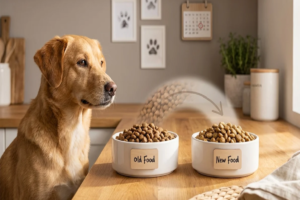
Package directions and calorie counts are more useful than copying another dog’s portion. Two foods can have different calorie densities, and a scoop that is generously filled can hold more than a level measure. When changing foods, read the new directions and reassess the portion rather than carrying over the old one by habit.
Weight alone does not tell the whole story
Dogs of the same breed or weight can have different builds. The ability to feel the ribs and see a waist can help you notice a change, but body-condition checks are not a diagnosis. If you are uncertain, a veterinary team can assess your dog and help set a realistic feeding goal.
A consistent routine makes portions easier to manage: use the package as a starting point, measure the full day’s food, count extras and keep an eye on body condition. If the numbers or your dog’s shape raise questions, your veterinarian can help you adjust safely.