Fiber advice often sounds simple: eat more of it. But “fiber” is an umbrella term, not a single ingredient with one effect. Some fibers help soften and move stool; others form a gel, are fermented by gut microbes, or do several things at once. That variety is one reason a mix of plant foods can be more useful than chasing a particular fiber product.
The good news is that building a higher-fiber pattern usually does not require special foods. Beans, whole grains, vegetables, fruit, nuts and seeds all contribute. The practical challenge is to add them in ways that suit your meals—and to increase intake gradually if your current diet is low in fiber.
What counts as fiber?
Dietary fiber is found in plant foods and is not fully broken down and absorbed in the small intestine. It includes different carbohydrates and related substances. Nutrition labels may also count certain added, isolated fibers when regulators recognize them as having beneficial physiological effects.
You may have heard fiber divided into “soluble” and “insoluble.” Soluble fiber dissolves in water to varying degrees, while insoluble fiber does not. These terms can help describe how a fiber behaves, but they are not a complete guide to its effects: fibers within either group can differ, and a single food can contain several kinds.
Some fibers hold water and can make stool softer or bulkier. Certain viscous fibers form a gel-like material in the digestive tract. Other fibers are fermented by bacteria in the large intestine. Fermentation produces compounds that researchers study for their role in gut and metabolic health, but not every fiber is fermented to the same extent. It is more accurate to think of fiber as a family of substances than as one interchangeable nutrient.
How much is a useful target?
In the United States, the National Academies set an Adequate Intake based on about 14 grams of fiber per 1,000 calories consumed. The Food and Drug Administration uses 28 grams per day as the Daily Value on Nutrition Facts labels, based on a 2,000-calorie diet. Individual needs vary with energy intake, age and other factors, so the label value is a reference point—not a personal prescription.
Many people get less fiber than recommended. Rather than treating a number as a pass-or-fail test, use it to notice patterns: Are most of your grains refined? Do beans or lentils appear in your meals? Is fruit usually eaten whole, or is it more often juice? Small, repeatable changes can move intake in the right direction.
Find fiber in foods you already eat
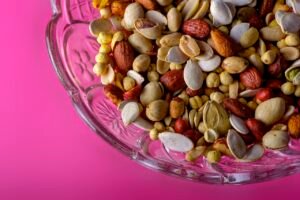
Plant foods offer a straightforward starting point. A bowl of oatmeal, whole-grain bread, lentils in soup, chickpeas in a salad, berries with breakfast, or a handful of nuts can each contribute. Vegetables and fruit add fiber as well as variety; when practical, eating fruit whole rather than drinking its juice generally retains more of the fruit’s fiber.
Beans, peas and lentils are particularly versatile. Stir them into soups, stews, pasta dishes or salads, or use them as part of a filling for wraps. If canned beans are easiest, they still count; draining and rinsing them is an option if you want to reduce some of the added sodium.
For grain foods, look for whole-grain choices such as oats, brown rice, whole-wheat bread or barley. The word “wheat” by itself does not necessarily mean a product is whole grain. Check the ingredient list for a whole grain named near the beginning. A switch need not be all-or-nothing: mixing a whole-grain choice with a familiar refined grain can make the change easier to keep.
Fiber content varies among foods and serving sizes, so labels can help with comparisons. On a U.S. Nutrition Facts label, the percent Daily Value gives a quick sense of how much a serving contributes to the 28-gram reference value. It does not tell you the full story of a food’s nutritional quality, and a packaged product with added fiber is not automatically equivalent to a meal built around minimally processed plant foods.
Increase gradually, and pay attention to comfort
A sudden jump in fiber can cause gas, bloating or abdominal discomfort for some people. If your usual intake is low, add one change at a time—perhaps a serving of fruit, a whole-grain breakfast or beans a few times a week—then give your body time to adjust. Drinking enough fluids can help fiber do its job, especially when increasing fiber to address constipation. Needs differ, so there is no single fluid target that fits everyone.
More is not always better for every person or every symptom. People with persistent digestive problems, a condition affecting the gut, or a medically prescribed diet may need individualized advice. Some high-fiber foods can aggravate symptoms for certain people, while others may be tolerated well. A clinician or registered dietitian can help tailor choices rather than relying on a one-size-fits-all rule.
Think in patterns, not “fiber hacks”
A fiber-rich way of eating is less about finding a magic seed or supplement than regularly including a range of plant foods. Different foods bring different fibers, and also contribute nutrients beyond fiber. A useful first step is to look at one meal you already enjoy and make a modest adjustment: add lentils to soup, choose oats instead of a low-fiber breakfast cereal, or serve fruit alongside a sandwich.
Those small choices are easier to sustain than a dramatic overhaul. They also make the goal tangible: not “eat perfectly,” but include more plants, notice how your body responds, and build from there.