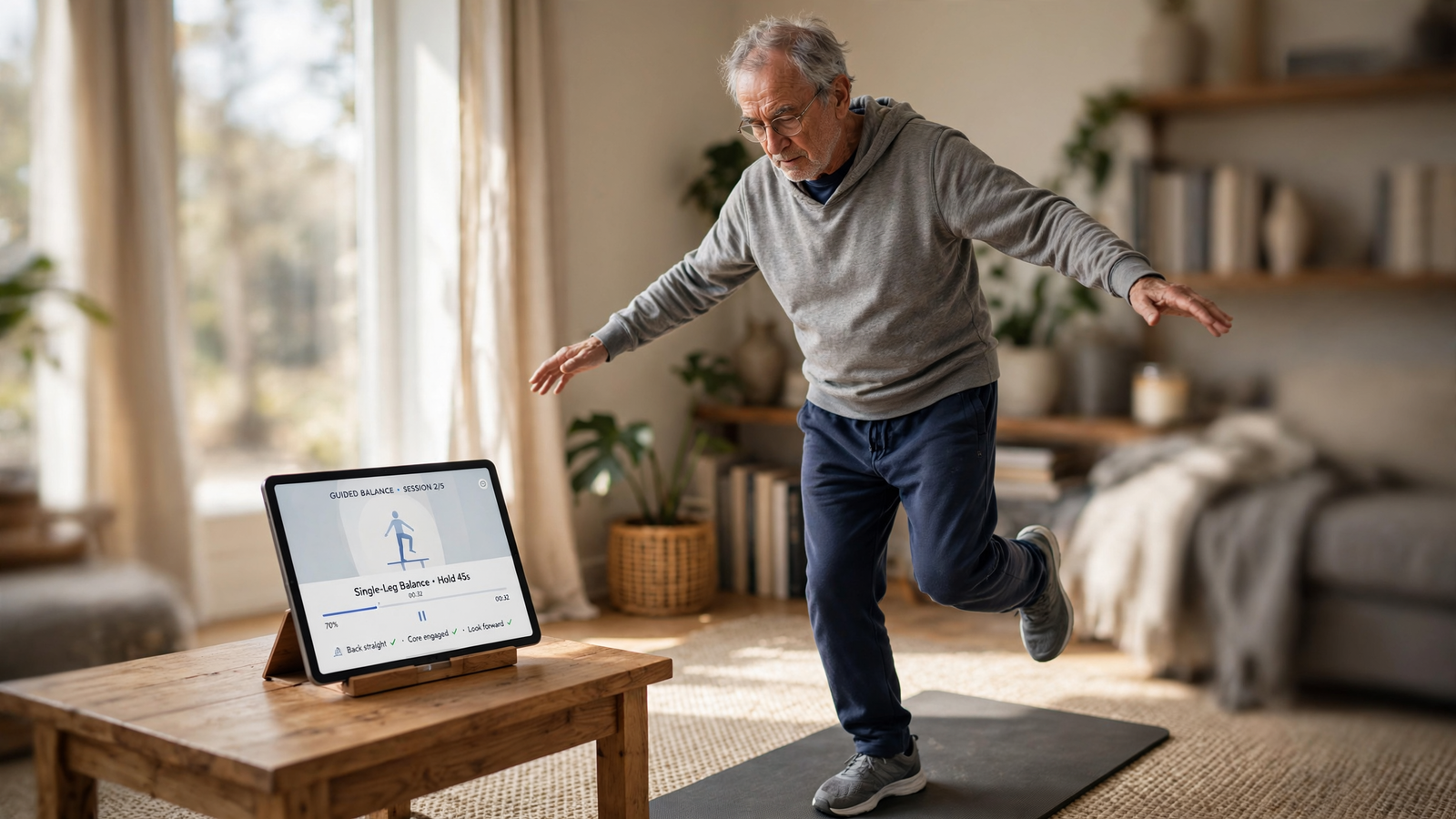
For many older people, a single fall can mean a hospital stay, loss of independence or a cascade of health problems. Health researchers and public‑health groups now point to a clear, practical message: targeted balance and strength programmes — including ones delivered on phones and tablets — can reduce the risk of falls and of injurious falls, and they can be scaled to reach people who can’t travel to classes.
What the evidence says
Large systematic reviews and guidelines have long identified exercise that challenges balance and builds leg strength as one of the most effective ways to prevent falls among community‑dwelling older adults. A major Cochrane review that pooled dozens of randomized trials concluded that exercise programmes of this kind reduce both the number of people who fall and fall‑related injuries. ([cochrane.org](https://www.cochrane.org/evidence/CD012424_exercise-preventing-falls-older-people-living-community?trk=article-ssr-frontend-pulse_little-text-block&utm_source=openai))
That long research base helps interpret two recent and influential trials testing whether digital, self‑managed programmes can deliver those benefits at scale. One landmark effort from Australia, StandingTall, delivered progressive balance training through an app and followed more than 500 participants for two years; the intervention group experienced significantly fewer falls and injurious falls over 24 months. ([pmc.ncbi.nlm.nih.gov](https://pmc.ncbi.nlm.nih.gov/articles/PMC8022322/?utm_source=openai))
More recently, the Safe Step randomized trial in Sweden enrolled 1,628 people age 70 and older to test an unsupervised, home‑based app plus educational videos against education alone. Although total fall rates did not differ significantly after 12 months, participants using the Safe Step app were about 11% less likely to experience at least one fall during the year — a meaningful reduction at population scale — and the study authors concluded that a self‑managed digital programme can be an effective component of fall‑prevention strategies. ([pmc.ncbi.nlm.nih.gov](https://pmc.ncbi.nlm.nih.gov/articles/PMC11997535/?utm_source=openai))
Why digital programmes matter
Traditional fall‑prevention classes work but face barriers: transportation, local capacity, and the costs of running instructor‑led sessions. Digital programmes address those problems by letting older adults follow tailored balance and strength exercises at home, on their own schedule. Trials show different digital approaches have varied adherence, but when uptake is sustained the benefits are similar to in‑person programmes — including reduced injurious falls in long follow‑up. ([pmc.ncbi.nlm.nih.gov](https://pmc.ncbi.nlm.nih.gov/articles/PMC8022322/?utm_source=openai))
Meta‑analytic work on mobile‑health and app‑based fall‑prevention studies finds pooled reductions in fall risk compared with usual care, supporting the idea that technology can broaden reach without diluting effectiveness. Implementation still matters: usability for older users, simple onboarding, and reminders or light coaching improve engagement. ([mdpi.com](https://www.mdpi.com/1424-8220/26/3/864?utm_source=openai))
Putting research into public policy: WHO’s Step Safely
The World Health Organization’s technical package Step Safely gathers this evidence into practical recommendations for policy‑makers and programme managers: strength and balance training for older people, targeted home‑hazard assessments and modifications for those at higher risk, and coordinated local approaches that combine safer people, safer environments and safer policies. The package is intended to help health systems deploy proven, low‑cost interventions where they will do the most good. ([cdn.who.int](https://cdn.who.int/media/docs/default-source/documents/social-determinants-of-health/who_stepsafely_digital.pdf?utm_source=openai))
How communities are translating evidence into action
Across high‑ and middle‑income countries, public health units, municipalities and voluntary groups are adopting blended approaches: instructor‑led classes where feasible, home hazard checks for people with prior falls, and app‑based exercise for those who prefer or require remote options. Some programmes embed digital apps into primary‑care referrals or home‑visit services, while others use community centres to help older people set up devices and learn the exercises. Those hybrid models address the two biggest challenges the trials identified: getting people started, and keeping them exercising over months and years. ([pmc.ncbi.nlm.nih.gov](https://pmc.ncbi.nlm.nih.gov/articles/PMC12687536/?utm_source=openai))
What this means for older adults and families
- Simple, effective choices exist. Balance and strength programmes — whether in a community class or via a phone app — are backed by strong evidence for reducing falls and serious injuries. ([cochrane.org](https://www.cochrane.org/evidence/CD012424_exercise-preventing-falls-older-people-living-community?trk=article-ssr-frontend-pulse_little-text-block&utm_source=openai))
- Digital does not mean impersonal. Trials show self‑managed apps can lower the chance of falling and, when paired with light support, reach people who otherwise wouldn’t access classes. ([pmc.ncbi.nlm.nih.gov](https://pmc.ncbi.nlm.nih.gov/articles/PMC11997535/?utm_source=openai))
- Start small and make it routine. Most programmes recommend at least an hour to two hours per week of targeted balance and strength work; adherence over months produces the biggest payoff. ([pmc.ncbi.nlm.nih.gov](https://pmc.ncbi.nlm.nih.gov/articles/PMC8022322/?utm_source=openai))
Falls will remain a major health challenge as populations age, but the combination of long‑standing exercise science, digital delivery tools and WHO’s practical technical guidance gives clinicians, families and community planners a realistic toolkit. For older people who want to stay independent, the message is encouraging and concrete: with a modest time investment and the right programme, many falls are preventable.