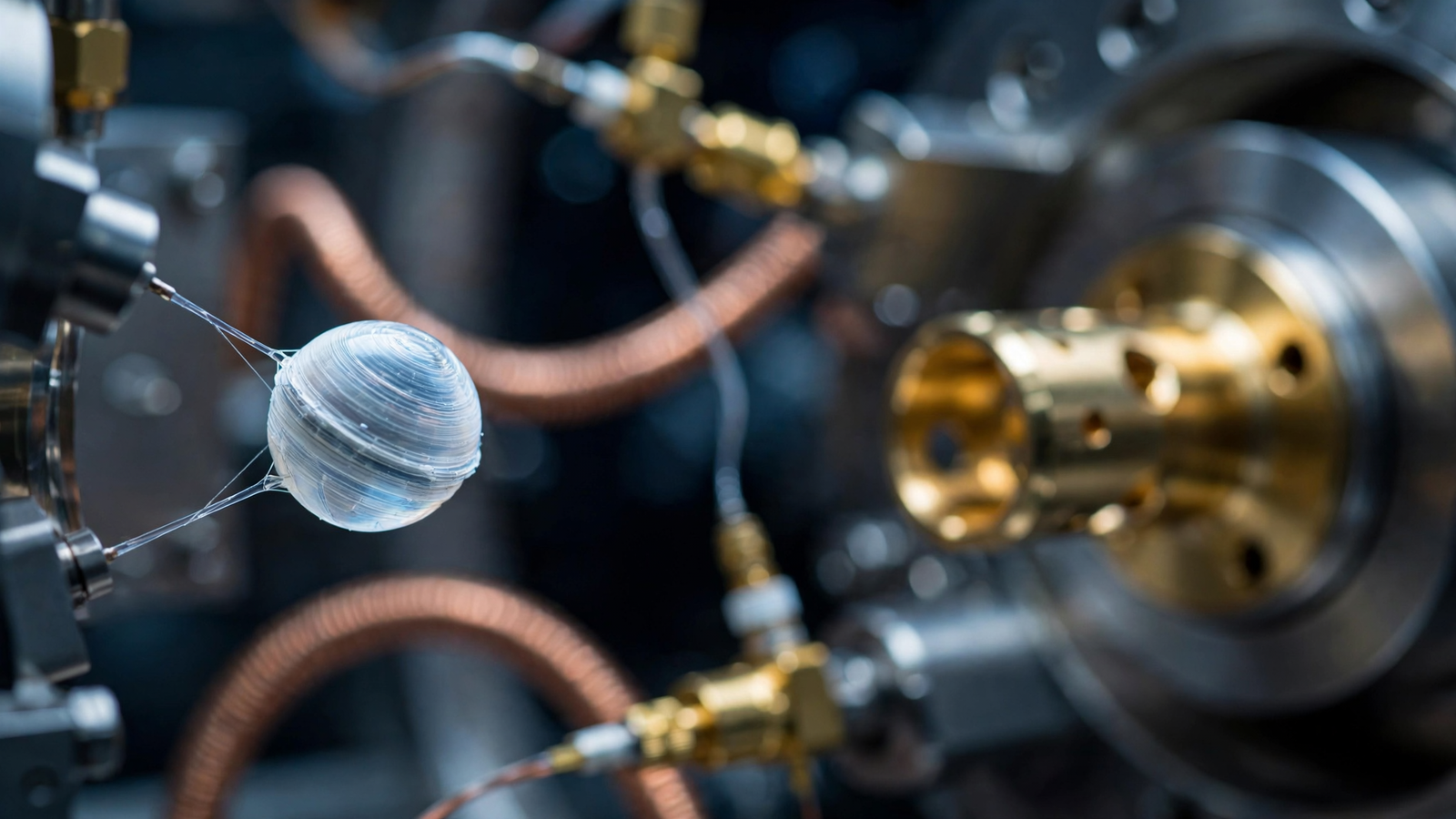
On April 7, 2025, the National Ignition Facility (NIF) at Lawrence Livermore National Laboratory produced 8.6 megajoules (MJ) of fusion energy in a single inertial‑confinement shot — more than four times the laser energy delivered to the target. The result, the highest measured yield to date at NIF, grew out of a deceptively small change: a graded, continuous distribution of a tungsten dopant inside the facility’s high‑density carbon (diamond) capsules that hold the fusion fuel. The change reduced destructive mixing during implosion and let the fuel burn far more completely than earlier designs. ([annual.llnl.gov](https://annual.llnl.gov/fy-2025/national-ignition-facility-2025))
The physics at work is straightforward in outline but fiendishly hard in execution. In inertial‑confinement fusion (ICF), 192 laser beams heat a hohlraum (a metal can) that bathes a millimeter‑scale capsule in x‑rays; those x‑rays compress and heat the capsule to conditions like the centers of stars. Small imperfections in the capsule’s shell seed hydrodynamic instabilities that mix cold shell material into the hot fuel, cooling it and killing the burn. By smoothing the jump in material properties at the shell’s inner surface through continuous gradient doping — gradually varying the tungsten content over microns instead of making abrupt layers — the LLNL team reduced that “mix” and unlocked dramatically higher yields. ([lmf.llnl.gov](https://lmf.llnl.gov/news/target-breakthrough-enabled-fusion-record-nif))
LLNL researchers report that the April 2025 experiment followed a February full‑scale test that produced 5 MJ using the same continuous‑doping idea, showing the change was not a one‑off fluke but part of a clear performance trend. “Success in target fabrication is shared very widely,” said Sal Baxamusa, a deputy program manager for Target Fabrication, comparing the graded dopant to replacing an on/off light switch with a dimmer — a metaphor intended to capture how continuous grading moderates previously abrupt material boundaries. ([lmf.llnl.gov](https://lmf.llnl.gov/news/target-breakthrough-enabled-fusion-record-nif))
Those results matter for two reasons. First, they show that careful materials engineering at the sub‑micron level can move the entire fusion experiment into a new regime of reproducibility and yield. Second, they provide hard experimental data that modelers can use to validate and refine simulations of implosion dynamics — the same simulations engineers would need to scale any design toward energy production or to support national‑security applications. Vincent Tang, principal associate director of LLNL’s NIF and Photon Science Directorate, framed it to staff as a demonstration of “teamwork, innovation, and commitment” that expands the frontier of fusion science. ([lmf.llnl.gov](https://lmf.llnl.gov/news/target-breakthrough-enabled-fusion-record-nif))
Why the advance is important — and also limited
It is tempting to read megajoules and gains and conclude that commercial fusion is just around the corner. But fusion specialists and federal planners emphasize the distinction between the different ways of measuring “gain.” The NIF result is typically reported as a target‑gain figure (fusion energy output divided by laser energy delivered to the target). That metric rose above four for the April 2025 shot. By contrast, wall‑plug gain (fusion energy divided by all the electrical energy the facility draws) remains many orders of magnitude lower because powerful lasers, cooling, and support systems consume very large amounts of energy. FusionBenchmark and other analysts stress that the numerator and denominator must be stated explicitly whenever “gain” is invoked. ([fusionbenchmark.com](https://fusionbenchmark.com/gain/))
The U.S. Department of Energy’s Fusion Science and Technology Roadmap situates NIF’s achievements within a broader strategy: inertial‑fusion experiments have entered a new era, but the Roadmap also lays out technical gaps and milestones needed to convert burning‑plasma science into a pathway toward practical fusion power. The Roadmap (published June 2026) points to the scientific advances at NIF while underlining that plant‑level engineering — materials that survive intense neutron fluence, tritium supply and handling, heat‑extraction systems and overall plant economics — remains a separate and lengthy challenge. ([energy.gov](https://www.energy.gov/fusion/articles/fusion-st-roadmap))
What physicists learn from “better” capsules
At the physics level, continuous doping is a control knob. It reduces instabilities that spoil compression, meaning experiments both deliver larger yields and more faithfully match high‑resolution computer models. That improves scientists’ ability to test physics in regimes impossible to reach on conventional test stands, from the behavior of matter at billions of atmospheres to alpha‑particle heating in small, dense plasmas. It also produces neutron doses useful for materials testing relevant to reactor components and stockpile stewardship work. ([lmf.llnl.gov](https://lmf.llnl.gov/news/target-breakthrough-enabled-fusion-record-nif))
But translating capsule‑level wins into a commercial reactor requires bridging multiple additional gaps: raising repetition rate from single shots to many per second, shrinking and simplifying driver costs, handling large neutron fluxes, and closing the whole‑plant energy balance. DOE’s roadmap and independent analysts caution that the path to a power plant will need sustained investment across materials science, systems engineering and supply‑chain development even as ICF experiments continue to push physics boundaries. ([energy.gov](https://www.energy.gov/fusion/articles/fusion-st-roadmap))
A practical outlook
For the physics community the result is cause for optimism: a concrete, reproducible pathway to higher yields that is grounded in measurable changes to targets and validated by diagnostics and simulation. For policy makers and engineers it is a reminder that promising physics milestones are necessary but not sufficient to produce electricity at grid scale. The April 2025 and February 2025 shots are advances in the scientific mission of NIF — and in the quality of the physical models on which future designs will depend — but the most important next steps are integrating those lessons into broader programs of engineering, materials testing and systems design. ([annual.llnl.gov](https://annual.llnl.gov/fy-2025/national-ignition-facility-2025))
In short: the diamond capsule’s smoother material profile did more than raise a record number on a chart; it demonstrated a controllable physical lever that researchers can use to probe and refine the extreme physics of burning plasmas. That is the sort of careful, cumulative progress that top‑line discoveries in physics have always required — a series of precise moves, an iterative improvement in technique, and the patience to turn laboratory advances into something engineers can build on. ([lmf.llnl.gov](https://lmf.llnl.gov/news/target-breakthrough-enabled-fusion-record-nif))
What to watch next: follow‑on shots at NIF that apply continuous‑doping targets; publications validating implosion models against the new data; and engineering demonstrations that address repetition rate, materials survivability and the wall‑plug energy balance that together will decide whether these physics gains can ever be turned into sustained electrical power. ([lmf.llnl.gov](https://lmf.llnl.gov/news/target-breakthrough-enabled-fusion-record-nif))