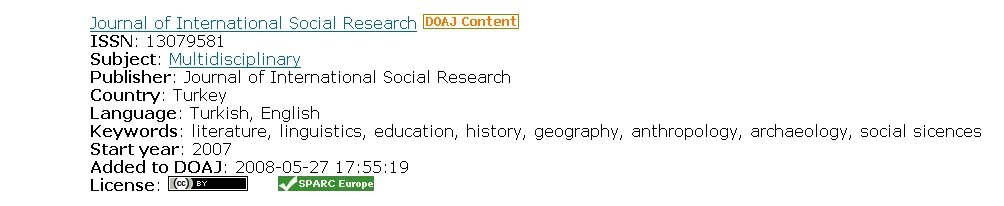
A directory can look like a simple list: names, links, perhaps a few labels. But in scholarly publishing, the details behind each entry matter. Is a journal genuinely open access? Does it explain how papers are reviewed? Who holds copyright, and what may readers do with published work?
The Directory of Open Access Journals, or DOAJ, was created to help answer a practical question: where can readers find scholarly journals that make their contents freely available? Launched in 2003 at Lund University in Sweden, it began with a collection of 300 open-access journals. It has since developed into an international directory covering journals across subject areas and languages.
Its work sits at the intersection of discovery and publishing practice. DOAJ helps readers locate journals, but it also asks publishers to provide clear information about how those journals operate. That makes the directory more than a catalogue: it is a way of making important publishing policies easier to inspect.
Making open access easier to find
In conventional subscription publishing, access to many research articles depends on payment by readers, libraries or institutions. Open-access publishing makes research available online without that reader-side price barrier. The model does not mean that publishing has no costs; journals may be funded in different ways, including through institutions, societies, grants or author-facing charges.
For a reader who does not already know a journal’s name, however, finding suitable open research can be difficult. Journals are spread across disciplines, countries and publishing platforms. A searchable directory offers a common starting point: users can browse or search for journals rather than relying only on a publisher’s own website or a general web search.
That is especially useful when a researcher, student, librarian or curious reader is looking beyond familiar publications. A directory can bring smaller or less widely known journals into view, while providing a route to their own sites and the articles they publish.
A listing depends on visible information
DOAJ’s application guidance sets out information journals need to provide for consideration. The requirements include details such as the journal’s open-access policy, peer-review process, editorial oversight, licensing and copyright arrangements. Those disclosures help readers understand the rules a journal says it follows, rather than asking them to infer them from a title or a polished website.
That distinction matters because “open access” describes how readers can reach material; by itself, it does not tell them everything about editorial practices. A journal’s website may offer articles for free while leaving questions about review, reuse or ownership unclear. A directory that asks for those policies to be stated can make comparison more informed.
There is also a useful limit to what a directory can do. DOAJ is not a substitute for reading a paper critically, checking whether its methods fit a question or assessing the reputation of a journal in a particular field. A listing should not be treated as a guarantee that every article is sound, or as an endorsement of every editorial decision. It is better understood as a discovery resource with entry requirements that put transparency in view.
Why the directory’s rules matter
Directories can shape attention. When a journal is included in a widely used index, it becomes easier to discover; when it is absent, readers may overlook it. That influence gives the process behind inclusion real importance. Clear application guidance gives publishers a published standard to consult and gives users a way to understand what the directory is trying to check.
DOAJ’s criteria are part of a broader effort in scholarly communication to make publishing practices more legible. The directory is among the organizations associated with the Principles of Transparency and Best Practice in Scholarly Publishing, developed with groups including the Committee on Publication Ethics, the Open Access Scholarly Publishing Association and the World Association of Medical Editors. The principles address matters such as governance, editorial processes, publication ethics and fees.
Such guidance cannot eliminate poor practice. Nor can a single organization inspect every aspect of every article. But public standards can give authors and readers better questions to ask: Is peer review explained? Are charges disclosed? Is the editorial team identified? Are reuse terms clear? These checks help shift attention from appearance to documented practice.
A reference tool for a changing research landscape
Open-access publishing is not one single business model, and the directory’s role is not to declare one universal route best. Its practical contribution is to organize journals that meet its stated criteria and make them easier to find. That can help a reader move from a topic to a journal, and from a journal to research they can access without first encountering a subscription paywall.
For libraries, the directory can support collection work and guidance for researchers. For authors, it can be one place to explore potential publishing venues and review their stated policies. For readers outside universities, it can offer a path into research that might otherwise be difficult to locate. In each case, the directory is a doorway, not the whole building: users still need to follow links, evaluate individual studies and consider a journal’s fit for their needs.
More than two decades after its launch, DOAJ’s premise remains straightforward: research that is openly available should also be easier to discover. The directory’s larger lesson is that a useful reference work does more than gather names. By asking journals to explain how they publish, it can help make the landscape of scholarly communication a little easier to navigate.