Earth has one unmistakable moon: the bright, familiar world that controls the tides and crosses the night sky. But our planet also has a much smaller companion, one that is easy to miss and technically does not belong to Earth at all.
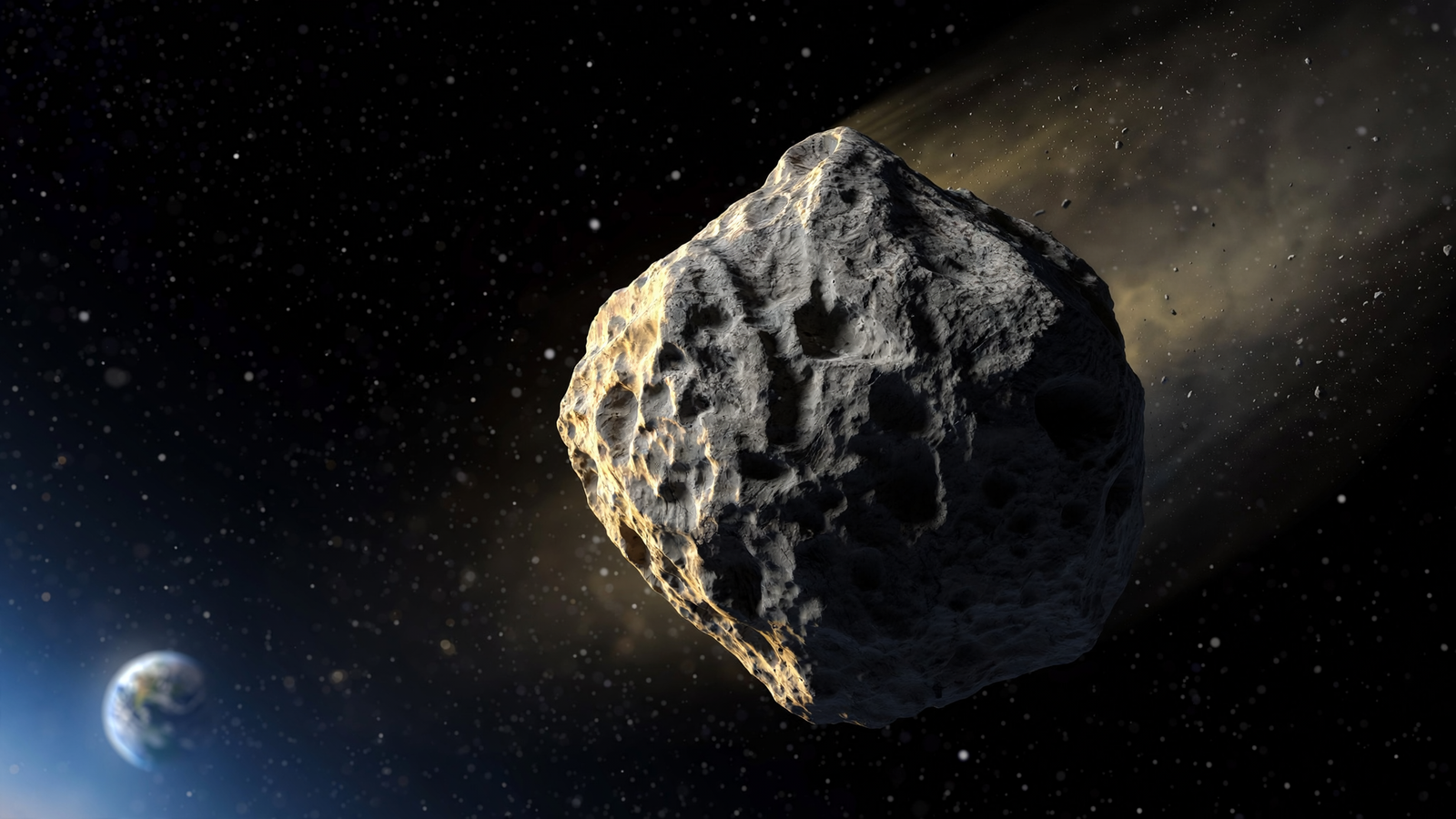
The object is called Kamoʻoalewa. It is an asteroid, probably only a few dozen meters across, traveling around the Sun on an orbit remarkably similar to Earth’s. From our planet’s perspective, it appears to loop around us. Astronomers call it a quasi-satellite.
That description sounds like a second moon. It is not. Kamoʻoalewa is not gravitationally bound to Earth in the way our true moon is. It follows the Sun, not Earth, and its apparent companionship is the result of a carefully balanced orbital relationship.
Even so, the asteroid is unusual enough to have become one of the most intriguing small bodies near Earth. Its orbit is stable on astronomical timescales, its surface appears to resemble lunar rock, and researchers have proposed that it may be a fragment blasted off the Moon long ago.
A companion hiding in plain sight
Kamoʻoalewa was discovered in 2016 by the Pan-STARRS survey telescope in Hawaii, which searches the sky for asteroids and other objects that pass relatively near Earth. Its temporary designation was 2016 HO3. The Hawaiian name was later chosen to describe an object that oscillates or moves in a repeating celestial pattern.
The asteroid is small and faint. It does not shine brightly enough to be seen with the naked eye, and even professional astronomers can observe it only during a limited period each year, when its position and illumination are favorable. Its faintness is one reason it remained unknown until modern survey telescopes began repeatedly scanning the sky.
Estimates place its width somewhere in the range of roughly 40 to 100 meters. That makes it far larger than a house but tiny compared with the Moon, which is about 3,475 kilometers across. Kamoʻoalewa is not a miniature moon in the ordinary sense. It is closer to a cosmic boulder moving through a carefully arranged dance.
Why it looks as if it circles Earth
Kamoʻoalewa travels around the Sun in approximately one Earth year. Its orbit is slightly tilted and somewhat more elongated than Earth’s, so it does not follow our planet’s path exactly. It also moves a little faster or slower than Earth at different points in its orbit.
When astronomers plot the asteroid’s motion relative to Earth, however, the geometry creates a striking pattern. Kamoʻoalewa appears to make a wide, looping path around our planet. It never completes a simple orbit around Earth, and it does not approach close enough to become a conventional satellite. Instead, the two bodies remain in a long-lasting orbital relationship while both travel around the Sun.
This is the key distinction between a true moon and a quasi-satellite. A moon is held in orbit by a planet’s gravity. A quasi-satellite shares a planet’s journey around the Sun but remains on its own solar orbit. Earth and Kamoʻoalewa are companions in motion, not in ownership.
Other objects have occupied similar relationships with Earth, but Kamoʻoalewa is considered especially interesting because its orbit is expected to remain stable for centuries and perhaps much longer. It is not a permanent fixture of the solar system, though. Gravitational nudges from Earth, the Moon, and other planets will eventually alter its path.
The clue hidden in reflected light
After its discovery, astronomers studied Kamoʻoalewa by examining the sunlight reflected from its surface. This technique, called spectroscopy, allows researchers to compare an asteroid’s reflected light with the known signatures of different minerals and types of rock.
The results were surprising. Kamoʻoalewa’s spectrum did not look like that of many ordinary near-Earth asteroids. Instead, it showed similarities to lunar material, particularly the kind of weathered rock found on the Moon’s surface.
The resemblance is not proof that the asteroid came from the Moon. Small bodies can sometimes develop similar surface properties for different reasons, and observations of a faint, rapidly rotating object are difficult. But the lunar comparison gave scientists a strong reason to investigate the possibility.
A 2021 study published in Nature Astronomy examined both the asteroid’s spectrum and the ways an impact could eject material from the Moon into a nearby solar orbit. The researchers concluded that a lunar origin was plausible and that Kamoʻoalewa’s unusual orbit was consistent with such a history.
One possible source is the large Giordano Bruno crater on the far side of the Moon. The crater is relatively young by lunar standards, although “young” still means hundreds of millions of years old. A powerful impact could have thrown fragments away from the lunar surface. Most pieces would eventually have fallen back, collided with another body, or entered different solar orbits. A small number might have taken a path resembling Kamoʻoalewa’s.
Researchers have not established that Giordano Bruno produced the asteroid. The crater is a candidate, not a confirmed birthplace. The larger point is that Kamoʻoalewa may offer scientists a way to study lunar material without relying solely on samples collected during Apollo missions or by robotic spacecraft.
A difficult target for future exploration
Its possible origin makes Kamoʻoalewa an appealing target for a spacecraft. A mission could measure the asteroid directly, examine its surface in detail, and perhaps determine whether its minerals truly match material from the Moon.
Getting there would not be simple. Kamoʻoalewa’s orbit is close to Earth’s in one sense, but its motion is not the same as that of a low-Earth satellite or the International Space Station. A spacecraft would need to match the asteroid’s path around the Sun, then operate near a small object with weak gravity and an uncertain surface.
The asteroid’s rotation creates another challenge. Observations suggest that Kamoʻoalewa spins rapidly, completing a rotation in less than half an hour. A fast-spinning, irregular body would require careful navigation if a spacecraft were to approach, orbit, land, or collect a sample.
China’s Tianwen-2 mission has been planned to visit and sample Kamoʻoalewa, making the asteroid a potential destination for one of the most ambitious small-body missions yet attempted. A successful encounter could test the lunar-fragment theory with measurements made at the source rather than from distant reflected light.
What a tiny object can reveal
Kamoʻoalewa matters even though it is small. The Moon is constantly struck by asteroids, and those impacts have shaped its surface for billions of years. If pieces of the Moon can be thrown into independent solar orbits, then some near-Earth asteroids may be fragments of worlds we already know rather than untouched leftovers from the solar system’s formation.
That possibility changes how astronomers think about the neighborhood around Earth. Near-Earth space is not populated only by ancient, unrelated rocks. It may also contain pieces of planets, moons, and asteroids that were separated by violent collisions and then carried into new orbits.
There is also something pleasingly strange about the asteroid’s relationship with Earth. Kamoʻoalewa is close enough to appear like a companion, distant enough to remain independent, and faint enough to hide from ordinary observation. It is neither a moon nor a passing visitor in the simplest sense. It is a small world sharing our broad route around the Sun.
For now, Kamoʻoalewa continues its quiet loop. Earth moves through space, the Moon circles Earth, and this possible lunar fragment travels alongside both of them—an almost invisible reminder that the solar system contains far more kinds of companionship than the night sky first reveals.