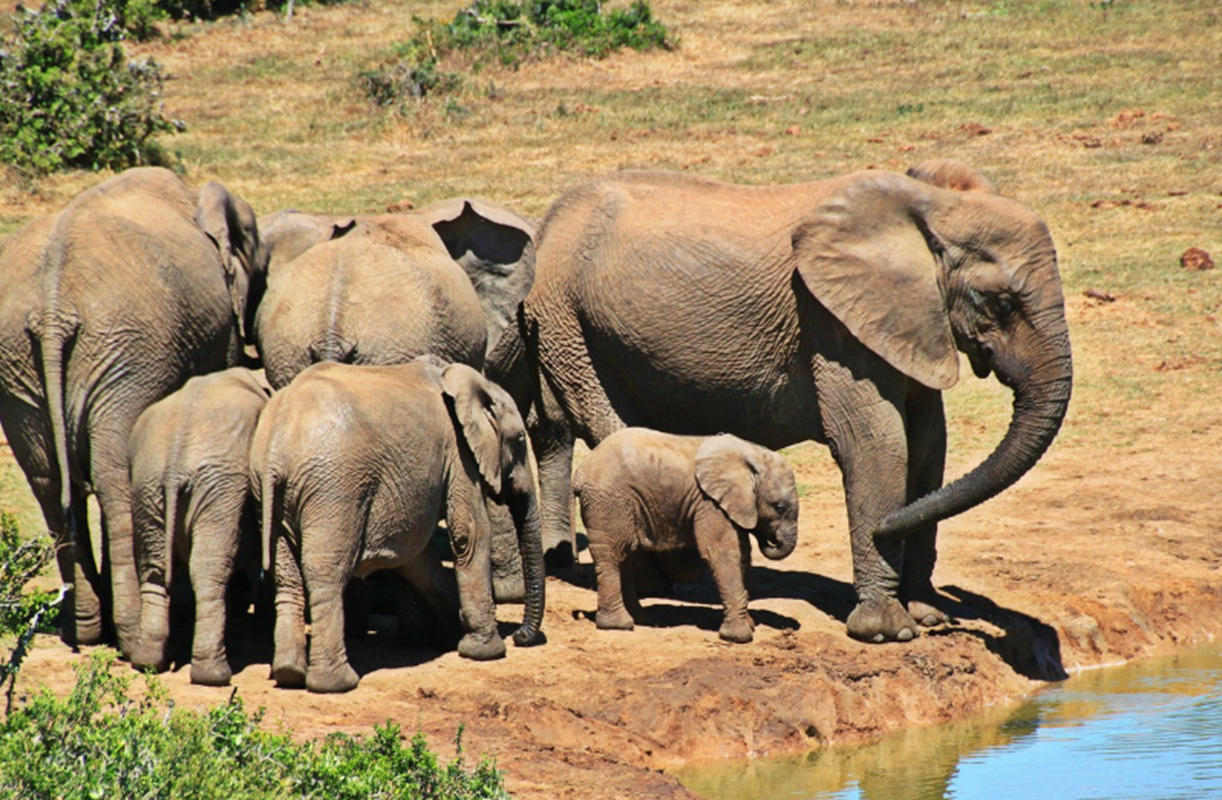
In the low rumble of an elephant call, researchers may have found something unexpectedly familiar: a signal that helps identify who is being addressed. A 2024 study of wild African elephants in Kenya found that calls carried information associated with particular receivers. In playback tests, elephants reacted more strongly to calls that researchers identified as addressed to them than to calls directed to another elephant.
The finding suggests elephants may use individually specific vocal labels—a capacity often compared to calling someone by name. It does not mean researchers have translated elephant speech or shown that elephants use names exactly as people do. But it offers evidence that their calls can do more than broadcast general information such as alarm or location: they may also help maintain communication between particular members of a socially complex group.
Listening for the intended listener
Elephants produce a varied repertoire of sounds, including deep rumbles that can travel over long distances. To investigate how those calls work, researchers analyzed recordings of African savanna elephants and looked for acoustic patterns linked to the individual receiving a call. A machine-learning model was able to classify the intended receiver more accurately than chance would predict.
That result alone could have several explanations. Perhaps a caller simply copies a sound made by the elephant it wants to reach. Or maybe certain call features reflect the caller, the context or the relationship between the animals rather than a receiver-specific label. So the researchers tested how elephants behaved when they heard calls.
In playback experiments, elephants heard recordings that had been identified as calls directed either to them or to another individual. They responded more strongly to calls classified as addressed to them. That response provides a separate line of evidence: the acoustic patterns were not just detectable by a computer model; they appeared to matter to the animals hearing them.
A name-like signal, not human language
The researchers’ interpretation is careful. The study supports the idea that elephants use individually specific vocal labels, sometimes described as name-like calls. It does not establish that each elephant has one fixed name, that every call contains one, or that the signals carry the same kinds of meaning as human names.
There is also a distinction between a vocal label and imitation. Some animals can learn to reproduce sounds made by others. In the elephant study, the calls were not simply imitations of the receiver’s own vocalizations. That makes the possibility of an individually specific signal especially interesting: a caller may be identifying another elephant without copying the sound that elephant makes.
Still, the acoustic structure of a call can be influenced by multiple things, and a machine-learning classification is not a direct translation. Researchers have not demonstrated a vocabulary with a one-to-one word for every elephant, or decoded a complete message from a rumble. “Name-like” is a useful comparison, not proof that elephant communication works just like conversation between people.
Why individual calls could matter
Elephant societies make communication across distance important. Individuals may travel apart and reunite, and a caller may need to reach a particular companion rather than simply alert every elephant within hearing range. A signal that helps a listener recognize it is the intended recipient could be useful in those situations—whether the message concerns contact, movement or another aspect of group life.
That is a plausible role for receiver-specific calling, not a conclusion that the study proved for every call. The research focused on acoustic patterns and responses to playbacks; it did not translate the contents of calls or establish exactly what each one meant in the animals’ daily lives. More recordings and behavioral observations can help connect call structure to context.
The work also adds to a growing scientific discussion about how animals identify one another vocally. Dolphins and some birds, for example, have been studied for learned vocal signals associated with individuals. The elephant findings are notable because the researchers found evidence for labels that were not simply copies of a receiver’s own call. Comparisons across species can help scientists ask which parts of communication are widespread and which may have evolved in different ways.
What the research opens up
For conservationists and researchers, learning how elephants communicate could eventually improve understanding of their social needs. But the immediate value of the study is more basic: it gives scientists a testable way to investigate how calls are structured, who they are directed toward and how listeners respond.
Future work can examine whether the same elephant is addressed with similar acoustic patterns in different situations, how listeners distinguish calls in noisy environments, and whether the signals change with relationships or context. Those questions require careful observation and larger bodies of evidence; the current results are a promising starting point rather than a complete account of elephant communication.
A rumble can carry across a landscape, but it may also be aimed at someone in particular. The study does not let us hear elephants’ conversations as humans would. It does suggest that their vocal world may include a subtle social detail: not only making a sound, but directing it to a specific listener.