Before a laptop joins a video call over Wi-Fi, before a server answers a request, and before a printer receives a document, there is often a more basic question: how will the machines move data from one place to another?
For much of modern computing, one answer has been Ethernet.
Ethernet is the family of wired networking technologies that lets computers and other devices exchange data across cables. It is easy to overlook because it usually works without demanding attention. A cable disappears behind a desk. A small light blinks on a router or switch. A device connects, receives an address, and gets on with its work.
But that quiet reliability began with an ambitious idea at Xerox’s Palo Alto Research Center in California: personal computers should be able to share information, printers, and other resources as naturally as people share a workplace.
A network for a new kind of office
In the early 1970s, Xerox PARC was exploring what the future of office computing might look like. Researchers were working with graphical workstations, laser printers, file servers, and other technologies that would later become familiar parts of personal computing.
Those machines needed a way to communicate. A single computer could not make the new environment very useful if it had to operate alone, and a network designed only for a large central computer would not suit an office filled with interactive workstations.
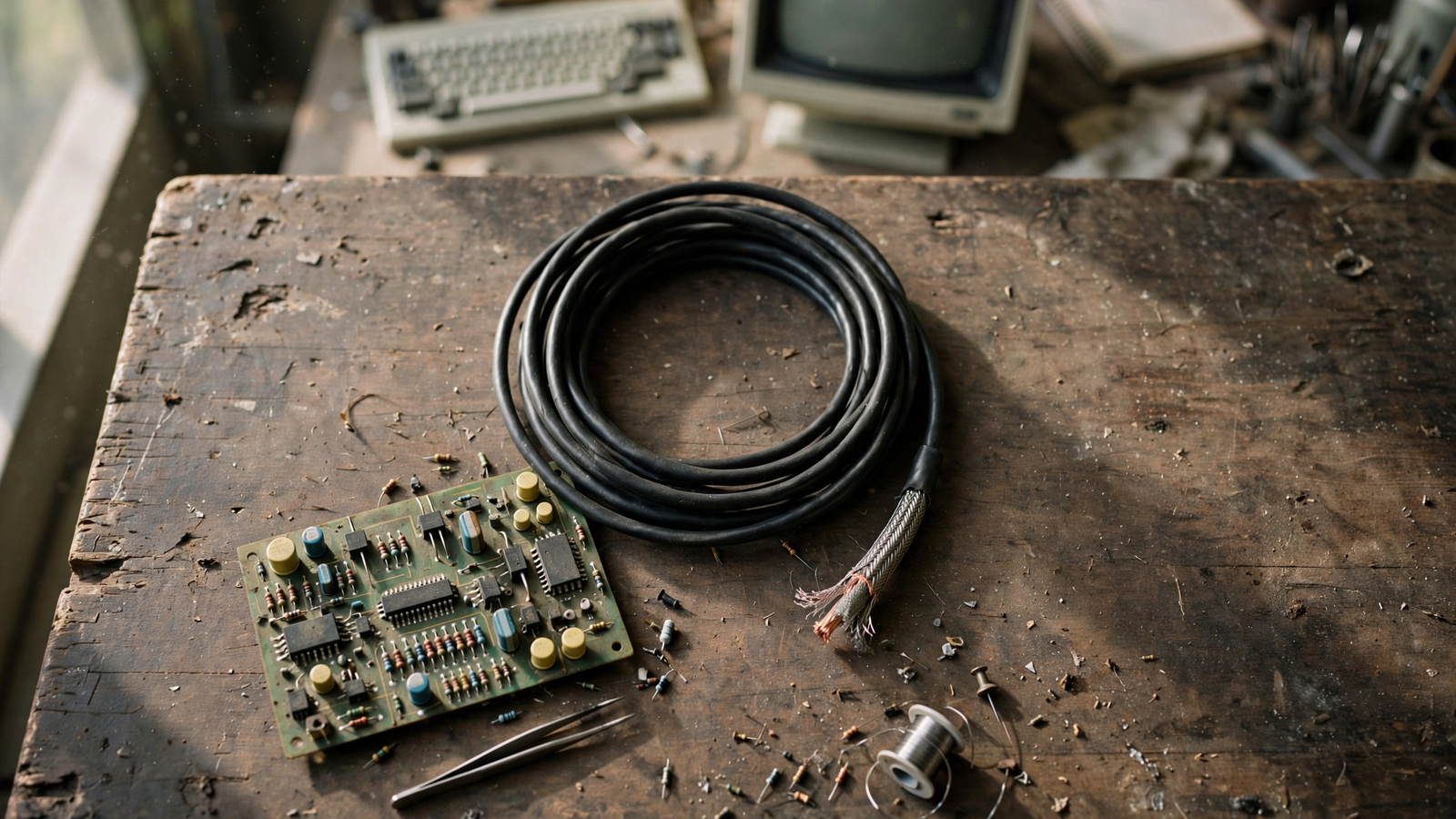
Robert Metcalfe and David Boggs developed an approach at PARC that became known as Ethernet. Metcalfe’s 1973 description of the system envisioned a shared communication medium connecting many devices. The early network used coaxial cable rather than today’s familiar modular plugs, but the central problem was already recognizable: several machines might want to transmit at the same time, so the system needed a way to manage that competition.
Ethernet’s name suggested the old idea of an “ether,” a medium through which signals traveled. The name was historical rather than a description of the final physical technology. Ethernet would eventually use many kinds of cable, including copper twisted pair and optical fiber.
The clever idea was not just the cable
One of Ethernet’s important contributions was a method called carrier-sense multiple access with collision detection, or CSMA/CD. For related reading, see The CAPTCHA: How a Tiny Test Became a Battleground Between Humans and Bots.
In simplified terms, a device first listened to the shared cable. If the line appeared quiet, it transmitted. If two devices transmitted together, they could detect the collision, stop, wait for different intervals, and try again. That approach did not eliminate competing transmissions, but it gave a network of independent machines a practical way to share one communication path.
The method reflected a useful engineering trade-off. Ethernet did not require a central controller to grant every device permission to speak. Instead, the devices followed common rules. The network could therefore grow without turning every exchange into a conversation with one central authority.
Modern switched Ethernet does not work exactly like the earliest shared coaxial networks. Most devices now have a dedicated cable to a switch, and the switch directs traffic between ports. But the original emphasis on common formats, local identification, and interoperable equipment remained part of Ethernet’s long life.
From research project to open standard
Xerox was not the only organization interested in local computer networks. In 1980, Digital Equipment Corporation, Intel, and Xerox published a specification commonly known as DIX Ethernet. It helped move the technology beyond one research laboratory and toward a broader equipment market.
The Institute of Electrical and Electronics Engineers then developed the 802.3 standard for Ethernet. The first IEEE 802.3 standard appeared in 1983. Standardization mattered because a network becomes much more useful when a computer made by one company can communicate with a network interface, switch, or printer made by another.
That interoperability is easy to take for granted. It is one reason Ethernet became infrastructure rather than a proprietary feature. Hardware manufacturers could build to published specifications, while network administrators could assemble systems from multiple suppliers.
The technology also changed physically. Early Ethernet’s thick coaxial cable was difficult to install and modify. Thinner coaxial cable helped, but the major practical shift came with twisted-pair wiring and the 10BASE-T standard. Twisted-pair Ethernet could use familiar building wiring and connect individual devices to a central hub or switch. Offices no longer had to treat the entire network as one long shared cable that ran from machine to machine.
Why a “slow” network kept getting faster
The first Ethernet systems operated at megabit speeds that seem modest beside today’s broadband connections. Yet Ethernet was designed to evolve. Fast Ethernet raised the rate to 100 megabits per second. Gigabit Ethernet followed, and later versions reached 10 gigabits per second and beyond in data centers and high-capacity networks.
The important point was not simply that each generation moved more bits. New versions could often fit into existing networking practices: familiar frames, addressing concepts, switches, and management tools. Cabling and equipment sometimes had to change, but organizations did not have to abandon the entire mental model of their networks. For related reading, see Linux: How a Student’s Operating System Became the Internet’s Quiet Foundation.
Ethernet also expanded across different physical environments. Copper cable remains common for desks, access points, cameras, and other nearby devices. Fiber-optic Ethernet carries data over longer distances and is useful where electrical isolation, high capacity, or resistance to interference matters. Data centers may use specialized optical connections and high-speed Ethernet links, while a home office may use a short copper cable between a computer and a router.
The frame beneath the familiar network
When people say that a device is “on Ethernet,” they may be describing more than a cable. Ethernet defines how data is packaged for transmission across a local network. Those packages, commonly called frames, include identifying information for the sending and receiving network interfaces along with the data being carried.
That local delivery role is different from the job performed by the Internet Protocol. IP helps move packets between networks. Ethernet generally handles the next local step: getting a frame from one interface to another across a nearby network segment. The two technologies work together but are not interchangeable.
This layered design is one reason networking can evolve. A web request may travel through Ethernet on one part of its journey, fiber on another, and Wi-Fi somewhere else while higher-level Internet protocols remain largely unchanged.
Ethernet becomes more than a data connection
Ethernet’s usefulness grew as it began carrying more than ordinary computer traffic. Power over Ethernet allows certain network cables to deliver electrical power as well as data. That has made it practical to install devices such as some wireless access points, security cameras, phones, and sensors without running a separate power cable to every location.
The approach is especially useful in buildings. A network switch can provide a managed connection to a device mounted on a ceiling, wall, or outdoor structure. Moving, replacing, or monitoring that device can be simpler when data and power arrive through one cable.
Ethernet has also become important in industrial systems, telecommunications, entertainment equipment, vehicles, and data centers. Not every application uses the same version or physical medium, but the shared family name reflects a durable set of standards rather than one particular cable. For related reading, see Reinforcement Learning: How Trial and Error Became a Core Idea in AI.
Why Ethernet still matters in a wireless age
Wi-Fi made networking dramatically more convenient, especially for phones and portable computers. But wireless convenience does not make wired networking obsolete.
A wired connection can provide predictable performance in places where radio signals are crowded or blocked. It can reduce dependence on wireless spectrum, offer a stable link for a stationary desktop or television, and simplify connections between network switches, servers, and access points. In a busy building, the invisible wireless portion of the network often depends on wired Ethernet somewhere behind it.
Ethernet is not automatically secure simply because it uses a cable. Someone with physical access to a network outlet or device may still pose a risk, and network security depends on authentication, segmentation, encryption, updates, and careful administration. A cable solves a connectivity problem; it does not solve every security problem.
What Ethernet means at home
For a household, Ethernet is usually the wired connection between a router and a computer, game console, television, printer, access point, or network-attached storage device. A cable can be useful when a device stays in one place and needs a dependable connection, while Wi-Fi remains more convenient for mobile devices.
If a wired connection fails, the simplest checks are still practical ones: confirm that the cable is fully inserted, inspect it for damage, try another cable or router port, and look for link indicators on the equipment. A connection may also negotiate at a lower speed when a cable, port, or configuration does not support the expected rate.
That modest troubleshooting routine reflects Ethernet’s larger story. The technology has advanced through faster signaling, better switching, new cable types, and increasingly sophisticated management. Yet its basic promise remains understandable: connect machines with shared rules so they can exchange information reliably.
Ethernet began as part of a research vision for an interactive office. It survived changes in computers, operating systems, cabling, and the rise of wireless devices because it was never only one product. It was a flexible agreement about how machines could communicate. More than half a century after the first experiments at Xerox PARC, that agreement still runs quietly through the infrastructure of everyday computing.
Use: Used to verify Ethernet’s development, the DIX specification, and the IEEE 802.3 standardization history.
Use: Used for the Xerox PARC context, the work of Robert Metcalfe and David Boggs, and Ethernet’s role in early office networking.
Use: Used to confirm the continuing IEEE 802.3 Ethernet standards family and its scope.
Use: Used for the distinction between local network delivery and higher-level Internet Protocol networking.
IEEE 802.3 Working Group — History of Ethernet — https://www.ieee802.org/3/history.html — Used to verify Ethernet’s development, the DIX specification, and the IEEE 802.3 standardization history.
Computer History Museum — Ethernet at 50 — https://computerhistory.org/blog/ethernet-at-50/ — Used for the Xerox PARC context, the work of Robert Metcalfe and David Boggs, and Ethernet’s role in early office networking.
IEEE Standards Association — IEEE 802.3 Ethernet — https://standards.ieee.org/ieee/802.3/ — Used to confirm the continuing IEEE 802.3 Ethernet standards family and its scope.
RFC Editor — RFC 1180, A TCP/IP Tutorial — https://www.rfc-editor.org/rfc/rfc1180 — Used for the distinction between local network delivery and higher-level Internet Protocol networking.