Some travel books are built around arrival. They promise a destination, describe the road toward it, and end when the traveler finally reaches the place that gave the journey its purpose.
Farthest North, Fridtjof Nansen’s account of his Arctic expedition, belongs to a stranger and more revealing tradition. Its central experience is not simply movement across a blank space. It is the discovery that, in the high Arctic, movement may be taken away entirely.
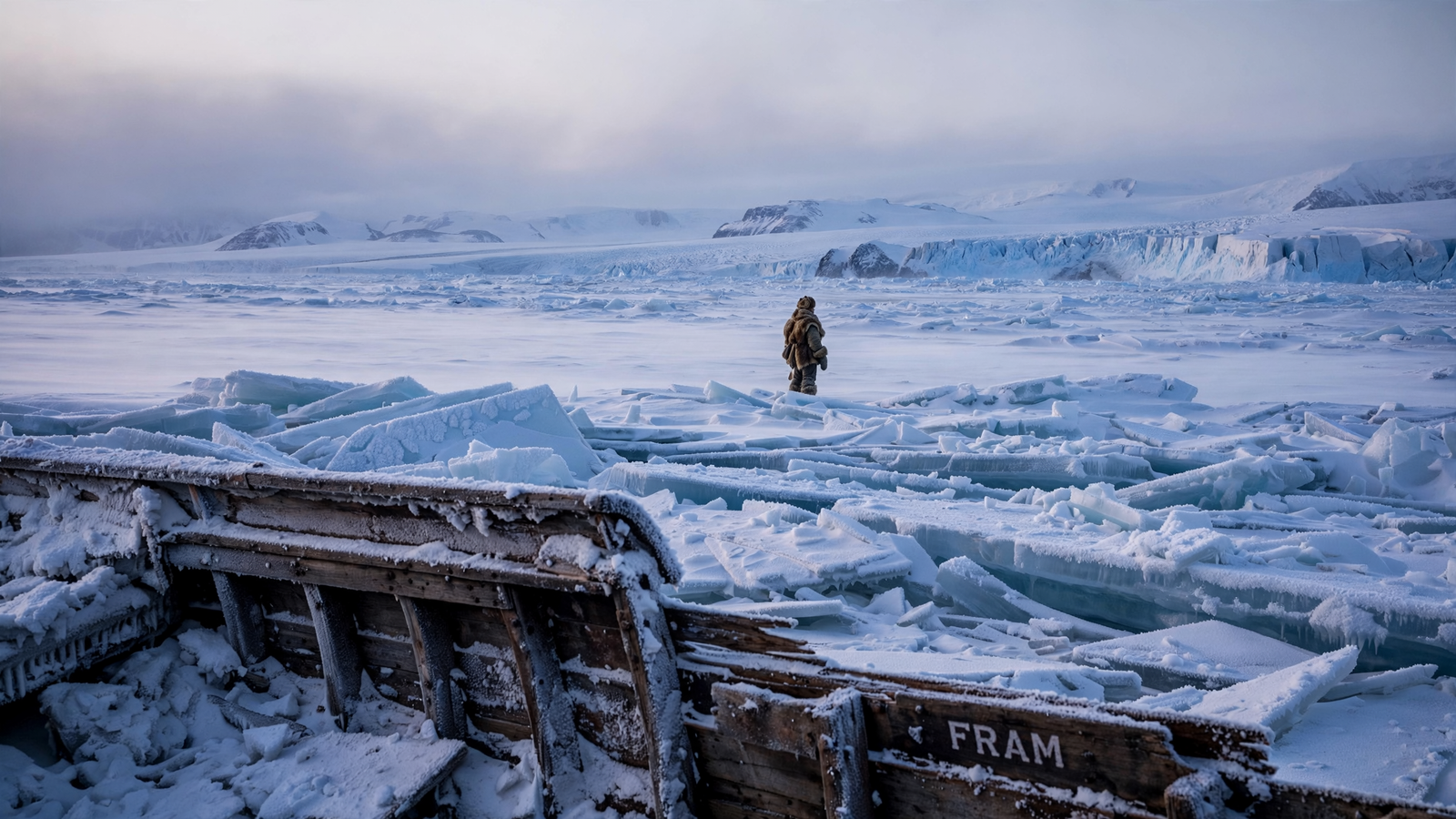
Nansen and his crew set out aboard the Fram in 1893 with a daring plan: allow the ship to be carried by the great, largely unknown drift of sea ice across the Arctic Ocean. Rather than fight the ice, they would trust it to transport them toward the North Pole. The expedition became a landmark in polar exploration, but the book that emerged from it is also an impressive work of travel writing—part scientific report, part expedition narrative, part meditation on solitude and time.
A journey designed around surrender
By the end of the nineteenth century, explorers had tried many ways to reach the North Pole. Ships had been trapped or crushed by ice, sledging parties had disappeared, and maps of the polar ocean remained incomplete. Nansen’s idea was based on evidence that ice and drift might carry a vessel across the central Arctic rather than simply block its way.
The Fram, designed by Norwegian naval architect Colin Archer, was built with a rounded hull intended to rise out of the pressure of the ice instead of being squeezed beneath it. Nansen’s strategy required an unusual kind of courage. The expedition would deliberately enter the ice north of Siberia, then wait to see where the moving pack carried the ship.
That decision shaped the entire character of Farthest North. The book is not a tale of uninterrupted progress. It is a record of days when the crew measured small changes in position, repaired equipment, observed animals and weather, carried out experiments, prepared food, read, argued, celebrated, and waited. The Arctic becomes not an empty backdrop but an active force—one that determines what human beings can and cannot do.
The Fram enters the ice
The expedition left Norway in June 1893. After sailing north and east along the Siberian coast, the Fram entered the pack ice in September. From that point, the ship was increasingly governed by the pressure and drift of the frozen ocean.
For readers accustomed to travel narratives that move from one named place to another, this was a radically different form of geography. The crew could be surrounded by ice for weeks or months while their position changed only gradually. The expedition’s progress depended on instruments, observations, and patience as much as on seamanship.
Nansen writes about the expedition at the scale of ordinary life. He describes work and weather, but also the habits that make isolation bearable: meals, maintenance, exercise, conversation, music, games, scientific routines, and the care of animals. The narrative shows how a small community creates structure when the outside world has become almost entirely inaccessible.
That attention to routine gives the book much of its literary strength. The Arctic is dramatic, but Nansen does not need to turn every moment into spectacle. A damaged piece of equipment, a change in the wind, or the appearance of an animal can carry the tension of a larger event because the crew understands how much depends on small details.
When waiting became its own expedition
The Fram did not drift as quickly toward the pole as Nansen had hoped. By early 1895, he concluded that remaining aboard would not bring him close enough to his objective. He made the difficult decision to leave the ship and attempt to travel north by dogsled with Hjalmar Johansen.
On March 14, the two men set out from the Fram with sledges, dogs, kayaks, supplies, and equipment. Their route across the sea ice was punishing. Open leads of water interrupted the frozen surface. Pressure ridges made travel slow and exhausting. The men had to haul their supplies, care for the dogs, and constantly judge whether the ice ahead was safe enough to cross.
They reached 86°14′ north, farther north than any previous expedition, but the pole remained out of reach. Continuing would have risked their survival without a realistic chance of success. Nansen turned south, beginning one of the most demanding retreats in the history of polar travel.
In Farthest North, this decision is important because it resists the simplest heroic story. The expedition’s achievement was not measured only by how far it went. It also depended on recognizing when a goal had become impossible and changing the plan before ambition became recklessness.
A travel book about an unmapped world
After abandoning their original route, Nansen and Johansen faced a landscape in which maps offered limited help. They traveled toward Franz Josef Land, an archipelago north of the Russian Arctic, and eventually spent the winter of 1895–96 in a rough stone-and-walrus-hide shelter on Frederick Jackson Island.
Their shelter was not comfortable, but it gave them protection through the polar night. They lived with limited food, cold, darkness, and uncertainty about when they might encounter another expedition or find a safe route onward. Their survival depended on improvisation as much as preparation.
This section of the journey gives Farthest North its most intimate passages. The grand scale of the Arctic contracts into the dimensions of a shelter, a sleeping place, a cooking area, and a few possessions. Travel becomes a problem of conserving heat, maintaining equipment, and preserving judgment.
In June 1896, Nansen and Johansen encountered the British explorer Frederick Jackson. The meeting was unexpected and transformed their journey. Jackson’s expedition helped bring them back to civilization, and Nansen was reunited with the Fram later that year. The ship had survived its long drift and emerged from the ice in the waters near Spitsbergen.
Why the book is more than an expedition report
Farthest North was published in two volumes in 1897. It combines Nansen’s narrative with maps, illustrations, scientific observations, and material gathered by members of the expedition. The result is not a diary in the narrow sense. It is a carefully shaped account that turns months of uncertainty into a coherent reading experience.
Nansen understood that exploration produced several kinds of knowledge at once. The expedition gathered data about ocean depth, currents, ice, weather, marine life, and the movement of the Arctic environment. But the book also records knowledge that cannot be reduced to measurements: how people live in confinement, how fear changes under repetition, and how a landscape becomes familiar without ever becoming safe.
That combination gives the book a distinctive voice. Nansen was trained as a scientist and was committed to careful observation, yet he was also attentive to beauty. The shifting colors of ice, the silence of the polar night, the sudden appearance of wildlife, and the vastness of the horizon are not decorative details. They are part of the expedition’s reality.
His method also makes the book a valuable travel narrative because it questions the idea that the traveler is always in control. The men bring technology, planning, and discipline into the Arctic, but the ice determines the timetable. Their most important skill is often not conquest but adaptation.
The lasting journey of Farthest North
Nansen’s expedition helped demonstrate that the central Arctic Ocean was not a fixed continent concealed beneath the ice. The Fram’s drift supplied evidence about the movement of the polar sea and supported a more accurate understanding of the region. The expedition also influenced later generations of polar explorers, including those who would attempt to reach the North Pole by different methods.
Yet the book’s continuing interest does not depend only on the expedition’s records. Farthest North remains readable because it captures an experience increasingly rare in modern travel writing: the feeling of entering a world that offers almost no familiar reference points.
Its deepest subject is not simply the North Pole. It is the human ability to remain attentive when progress is slow, information is incomplete, and the environment refuses to conform to expectation. Nansen’s great journey was measured in degrees of latitude, but his book is built from smaller units—days, tasks, observations, decisions, and moments of wonder.
That may be why Farthest North still speaks beyond the history of exploration. It presents travel not as a sequence of destinations but as an education in limits. Sometimes the world does not reward speed. Sometimes the most important act is to wait, watch, revise the plan, and keep enough strength for the journey home.