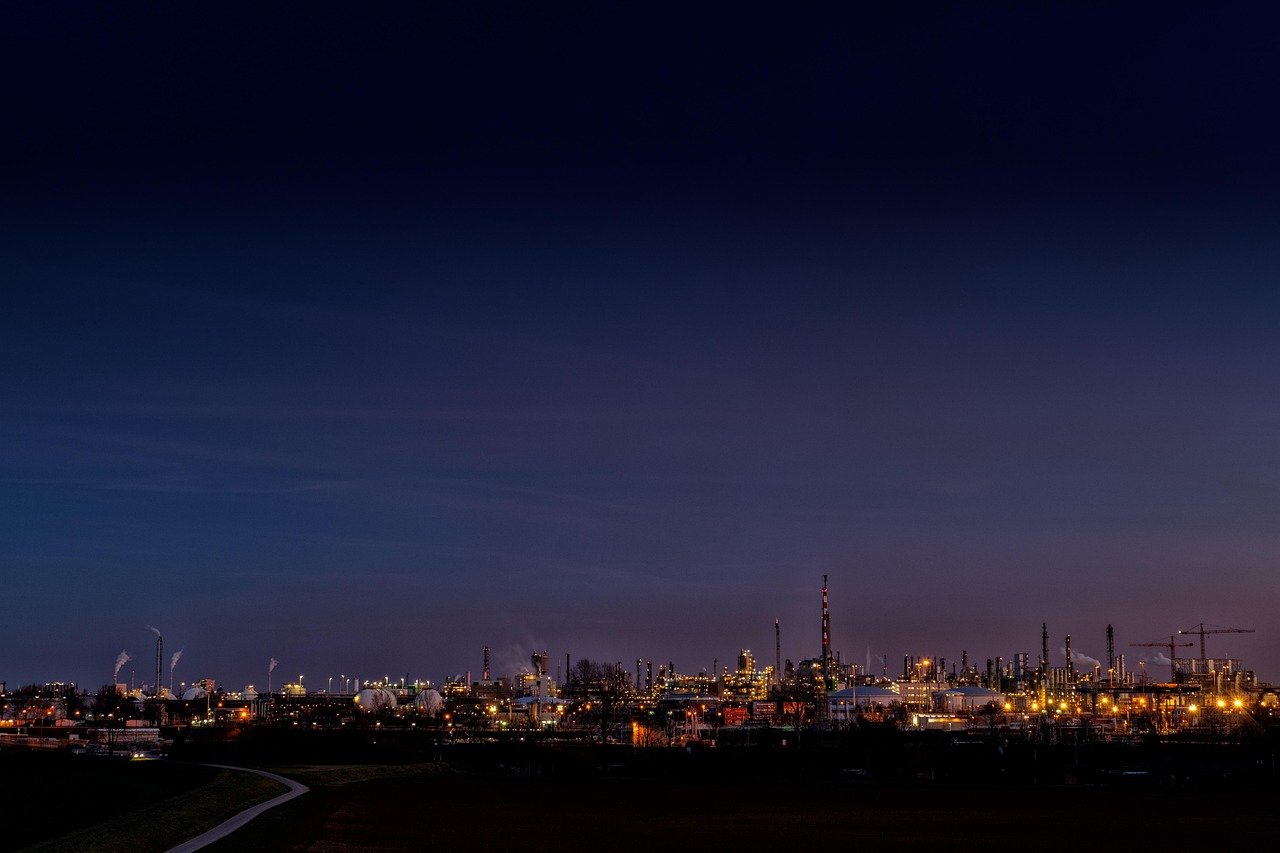
Most of the air around us is nitrogen. Yet for much of human history, that abundance was little help to farmers: the nitrogen gas in the atmosphere is exceptionally stable, and plants cannot use it directly. The Haber-Bosch process changed that by making ammonia, a useful source of nitrogen, from atmospheric nitrogen and hydrogen on an industrial scale.
The process is a story of chemical ingenuity, high-pressure engineering and a continuing trade-off. It helped make nitrogen fertilizer widely available, supporting much larger harvests. But making ammonia conventionally takes substantial energy and usually relies on fossil fuels. Understanding the chemistry helps explain both why the process became so important and why researchers are working to change how it is powered.
Why atmospheric nitrogen is hard to use
Nitrogen gas consists of two nitrogen atoms joined by a strong triple bond. That bond makes the molecule stable: under ordinary conditions, it does not readily react into forms that plants can take up. Some soil and root-associated microorganisms can fix nitrogen biologically, and lightning can create nitrogen compounds, but those natural pathways do not by themselves meet all the demand of intensive agriculture.
Ammonia, by contrast, contains nitrogen in a form that can be used to make fertilizers. The chemical equation for its synthesis is simple to write: one nitrogen molecule reacts with three hydrogen molecules to form two ammonia molecules. Getting the reaction to proceed quickly and efficiently is the harder part.
From a laboratory reaction to a factory process
In the early 20th century, German chemist Fritz Haber developed a way to synthesize ammonia from nitrogen and hydrogen under high pressure, with a catalyst. The reaction became a practical industrial process through the work of engineers at BASF, notably Carl Bosch, who helped solve the formidable problems of constructing and operating equipment that could withstand high pressures.
The name Haber-Bosch reflects those two contributions: the chemical method and its industrial scale-up. Haber received the 1918 Nobel Prize in Chemistry for the synthesis of ammonia from its elements. Bosch later shared the 1931 chemistry prize for contributions to the invention and development of chemical high-pressure methods.
The process works by balancing competing demands. High pressure favors ammonia formation because the product side of the reaction has fewer gas molecules. A lower temperature also favors the reaction’s equilibrium, but makes it proceed more slowly. Factories therefore use elevated temperatures and pressures as a compromise between reaction speed, ammonia yield and operating demands. A catalyst helps the reaction happen faster; it does not change the reaction’s final equilibrium or supply the nitrogen and hydrogen.
In conventional plants, hydrogen is commonly made from natural gas, while nitrogen is separated from air. The gases pass through a synthesis loop, where some react to form ammonia and unreacted gases are returned for another pass. The resulting ammonia can be used directly or turned into other nitrogen fertilizers.
A change in agriculture—and in the nitrogen cycle
Before industrial ammonia, farmers depended on sources such as manure, compost, crop rotations and naturally occurring deposits to replenish soil nitrogen. Haber-Bosch allowed manufacturers to produce nitrogen fertilizer in quantities that natural sources alone could not supply. That helped raise agricultural productivity and made modern high-input farming possible in many regions.
The benefits have a wider context. More fertilizer does not automatically mean more food: crop choice, soil, water, distribution and farming practices also matter. And plants do not absorb every nitrogen compound applied to fields. Excess can move into waterways, contribute to algal blooms and affect ecosystems; nitrogen compounds can also escape to the air. The same chemical that helps crops grow can cause harm when its use exceeds what plants and soils can retain.
The process also carries an energy cost. Conventional ammonia production uses significant energy, and making hydrogen from natural gas releases carbon dioxide. The International Energy Agency identifies ammonia production as an energy- and emissions-intensive industry, making it an important target for efficiency improvements and lower-emissions production.
What could change—and what would stay the same
One proposed route to lower-emissions ammonia is to make hydrogen using electricity from low-emissions sources, rather than deriving it from natural gas. This is often called green hydrogen. The synthesis step still combines nitrogen and hydrogen, but the climate impact depends on how the electricity and other inputs are produced. The label alone is not a guarantee that a whole supply chain has no emissions.
Researchers and companies are also exploring different catalysts and plant designs. Such changes may improve efficiency, but the fundamental chemistry remains a useful starting point: nitrogen’s stable bond must be activated, and the reaction needs suitable conditions to form ammonia at a practical rate.
Haber-Bosch is more than a formula in a chemistry textbook. It is a demonstration of how understanding a molecular reaction, then building equipment to control it, can reshape a basic human activity. Its next chapter is not simply about making more ammonia. It is about finding ways to make this essential chemical with less energy and fewer emissions, while managing the nitrogen that reaches fields, rivers and the atmosphere.