A room that stays uncomfortable while the rest of the house feels fine may point to a problem with its ductwork—not just its thermostat. Leaks at duct joints can let conditioned air escape into an attic, crawlspace or basement. Sealing accessible leaks can help air reach the rooms the system is meant to serve, though it cannot fix every heating or cooling problem.
This is a small inspection-and-repair project for ducts you can reach safely. If the system has combustion equipment, damaged ducts, or ductwork in a tight or hazardous space, get a qualified HVAC professional to assess it.
Start with a visual check
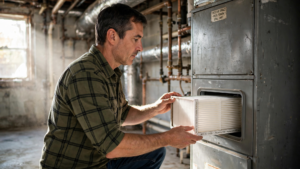
Turn the heating or cooling system off before inspecting. Look at exposed duct runs in a basement, utility area or accessible attic. Pay attention to joints, elbows, seams and connections near the air handler. Gaps, disconnected sections, damaged insulation or obvious patches are reasons to investigate further.
You may notice dust near a joint, but dust alone does not prove that air is leaking. If you want a more systematic check, a professional can measure duct leakage. A room that is persistently too hot or cold can also have causes other than duct leaks, including poor airflow, insulation problems or equipment issues.
Use a sealant made for ducts
For accessible, small leaks at joints, use duct mastic or metal-backed tape specifically listed for HVAC duct sealing. Follow the product label and apply it to clean, dry surfaces. Mastic is a paste that can be brushed over joints; some products call for reinforcing mesh over wider gaps. Metal-backed tape can work for suitable seams when installed as directed.
Ordinary cloth-backed “duct tape” is not a durable substitute. Choose a product labeled for duct use, and do not cover access panels, dampers, equipment labels or parts that need to open for service. Never use sealant to repair a badly crushed, disconnected or deteriorated duct; that section may need professional repair or replacement.
A careful, practical sequence
- Make the area safe. Switch the system off. Use a stable ladder, wear gloves and avoid stepping between attic joists. Do not work near exposed wiring or enter a confined, unsafe or excessively hot space.
- Clean the joint. Remove loose dust so the sealant can adhere. Do not scrape or disturb suspect asbestos-containing materials, and do not spray products into the duct interior.
- Seal the connection. Apply mastic or listed metal-backed tape over the seam according to its instructions. For a gap too large for the product, or a joint that has come apart, stop and arrange a repair.
- Check the result. Let the material cure for the time stated on its label before restarting the system. Recheck the repaired spot during a later inspection.
Know when to call an HVAC technician
Do not seal a furnace flue, chimney connector, combustion-air opening or any component that is not a supply or return duct. These parts have different safety requirements. If you cannot confidently distinguish them, leave the area untouched and ask a technician.
A professional is also the safer choice for ducts inside walls or ceilings, extensive leakage, mold or moisture, disconnected runs, or work that requires opening building materials. Sealing ducts is one part of home comfort: duct insulation, equipment condition, airflow and the building’s insulation and air sealing all affect performance. A targeted repair is useful, but a whole-system problem calls for a whole-system diagnosis.