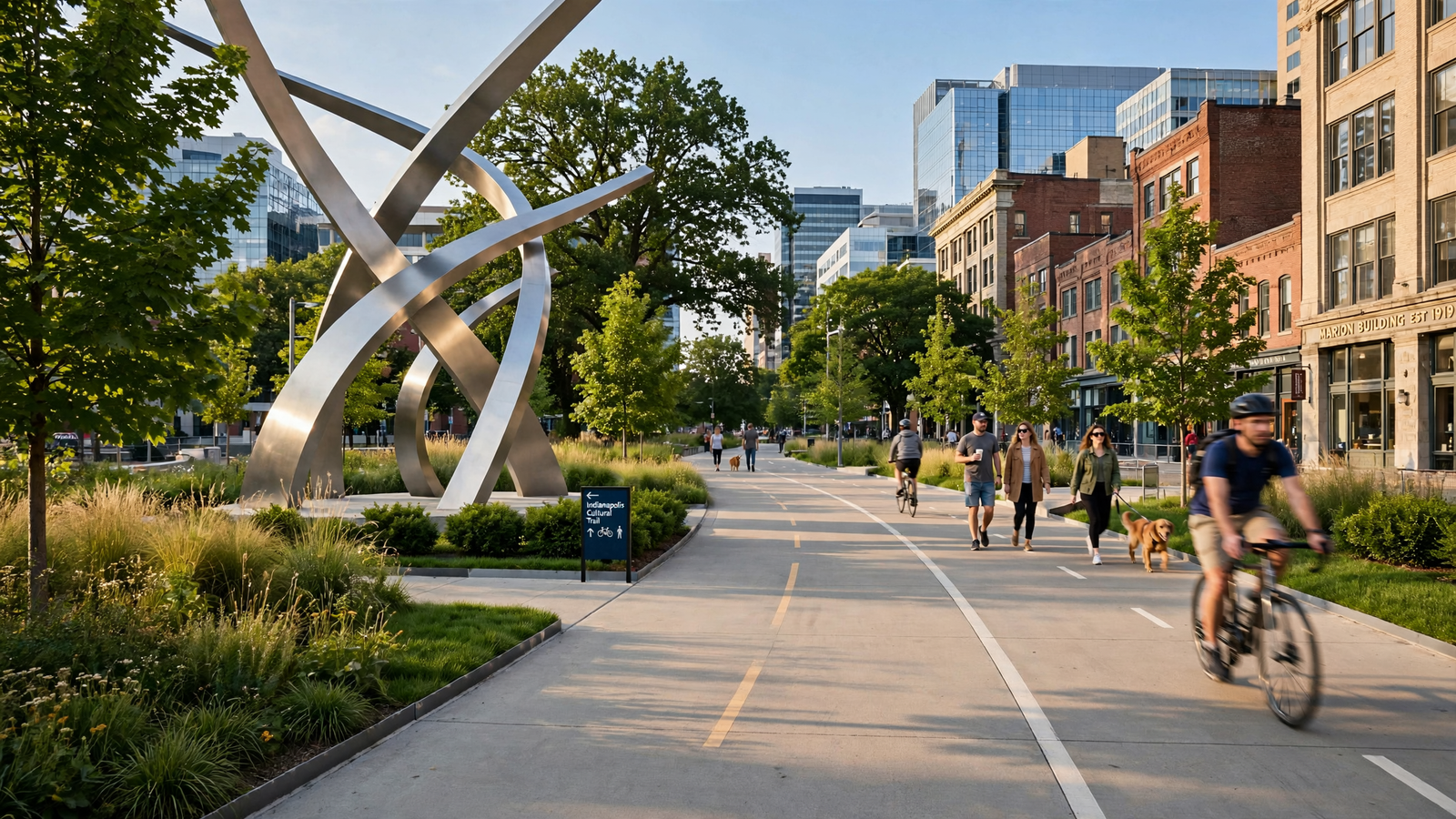
In Indianapolis, a walk downtown can feel like a tour through the city’s identity.
A path leads past public art, gardens, restaurants, museums, theaters and the entrances to six distinct cultural districts. Cyclists move alongside pedestrians. Benches offer places to pause. At several intersections, carefully designed crossings give people on foot and on bikes a visible presence in streets once organized almost entirely around cars.
This is the Indianapolis Cultural Trail, an eight-mile urban route that connects the city center with surrounding neighborhoods. It is transportation infrastructure, but it is also something more unusual: a piece of public space designed to make the city easier to explore and easier to share.
A trail built through the middle of a city
The Cultural Trail opened in 2013 after years of planning, fundraising and design work. Rather than following a remote riverbank or an abandoned rural railway, it was built into the existing fabric of downtown Indianapolis.
That decision shaped the experience. The trail does not ask people to leave the city behind. It places walking and cycling directly beside offices, shops, cultural institutions and residential streets. In many places, the route occupies space that might otherwise have been used for parking or additional traffic lanes.
The trail’s planners also treated its design as part of the project’s purpose. Landscaping, lighting, seating, signs, stormwater features and intersection treatments were developed as a coordinated system. The result is not simply a painted bike lane or a sidewalk with a new name. It is a recognizable public corridor with its own visual language.
According to the nonprofit Indianapolis Cultural Trail Inc., the route links the city’s downtown core with the Mass Ave, Fountain Square, Indiana Avenue, Canal and Market East areas, as well as the Wholesale District. Each district has a different history and atmosphere. The trail makes it possible to experience those differences without getting back into a car after every stop.
Connecting the places that define Indianapolis
Indianapolis is often associated with major events and large venues, but the Cultural Trail emphasizes the city’s smaller points of connection. A visitor can use it to reach galleries, performance spaces, restaurants and public plazas. A resident might use the same route to commute, exercise or meet a friend.
That mixture of ordinary and special destinations is important. A successful city route cannot depend only on tourism. It has to be useful on a Tuesday morning as well as during a festival weekend.
The trail passes close to institutions such as the Eiteljorg Museum of American Indians and Western Art, the Indiana State Museum, the Indianapolis Public Library’s Central Library and the Madam Walker Legacy Center. It also reaches commercial corridors where the main attraction may be a café, a local shop or a neighborhood gathering place.
Public art gives the route another layer. Works commissioned for the trail include sculpture, lighting, mosaics and installations that respond to local history or the surrounding streetscape. Some pieces are immediately visible; others reward a slower trip. The art turns movement through the city into an opportunity for observation, rather than treating the route as a neutral channel between destinations.
Why the street design matters
One of the Cultural Trail’s most consequential features is its approach to intersections. In a conventional downtown, people walking or cycling may have to negotiate wide crossings, turning vehicles and limited visibility. The trail uses elements such as raised crossings, distinctive paving, curb extensions and signal treatments to make its path more legible.
These details communicate a broader idea: people outside cars are not interruptions to urban movement. They are part of the movement a city is designed to support.
The trail also uses planted areas and landscaped edges to soften hard streetscapes. Its trees and gardens make the route more comfortable, while stormwater features help manage rain where it falls. Those elements do not solve every environmental challenge facing a growing city, but they show how a transportation project can serve several civic purposes at once.
A road can move vehicles. A trail can move people while also providing shade, habitat, gathering space and a stronger visual connection between neighborhoods.
A public project with private beginnings
The Cultural Trail emerged from collaboration among city government, philanthropic organizations, cultural institutions and private donors. The Central Indiana Community Foundation played a major role in developing the project, and Indianapolis provided the public setting in which the trail could operate.
That partnership model helped the project move forward, but it also raises a question that accompanies many privately supported public improvements: who is responsible for keeping the space welcoming and well maintained over time?
In Indianapolis, the trail is operated and maintained by a nonprofit organization rather than being treated as an ordinary sidewalk or road facility. That arrangement has allowed the trail to develop programming, public art and landscaping as continuing parts of its identity. It also means that the route depends on sustained organizational capacity and funding, not simply on the completion of construction.
That long-term work is easy to overlook. Public spaces are often celebrated when they open, but their real value depends on what happens afterward: whether plants survive, signs remain clear, surfaces are repaired, art is cared for and people continue to feel that the place belongs to them.
More than a tourist attraction
The Cultural Trail has become one of Indianapolis’s best-known visitor experiences, but its deeper achievement is making tourism and daily life overlap.
A visitor may discover the city by renting a bicycle and following the route between cultural districts. A worker may use the same infrastructure to reach an office. A family may stop at a public artwork on the way to dinner. A resident who does not own a car may find a more direct connection between home, work, transit and neighborhood businesses.
Those uses are not identical, but they reinforce one another. More people in public space can support local businesses and create a stronger sense of activity. Cultural institutions become easier to reach. Neighborhoods that might otherwise feel separated by busy streets become part of a single experience.
The trail does not erase the city’s challenges. Indianapolis still faces the familiar problems of American metropolitan areas: uneven access to transportation, traffic injuries, changing neighborhoods and the need to connect investments with residents who have historically received less of them. A signature project cannot stand in for comprehensive mobility policy or affordable development.
But the trail offers a practical example of what can happen when a city treats movement as a civic question rather than only an engineering one. The route asks who gets to occupy the street, what people should encounter while traveling and how infrastructure can contribute to local identity.
The city as a destination between destinations
The most appealing places along the Indianapolis Cultural Trail are not necessarily the largest ones. They are the moments in between: a shaded bench near a planting bed, a sculpture glimpsed from a bicycle, a corner where several neighborhoods meet, or a short stretch where the skyline opens up.
That is the quiet strength of the project. It makes the spaces between destinations matter.
Many cities have cultural institutions, bike routes and downtown redevelopment plans. Fewer combine them into a single, continuous public experience. Indianapolis used the trail to make its cultural life more visible and its street network more approachable, while giving residents a new way to move through familiar places.
The Cultural Trail is therefore best understood not as a single attraction but as a framework. It connects things the city already had—neighborhoods, art, commerce, history and public life—and gives people a slower, more human-scaled way to encounter them.
In a country where many urban journeys still begin and end inside a vehicle, Indianapolis built a different kind of route through its center. It turned eight miles of streets into an invitation: walk farther, look closer and see the city as a collection of connected places rather than isolated stops.