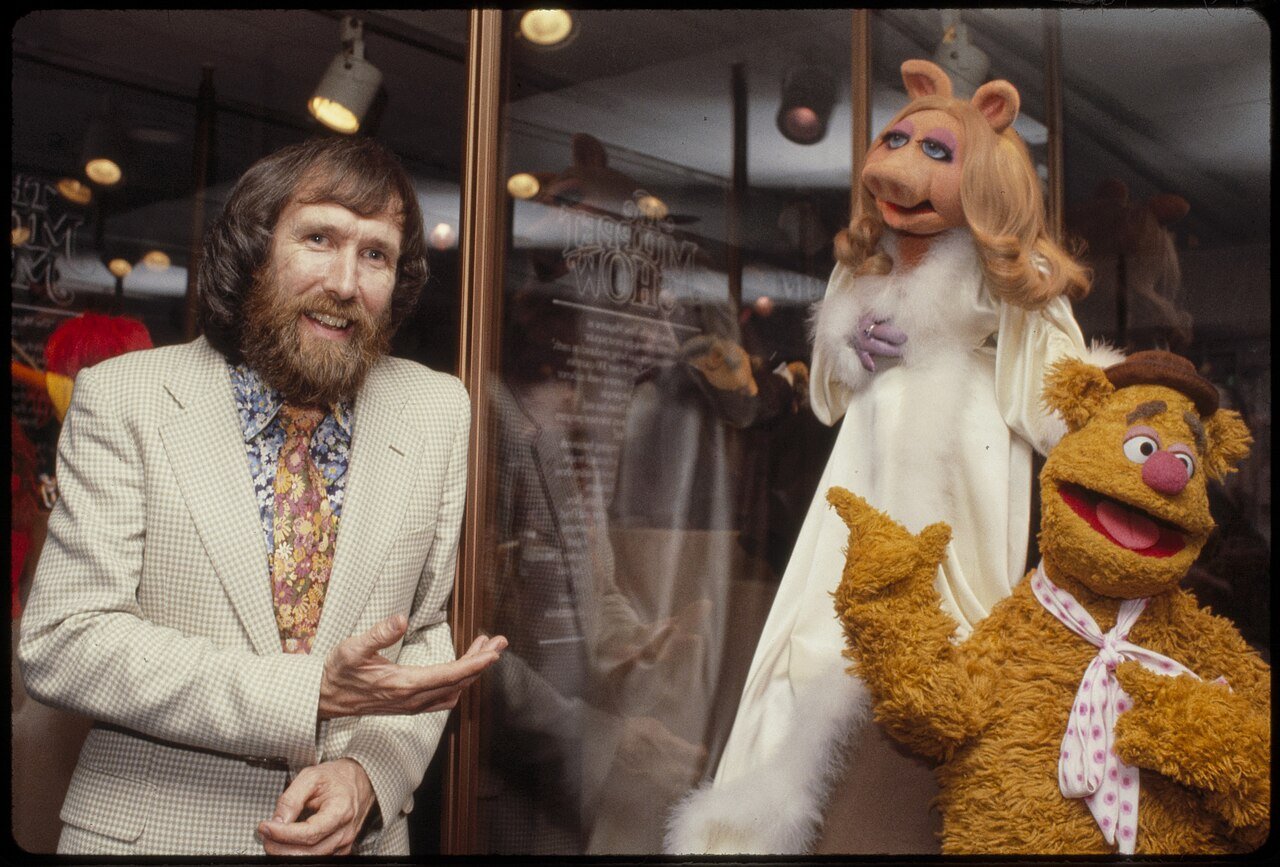
Before Kermit hosted a variety show from a fictional theater, he was a young television character on a local Washington program. That small beginning helps explain Jim Henson’s larger achievement: he treated puppets not as decorations or interludes, but as performers who could carry a scene.
Henson’s work moved between children’s television, comedy, music and film. Its familiar characters are part of the story, but so is the way he adapted puppetry to the camera. He helped make a handmade character feel at home in a close-up, a sketch or a song—and, eventually, beside human actors on screens around the world.
A television idea takes shape
Born in Mississippi in 1936, Henson grew up during a period when television was becoming a new kind of household entertainment. As a student at the University of Maryland, he began working in television in Washington, D.C. In 1955, he created Sam and Friends, a brief local show built around puppet characters. Kermit appeared in this early work, though the familiar frog’s design developed over time.
The show’s short format was a useful creative constraint. Characters had to make an impression quickly, and puppets had to be readable through the television camera. Henson and his collaborators developed designs and performances that made small movements matter: a turn of the head, a shift in posture, a mouth moving in time with speech. The effect was less like watching a puppet demonstration than watching a character respond.
That distinction depended on more than the puppet itself. A performer’s hand, voice and timing gave a character its presence; camera framing and editing helped audiences focus on that performance. Television could bring viewers close to the face and make a modest gesture feel expressive. Henson’s work took advantage of that intimacy.
Characters enter a wider world
Henson’s career was collaborative. Performers, writers, designers and builders helped shape the characters and the productions around them. His work with Sesame Street, which began in 1969, brought Muppet characters into a program designed to combine entertainment with early learning. The show’s format made room for songs, comedy and short segments, while recurring characters helped give it a recognizable world.
Henson performed several characters, including Kermit and Ernie, but the Muppets were never simply one performer’s act. Other puppeteers brought characters to life, and the creative work extended well beyond performance. Big Bird and Oscar the Grouch, for example, became closely associated with performer Caroll Spinney. The distinction matters: Henson’s influence came partly from building a creative environment in which a cast of distinct characters could work together.
That ensemble approach also shaped The Muppet Show, which began in 1976. The program framed the characters as a troupe putting on a variety show, complete with backstage mishaps and guest performers. Kermit served as the increasingly harried host, while the other Muppets supplied musical numbers, comic turns and interruptions. The structure gave the puppets a reason to share a stage—and gave the show room to shift between different kinds of performance.
Its comedy worked on more than one level. Children could enjoy the characters and the physical jokes; adults could recognize the familiar pressures of producing a show, managing a cast and trying to keep events on schedule. Human guests did not merely observe the Muppets. They joined the fictional performance, helping the puppet characters feel like members of the same entertainment world.
Beyond the variety-show stage
Henson also pursued projects that did not fit the usual Muppet comedy formula. The Dark Crystal (1982) and Labyrinth (1986) used puppetry and elaborate imagined settings to build fantasy films. Their scale made clear that Henson was interested in the medium as a way to create worlds, not just a way to deliver jokes.
These projects required teams of artists and technicians, and they belonged to a wider history of puppetry and practical effects. Henson’s contribution was not that he invented puppets, or that every production used the same technique. It was that he kept exploring what performance with designed characters could do across television and cinema.
That exploration had limits and trade-offs. Handmade characters require skilled performers, careful construction and production time. They do not become expressive by themselves. The work is visible in the coordination between a puppeteer’s movement and voice, the design of a face, and the choices made behind the camera. Henson’s productions made that technical labor serve the illusion of spontaneous character.
A legacy built by many hands
Henson died in 1990, aged 53. The characters and programs associated with him continued, carried forward by performers and creative teams. Their longevity can make it easy to remember the finished figures more than the people who animated them. Yet the central idea in Henson’s work was the relationship between the two: a character could feel vivid because an ensemble of people gave it thought, movement and voice.
That is why his story is not only about Kermit or a collection of well-known puppets. It is about recognizing television’s particular strengths—its close framing, repeatable formats and ability to bring performance into the home—and using them to make an unlikely cast feel present. Henson helped turn puppetry into a flexible form of screen acting, capable of moving from a quick sketch to a musical number, an educational segment or a fantasy film.
The result was a new kind of television performer: visibly handmade, unmistakably artificial, and still able to hold an audience’s attention as if there were someone on the other side of the screen.