For most of the space age, spacecraft have communicated with Earth using radio waves. The method is dependable, but the available bandwidth is limited: a probe may spend hours sending home a small collection of images, measurements, or engineering records.
NASA is now testing a different way to move information through deep space. Its Deep Space Optical Communications experiment, known as DSOC, uses a tightly focused laser beam rather than traditional radio. The demonstration is not a new internet for the planets, and it is not carrying messages for astronauts today. It is something more foundational: a test of whether future spacecraft can send far more data across the solar system.
So far, the answer has been encouraging. Attached to NASA’s Psyche spacecraft, DSOC has transmitted data across distances measured in hundreds of millions of miles. The experiment has shown that laser communication can work beyond the Moon and can deliver the kind of data rate that would make high-resolution science, video, and more complex robotic operations easier to support.
Why deep-space communication needs a new approach
Radio communication has carried humanity’s signals to every planet visited by spacecraft. NASA’s Deep Space Network, a worldwide system of large antennas, receives those faint transmissions and sends commands back to distant probes. Because the network operates around the clock from sites in California, Spain, and Australia, at least one station can generally see a spacecraft as Earth rotates.
But distance creates a severe communications problem. A signal spreads as it travels, and the amount of energy that reaches Earth becomes smaller. Spacecraft also have limited power, while their antennas and transmitters must fit within strict mass and size limits. The farther a mission travels, the more carefully engineers must balance science data against transmission time.
Optical communication offers a possible improvement. Infrared laser light has a much higher frequency than radio, allowing engineers to encode more information into a beam. A laser can also be made extremely narrow, concentrating energy in a specific direction instead of spreading it across a wider cone.
That narrowness is both the advantage and the central difficulty. A radio antenna can illuminate a relatively broad region of sky. A laser terminal must point with extraordinary accuracy at a receiver that may be millions of miles away, while both spacecraft and Earth continue moving through space.
A communications experiment riding with Psyche
DSOC launched in October 2023 aboard NASA’s Psyche spacecraft. Psyche’s main mission is traveling toward a metal-rich asteroid of the same name, but the spacecraft also carries the optical communications technology demonstration.
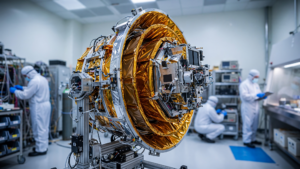
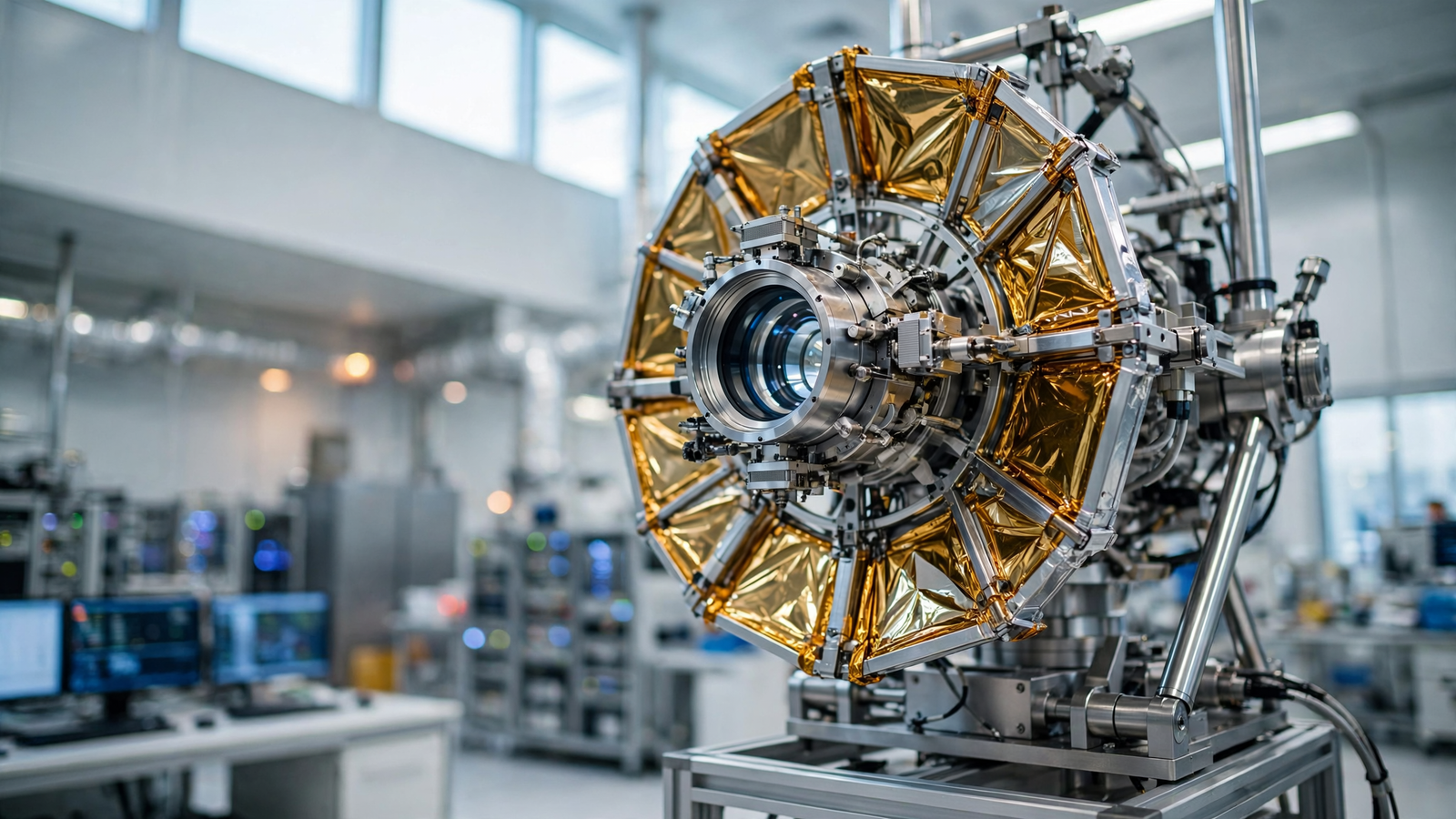
The experiment includes a laser transceiver mounted on the spacecraft, a powerful uplink laser at NASA’s Jet Propulsion Laboratory in Southern California, and a receiver telescope at Caltech’s Palomar Observatory. The ground equipment is designed to transmit and receive laser signals while also helping engineers determine whether the beam is correctly aligned.
In November 2023, DSOC completed its first successful “first light” test, sending and receiving data over roughly 10 million miles. That distance was already many times greater than the distance between Earth and the Moon. The test confirmed that the spacecraft could aim its laser toward Earth and that the ground system could acquire the signal.
A few weeks later, NASA transmitted a short ultra-high-definition video through the system from nearly 19 million miles away. The demonstration video showed a cat named Taters chasing a laser pointer, a playful subject chosen to make the achievement easy to recognize. The important point was not the content itself. It was that a high-quality video file had crossed deep space through an optical link.
NASA reported that the transmission took less than two minutes to reach Earth at the speed of light, while the data itself took considerably longer to arrive because of the system’s available rate and the file size. That distinction matters: laser communication does not make light travel faster. It increases the amount of information that can be carried in the signal.
From demonstration to distance record
As Psyche moved farther from Earth, DSOC continued testing the limits of the technology. In June 2024, NASA reported that the system had sent engineering data from a distance of nearly 140 million miles, approximately the distance between Earth and the Sun. Later tests pushed the communications link even farther as the spacecraft continued along its trajectory.
NASA described a December 2024 transmission from about 290 million miles away as the farthest successful demonstration of optical communications. At that distance, the spacecraft was roughly equivalent to more than 1,000 times the average Earth-Moon distance from the receiving system. The achievement showed that optical links could remain useful even when a spacecraft is operating across a large portion of the inner solar system.
These tests also did more than establish a record. Engineers studied how the system behaved as the beam traveled through space, how accurately the spacecraft could maintain its pointing, and how atmospheric conditions affected the signal once it reached Earth. Each test added information future mission designers can use when deciding whether to include laser communication.
The atmosphere is still part of the problem
Space is not the only environment that optical communications must overcome. Earth’s atmosphere can distort or weaken a laser beam. Clouds can block a ground station entirely, while turbulence can cause the signal to shimmer or spread.
DSOC addresses this by using a high-altitude laser transmitter and receiver at the JPL Table Mountain Facility, along with the Palomar telescope for receiving data. Mission planners can also use weather forecasts and geographically separated ground stations. A future operational network would likely combine optical terminals with radio systems, allowing a spacecraft to switch methods when clouds, pointing constraints, or other conditions make laser transmission difficult.
That hybrid approach is important. Laser communications are not expected to replace the Deep Space Network. Radio remains valuable because it is robust, well understood, and capable of supporting spacecraft in difficult conditions. Instead, optical links could add a high-capacity lane for data-heavy operations while radio continues to provide a dependable backup and command channel.
What more bandwidth could make possible
More bandwidth would directly benefit planetary science. Cameras could return larger images with finer detail. Spectrometers and radar instruments could send home more complete measurements. A mission studying a distant world could transmit more of the raw data that researchers use to check results and discover unexpected patterns.
Higher data rates could also improve robotic exploration. Rovers and landers might exchange richer maps with Earth, allowing scientists to evaluate a landscape in greater detail. Future spacecraft could send back more video of landings, sample collection, or geological activity. The goal is not simply to make space missions look better. Faster transmission can help scientists make decisions with more information and reduce the amount of valuable data discarded or heavily compressed.
For human exploration, the implications are potentially larger. Crews traveling beyond the Moon would need dependable communications for science, operations, health support, and contact with Earth. A laser system could help move large files, medical imagery, and high-definition video between spacecraft and ground stations. It would still face delays caused by the speed of light—minutes between Earth and Mars, depending on their positions—but greater bandwidth would make those delayed exchanges more useful.
NASA is also developing related optical communications systems for nearer destinations. The Lunar Laser Communications Demonstration, flown on the LADEE mission in 2013, showed that laser links could send data between the Moon and Earth. DSOC extends the challenge much farther, testing the technology at interplanetary distances where pointing, signal strength, and timing become more demanding.
A step toward an information-rich solar system
DSOC is a technology demonstration, not a permanent communications service. Its equipment was built to prove performance during Psyche’s cruise rather than to become a standard spacecraft subsystem overnight. Turning the experiment into an operational capability will require smaller terminals, compatible ground infrastructure, standardized procedures, and careful integration with existing radio networks.
Even so, the experiment marks a meaningful change in what future missions can imagine. Spacecraft have often been designed around the assumption that data is scarce and transmission time is precious. Optical communications could gradually loosen that constraint.
The deeper significance is not that a laser beam carried a short video of a cat across space. It is that a spacecraft traveling through the solar system demonstrated a new way to share what it sees. If the technology matures, future missions may return not just occasional snapshots, but fuller scientific records of distant worlds—helping Earth understand the solar system in greater detail and with less waiting for the next small packet of information.
Use: Mission overview, technology goals, equipment, and reported test results.
Use: First-light demonstration and early deep-space transmission details.
Use: DSOC distance milestones and the implications of optical communications for future missions.
Use: Spacecraft and mission context for the DSOC technology demonstration.
NASA — Deep Space Optical Communications — https://www.nasa.gov/mission/deep-space-optical-communications/ — Mission overview, technology goals, equipment, and reported test results.
NASA Jet Propulsion Laboratory — NASA’s First Deep Space Optical Communications Successfully Sends Data — https://www.jpl.nasa.gov/news/nasas-first-deep-space-optical-communications-successfully-sends-data/ — First-light demonstration and early deep-space transmission details.
NASA Jet Propulsion Laboratory — NASA’s Laser Communications Demo Hits Major Milestones on Way to Mars — https://www.jpl.nasa.gov/news/nasas-laser-communications-demo-hits-major-milestones-on-way-to-mars/ — DSOC distance milestones and the implications of optical communications for future missions.
NASA — Psyche Mission — https://science.nasa.gov/mission/psyche/ — Spacecraft and mission context for the DSOC technology demonstration.