For decades, supersonic passenger flight has faced the same stubborn problem: speed creates noise.
When an aircraft travels faster than sound, pressure waves join into a shock wave that reaches the ground as a sonic boom. The sound can rattle windows, disturb communities and make regulators reluctant to allow supersonic aircraft over land. NASA’s X-59 is an attempt to change that equation.
An airplane built around a quieter question
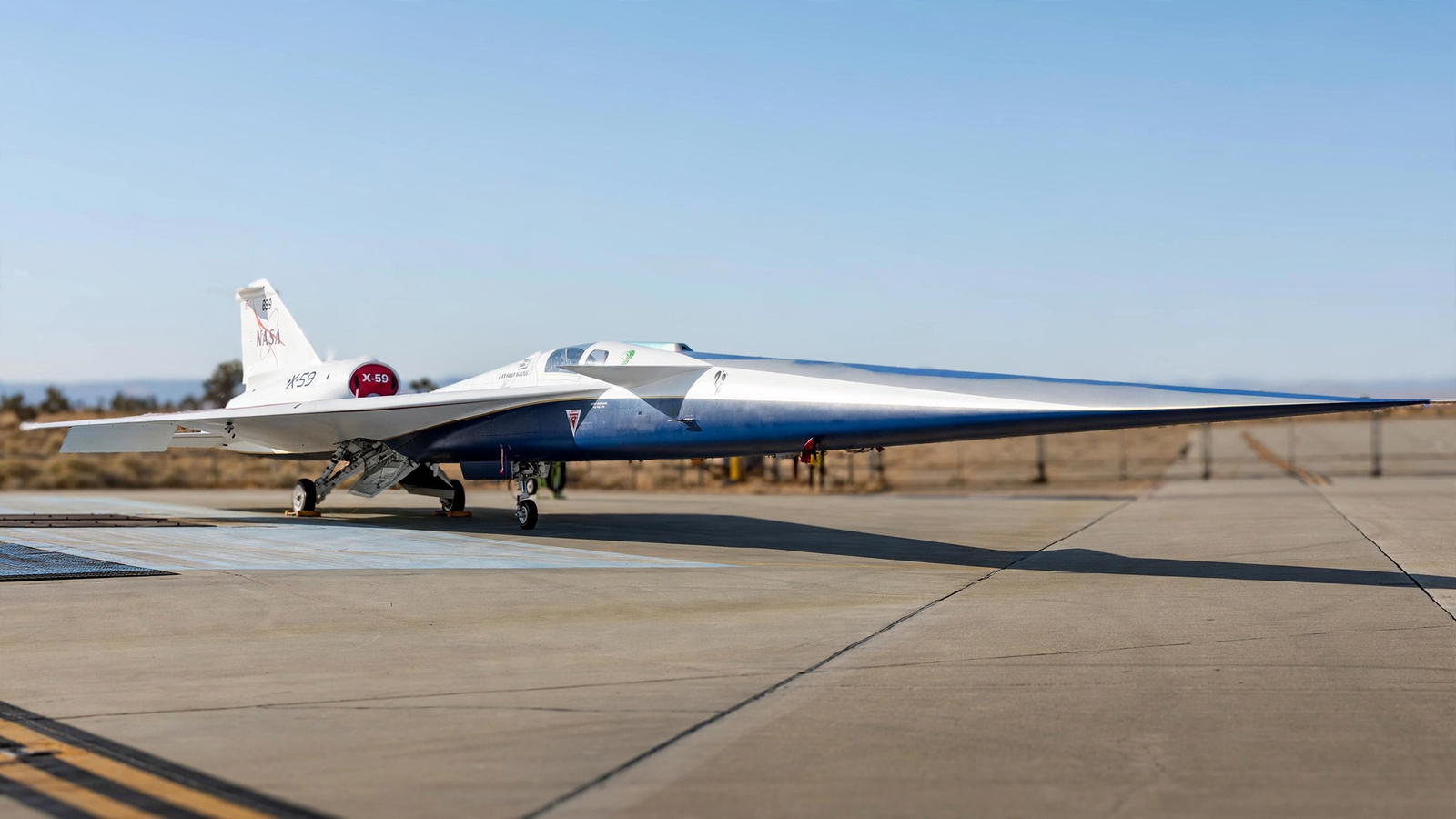
The X-59 is the centerpiece of NASA’s Quesst mission, a research program intended to find out whether supersonic flight can be made quiet enough for communities to accept. Rather than trying to eliminate the pressure waves entirely, engineers shaped the aircraft so those waves would be spread out and weakened before reaching the ground.
That unusual goal has influenced nearly every part of the aircraft. The X-59 has a long, narrow nose, a carefully contoured fuselage and no conventional forward-facing cockpit window. Instead, its pilot will use an external-vision system that combines cameras and displays to provide a view ahead.
The result looks less like a future airliner than a flying laboratory. That is deliberate. NASA is not building the X-59 as a commercial passenger aircraft. It is building a way to measure what a quieter supersonic overflight sounds like to people on the ground.
From the runway to the neighborhood
Before it can gather public reactions, the aircraft must demonstrate that it can operate safely. NASA and its industry partners have been moving the X-59 through ground testing, systems checks and preparations for flight testing at the agency’s Armstrong Flight Research Center in California.
Those tests are important because the mission depends on more than a promising shape. Engineers must verify the aircraft’s propulsion, flight-control systems, pilot displays and structural performance. The aircraft also needs to produce reliable, repeatable sound measurements during supersonic flight.
Once flight testing begins, NASA plans to fly the X-59 over selected U.S. communities. Residents will be asked to describe what they hear, while aircraft and ground instruments record the sound. NASA intends to provide that information to the Federal Aviation Administration and international aviation authorities.
Why a quieter boom matters
Current U.S. rules generally restrict civil aircraft from flying faster than sound over land because of the disturbance caused by sonic booms. If the X-59 demonstrates that a controlled “sonic thump” is acceptable to people on the ground, the research could give regulators better evidence for reconsidering those rules.
That would not automatically bring supersonic airliners back. New aircraft would still need to meet demanding standards for safety, fuel use, emissions, airport operations and economics. But a quieter aircraft could remove one of the largest barriers to fast commercial travel.
The wider significance of the X-59 is that it treats public acceptance as an engineering measurement. A successful flight will not be judged only by how quickly the aircraft crosses the sky. It will also be judged by what people below experience.
NASA’s experiment therefore points toward a different future for aviation: one in which speed is tested not just in the air, but in the neighborhoods beneath the flight path.