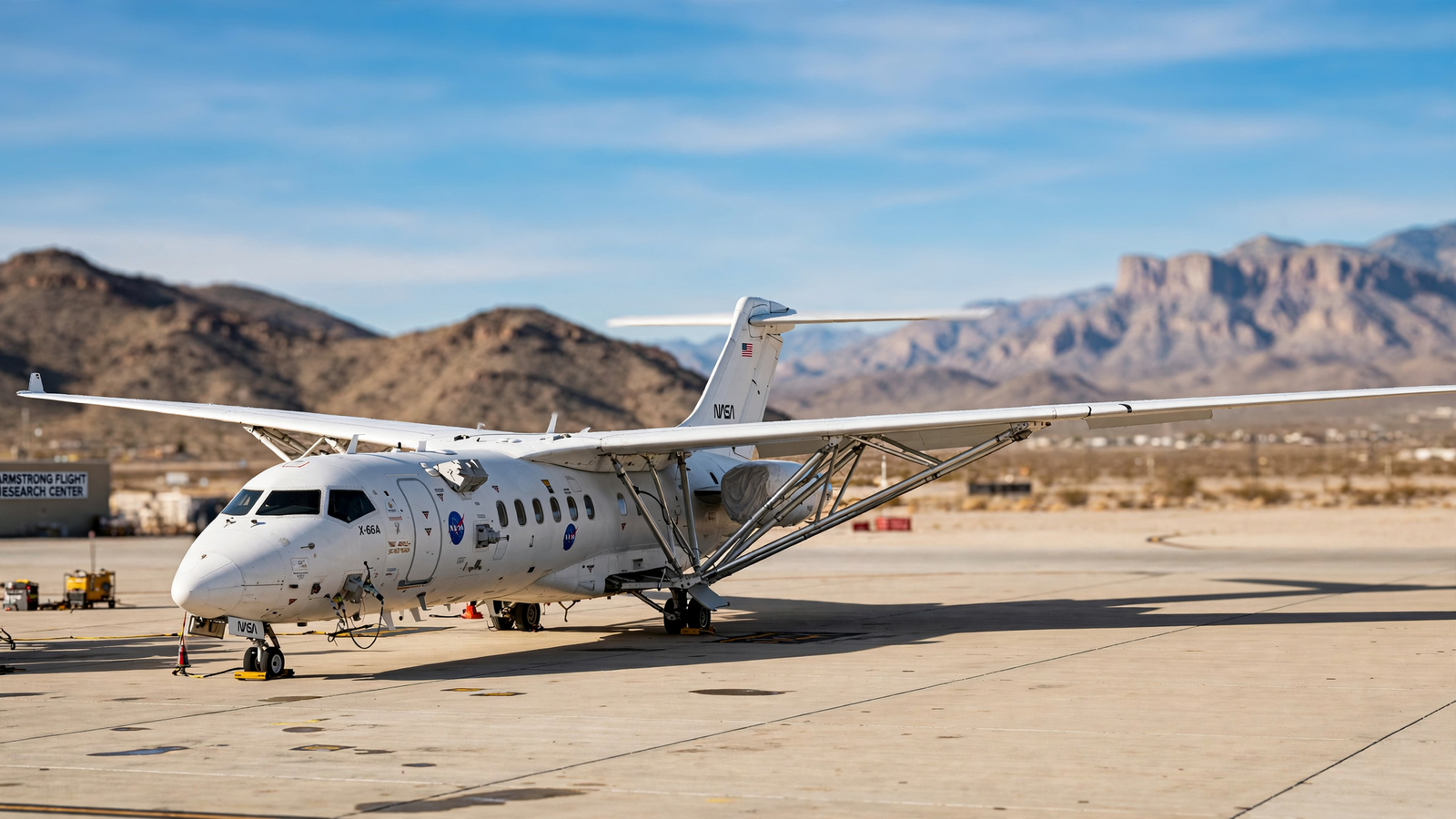
Commercial aviation is unlikely to become fully electric anytime soon. Passenger aircraft carry too much weight over too much distance for today’s batteries to replace jet fuel at large scale. That has made a different question increasingly important: how much more efficient can a conventional airliner become?
NASA’s answer is the X-66A, an experimental aircraft being developed with Boeing to test a new wing design for the single-aisle jets that carry millions of passengers every day. The project is part of NASA’s effort to reduce aviation emissions through changes to aerodynamics, propulsion and aircraft structure.
A wing built around a different idea
The X-66A is designed around a long, slender wing supported by diagonal struts. Known as a transonic truss-braced wing, the configuration allows the wing to be thinner and longer than a conventional airliner wing while using the brace to carry some of the structural loads.
That shape matters because a longer, thinner wing can create less drag during cruise. Lower drag means the engines do not have to work as hard to maintain speed, potentially reducing the amount of fuel the aircraft burns.
The concept is not simply a matter of stretching an existing wing. Engineers must balance aerodynamic gains against the additional weight and complexity of the truss, as well as the forces created during takeoff, landing and turbulence. The X-66A will give researchers a way to study those trade-offs in flight rather than relying only on computer models or wind-tunnel experiments.
Why the test aircraft is based on an MD-90
Boeing and NASA are using a modified MD-90 as the foundation for the demonstrator. The aircraft provides a practical test platform with the size and flight characteristics of a narrow-body airliner, while its existing structure can be adapted for the experimental wing.
That connection to a familiar airliner is important. The goal is not to put the X-66A into passenger service. Instead, engineers want to gather data that could influence a future generation of commercial aircraft, particularly the single-aisle jets used on domestic and short international routes.
NASA says the project is intended to help demonstrate technologies that could reduce fuel use and carbon emissions by as much as 30 percent compared with today’s best-in-class single-aisle aircraft. That figure is a program objective, not a result already demonstrated by the X-66A, and the final benefit will depend on the aircraft’s complete design, including its engines and operating system.
Testing one piece of aviation’s larger transition
The project illustrates why cleaner aviation is likely to arrive through several technologies rather than one dramatic replacement. Sustainable aviation fuel can reduce the carbon intensity of existing fleets. Improved engines can make better use of each gallon of fuel. New materials can reduce weight. Aerodynamic changes such as the truss-braced wing can reduce the energy required to push an aircraft through the air.
NASA and Boeing unveiled the X-66A design in 2024, and the aircraft remains a research demonstrator rather than a certified product. Before it can fly, the team must complete structural modifications, ground testing and the process required to ensure the aircraft is safe for experimental operations.
Its eventual flight campaign will therefore be watched for more than a single headline performance number. Researchers will be looking at how the wing behaves across different speeds, how it handles turbulence and maneuvering, and whether its efficiency gains can justify the engineering challenges of bringing the design to a full-size airliner.
If the concept works, the most important result may not be a new aircraft model. It may be a new set of design rules for the familiar jets that connect cities every day.