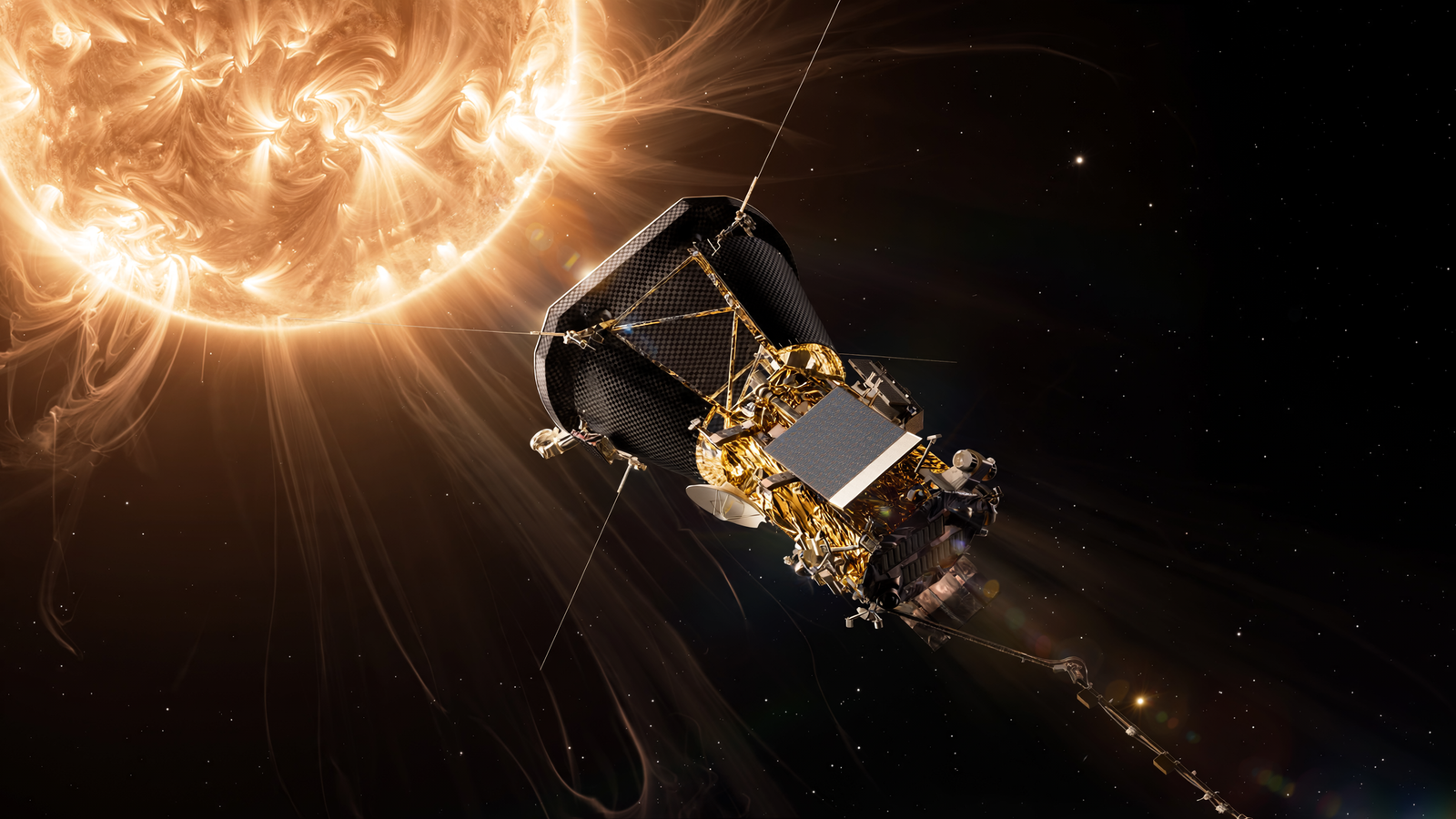
On Christmas Eve 2024, a spacecraft the size of a small car went closer to the Sun than anything humanity has ever built. For related reading, see Parker Solar Probe Has Touched the Sun—And It Is Sending Back New Clues.
NASA’s Parker Solar Probe passed about 3.8 million miles, or 6.1 million kilometers, above the solar surface while traveling at roughly 430,000 miles per hour. The distance sounds enormous by ordinary standards. In the scale of the solar system, however, it placed the probe inside the Sun’s outer atmosphere, a turbulent region called the corona.
The spacecraft was out of contact during the encounter. Mission controllers at the Johns Hopkins Applied Physics Laboratory had to wait for a signal that would confirm whether Parker had survived its closest pass. On December 26, NASA received the expected beacon signal. The probe was operating normally and had completed the most daring phase of its mission.
The achievement was not simply a record for distance. Parker had entered a part of the Sun that no spacecraft had previously explored so closely. Its instruments are designed to sample the particles, magnetic fields, and waves that escape from the corona and eventually spread throughout the solar system.
A journey built around repeated close calls
Parker Solar Probe launched in August 2018 from Cape Canaveral, Florida. Its mission required more than a powerful rocket. To reach the Sun, the probe needed to lose some of the sideways motion it inherited from Earth’s orbit. It accomplished that through a series of carefully planned encounters with Venus.
Each Venus flyby adjusted Parker’s orbit and brought its next solar approach closer. The spacecraft did not plunge directly into the Sun. Instead, it followed a long, narrow path that repeatedly carried it near the star and then back into space.
By late 2024, Parker had already made more than 20 close approaches. The December pass was the first of three planned encounters at its record distance. The next two were scheduled for March and June 2025, using nearly the same trajectory.
The mission’s namesake, astrophysicist Eugene Parker, proposed the existence of the solar wind in the 1950s. At the time, the idea that the Sun continuously sends a stream of charged particles through space was controversial. Parker Solar Probe was the first NASA mission named for a living person, honoring the scientist whose work reshaped the study of the Sun.
Why the Sun’s outer atmosphere is such a puzzle
The corona is one of the most counterintuitive places in the solar system. The visible surface of the Sun is about 10,000 degrees Fahrenheit, or roughly 5,500 degrees Celsius. Yet the corona above it reaches temperatures of millions of degrees.
Scientists know that magnetic fields are involved in heating the corona, but they are still working to identify the precise processes. Small-scale magnetic movements may release energy into the atmosphere. Waves moving through the plasma may also transfer heat. The competing explanations are difficult to test from Earth because the most important action occurs close to the Sun.
The corona is also where the solar wind begins. That wind is not a steady breeze. It includes streams of charged particles moving at different speeds, magnetic disturbances, and sudden eruptions. As the solar wind travels outward, it can interact with Earth’s magnetic field.
Those interactions can produce auroras, but powerful solar storms can also disrupt radio communication, satellite operations, navigation systems, and electrical networks. A better understanding of how the solar wind forms could improve forecasts of this space weather.
A shield made for an extreme environment
Parker survived its close approach because of a 4.5-inch-thick carbon-composite heat shield called the Thermal Protection System. The shield faces the Sun while the spacecraft’s instruments operate in its shadow.
During the December encounter, the front of the shield experienced temperatures of roughly 2,500 degrees Fahrenheit, or about 1,370 degrees Celsius. The spacecraft itself was designed to remain near room temperature behind the shield.
That arrangement required extraordinary precision. Parker travels through the inner solar system at immense speed, but its instruments still need to point in the right direction and collect data. The spacecraft uses an autonomous guidance system to keep the heat shield aligned with the Sun. If the probe began to drift, it could expose sensitive equipment to sunlight and suffer catastrophic damage.
The probe also carries a wide range of sensors. Some measure particles in the solar wind directly. Others examine electric and magnetic fields or photograph structures in the corona. A camera system called WISPR looks outward from behind the shield, allowing scientists to observe features such as coronal mass ejections and the solar wind’s complex streams.
What Parker has already changed
Parker did not wait until its record-breaking pass to produce important science. In 2021, NASA announced that the spacecraft had entered the corona for the first time, crossing the boundary where solar material is no longer held tightly to the Sun and begins flowing outward as solar wind.
That passage gave scientists direct observations of a region previously studied mainly through remote sensing. The probe detected structures in the magnetic field and helped identify how the solar wind changes as it leaves the Sun.
Earlier encounters also helped researchers study “switchbacks,” sudden reversals in the direction of the solar magnetic field. These zigzag-like features are carried outward by the solar wind. Parker’s measurements suggest that at least some switchbacks originate near the Sun rather than forming only after the wind has traveled through space.
The spacecraft has also helped scientists examine why the solar wind is not uniform. Some streams move relatively slowly and contain more complex structures. Others travel faster and appear to emerge from large open areas in the Sun’s magnetic field. The differences matter because they shape the space-weather environment experienced by planets and spacecraft.
A mission with Earthly consequences
Studying the Sun can sound remote, but solar activity is part of the operating environment for modern technology. Satellites depend on predictable conditions. Crews aboard spacecraft face increased radiation risks during major solar events. High-frequency radio links can weaken, and navigation signals can be affected.
In extreme cases, geomagnetically induced currents can travel through long electrical conductors on the ground. The effects depend on the strength and direction of the solar disturbance, as well as local infrastructure. Space-weather forecasting is therefore becoming part of the broader effort to protect communication, energy, and navigation systems.
Parker cannot prevent a solar storm, but its measurements can help make forecasts more physically grounded. The closer data are collected to the source, the better scientists can compare conditions near the Sun with what arrives at Earth several days later.
The probe is also contributing to a more complete understanding of stars beyond our own. The Sun is the only star close enough for spacecraft to sample its atmosphere directly. Learning how it produces winds, magnetic eruptions, and high-energy particles gives astronomers a reference point for interpreting activity around other stars.
The record is only part of the story
Parker Solar Probe’s closest approach is an engineering milestone, but the most valuable results will arrive as the spacecraft’s data are analyzed. The probe does not send every measurement to Earth immediately. Some data must be stored and transmitted when its position and communications schedule allow.
Its mission is expected to continue making close approaches through the end of its planned operations. Each pass offers another opportunity to compare the Sun’s behavior with the particles and magnetic fields measured nearby. The encounters also occur as the Sun moves through an active phase of its roughly 11-year cycle, giving researchers a chance to observe a more energetic star.
Humanity has photographed the Sun for centuries, watched it through telescopes, and built increasingly sophisticated models of its behavior. Parker Solar Probe adds something different: direct experience. It is carrying instruments into the region where the Sun’s influence begins, enduring heat and radiation so that scientists can study the star not from a safe distance, but from inside its most dynamic outer atmosphere.
The spacecraft’s record-breaking pass did not bring the Sun closer to Earth. It brought scientific observation closer to the source of the space environment through which Earth, its satellites, and future explorers travel.
Use: Mission history, spacecraft design, scientific goals, Venus flybys, and solar encounters.
Use: December 2024 closest approach, confirmation signal, speed, distance, and mission status.
Use: Mission engineering, instruments, thermal protection, and the probe’s scientific objectives.
NASA Science — Parker Solar Probe mission overview — https://science.nasa.gov/mission/parker-solar-probe/ — Mission history, spacecraft design, scientific goals, Venus flybys, and solar encounters.
NASA — Parker Solar Probe makes historic first pass by the Sun — https://www.nasa.gov/news-release/nasas-parker-solar-probe-makes-historic-first-pass-by-sun/ — December 2024 closest approach, confirmation signal, speed, distance, and mission status.
Johns Hopkins Applied Physics Laboratory — Parker Solar Probe — https://www.jhuapl.edu/missions/parker-solar-probe — Mission engineering, instruments, thermal protection, and the probe’s scientific objectives.