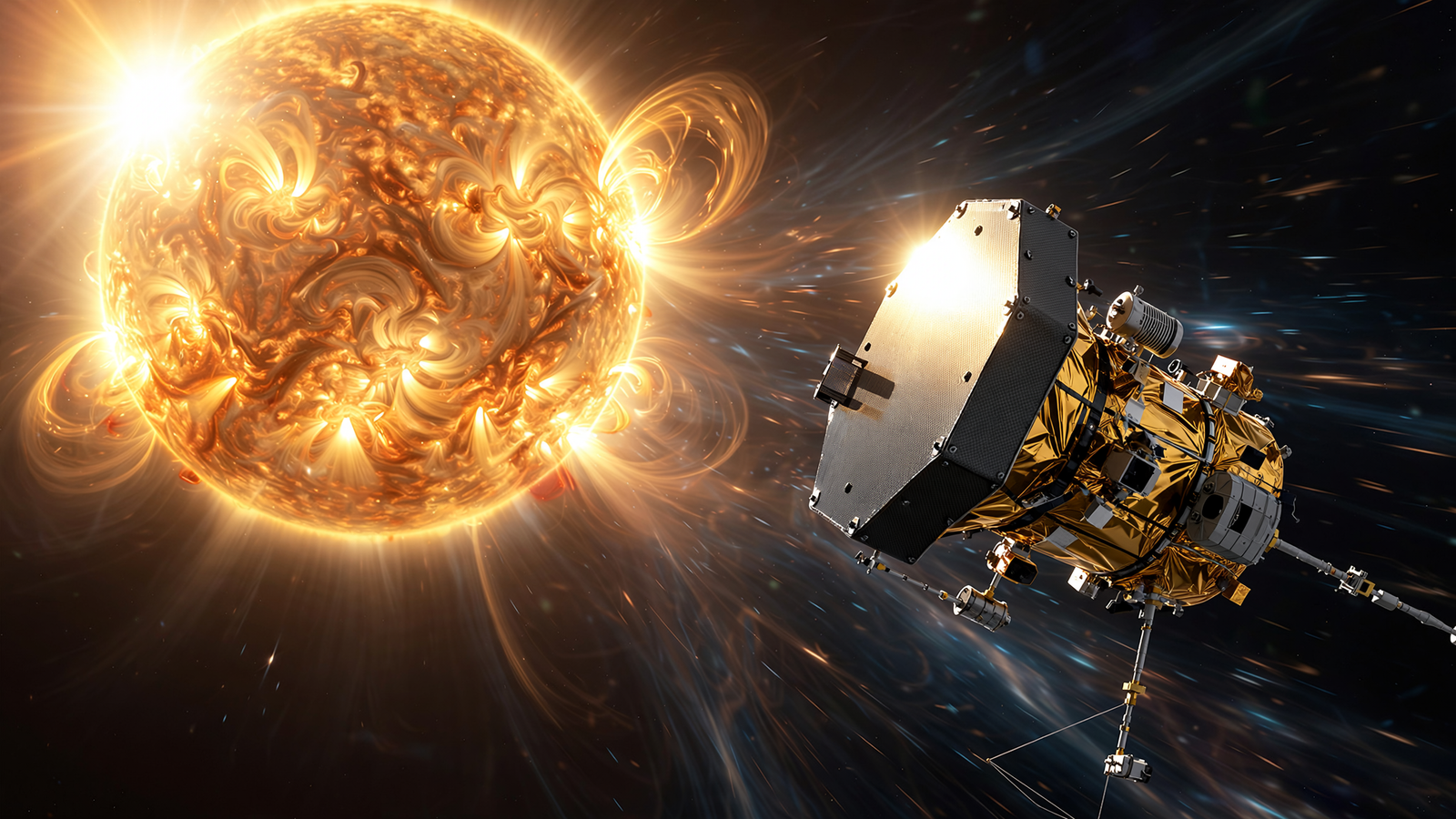
On December 24, 2024, a spacecraft built on Earth completed a journey that once belonged to science fiction: NASA’s Parker Solar Probe flew through the Sun’s outer atmosphere.
The probe passed about 3.8 million miles from the Sun’s visible surface—closer than any human-made object has ever traveled. At that distance, it was moving at roughly 430,000 miles per hour, making Parker the fastest object ever built.
NASA received confirmation that the spacecraft had survived the encounter several days later. The probe’s position meant that its radio signal was temporarily difficult to detect, but an expected “beacon” signal showed that Parker was healthy and continuing its mission.
A spacecraft designed to enter the corona
Parker Solar Probe launched in 2018 with a specific goal: to study the Sun’s corona, the thin, extremely hot atmosphere that extends millions of miles into space. The corona is much hotter than the Sun’s visible surface, a long-standing scientific puzzle known as the coronal-heating problem.
The corona is also where the solar wind begins. This constant flow of charged particles travels throughout the solar system and can affect satellites, astronauts, radio communications and electrical systems when powerful eruptions reach Earth.
By flying through the region rather than observing it from a distance, Parker can measure the particles and magnetic fields before they have been altered by their journey through space. Its instruments examine the solar wind, magnetic activity and structures moving through the corona. A camera system also images the environment around the spacecraft.
Why the mission matters on Earth
Solar storms are natural events, but modern society is increasingly dependent on systems that can be disrupted by space weather. Strong activity from the Sun can interfere with navigation signals, satellite operations and high-frequency radio. In extreme cases, it can induce currents in power networks.
Parker’s measurements will not stop solar storms. They could, however, help researchers understand how those storms form and improve predictions of when their effects may reach Earth. The mission is part of a broader effort to treat space weather as an environmental hazard that can be monitored and forecast.
Venus helped shape the route
Reaching the Sun required more than pointing a rocket toward it. Parker repeatedly used close passes by Venus to change its orbit and gradually swing closer to the Sun. Each maneuver reduced the spacecraft’s orbital distance and set up later record-breaking encounters.
The probe is protected by a roughly 4.5-inch-thick carbon-composite heat shield. Although the shield faces temperatures of more than 2,500 degrees Fahrenheit during the closest passes, the spacecraft’s instruments operate in a far more moderate environment behind it.
The December encounter was not the end of the mission. Parker is scheduled to make additional close approaches, allowing scientists to compare conditions at different points in the Sun’s activity cycle. Each passage adds another set of measurements from a place no spacecraft had reached before.
The achievement is therefore more than a distance record. Parker Solar Probe is turning the Sun from a distant object of observation into a nearby laboratory—and giving scientists new tools to understand the star at the center of our solar system.