Before climate graphics filled social feeds and environmental campaigns arrived in carefully branded digital packages, a movement had to find space on walls, windows, noticeboards and classroom doors. In the spring of 1970, that space became one of the first great stages of modern environmentalism. For related reading, see The WPA Poster: How the New Deal Put Art in Public Life.
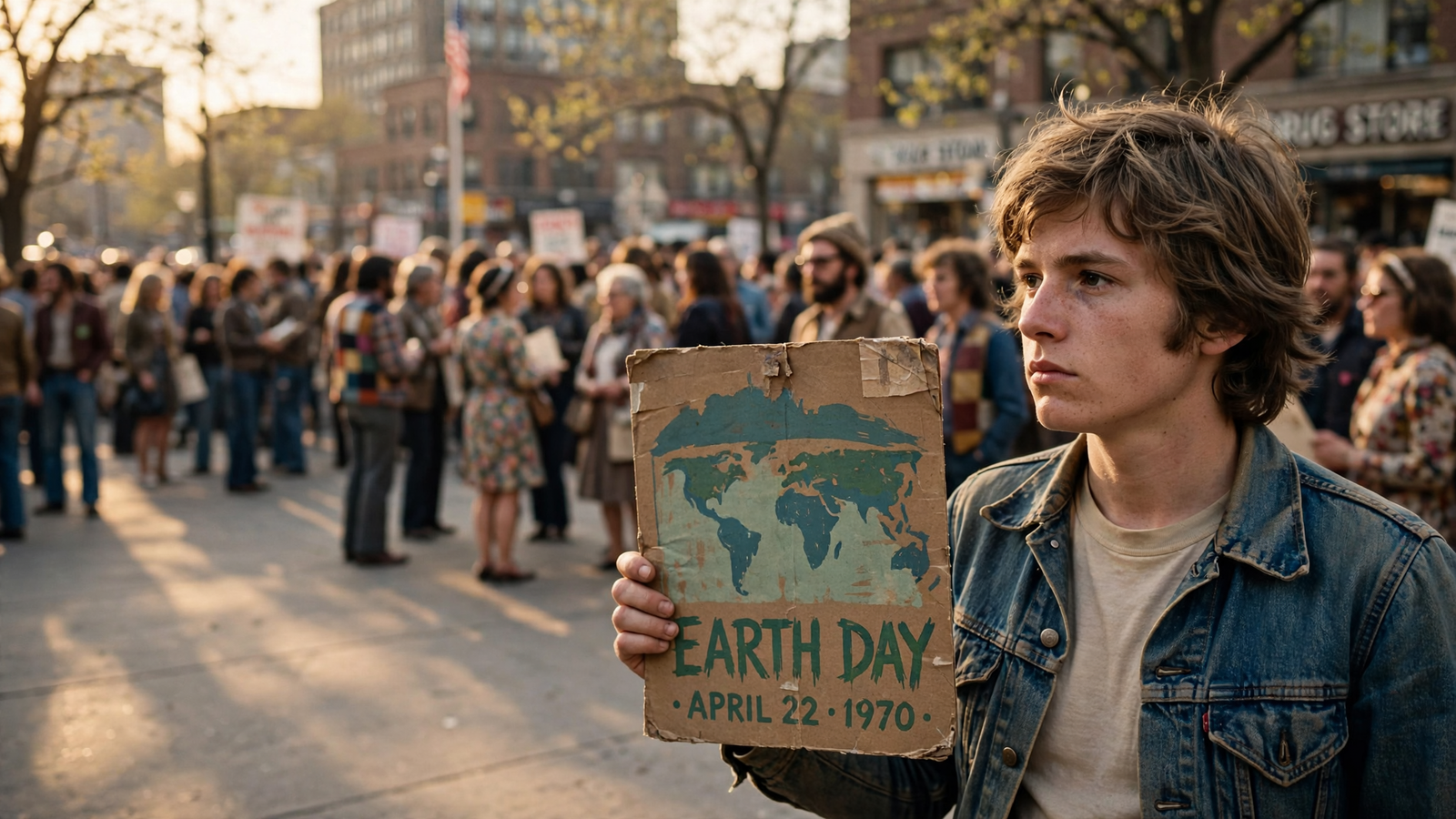
The first Earth Day was not a single march with a single symbol. It was a sprawling collection of rallies, teach-ins, lectures, clean-ups and demonstrations held across the United States on April 22, 1970. Posters and flyers helped give that decentralized event a public face. They announced meetings, named threats and made a new political vocabulary visible: pollution, ecology, endangered nature and the health of the planet.
That is what makes the Earth Day poster important as ephemera. It was not merely a souvenir of a famous date. It was part of the movement’s infrastructure—a cheap, reproducible object that helped strangers recognize that their local concerns belonged to a much larger story.
A movement assembled from many local voices
The idea for a national day of environmental action came from Senator Gaylord Nelson of Wisconsin, who had become increasingly concerned about air and water pollution. Nelson announced the plan in 1969 and recruited Denis Hayes, then a Harvard graduate student, to coordinate the event.
Hayes and the organizing network did not build Earth Day as a conventional national organization with one central program. Instead, they encouraged local groups, schools, universities and civic organizations to create their own events. That structure helped the campaign expand rapidly. According to the U.S. Environmental Protection Agency, an estimated 20 million Americans took part in the first Earth Day.
The range of activity was enormous. Some communities organized river clean-ups. Others held public hearings, street demonstrations, lectures or educational programs. Students challenged universities to address pollution and military research. Neighborhood groups discussed smog, pesticides, waste and the loss of open land.
A movement organized in this way needed more than a national announcement. It needed objects that could travel from one setting to another. A poster could be designed by a student group in one city, printed cheaply and placed wherever people gathered. It could transform a blank wall into an invitation, a warning or a declaration of belonging.
Why the poster was the right medium
Posters have always worked at the boundary between information and atmosphere. They need to be read quickly, often from a distance, but they also need to create a feeling strong enough to make people stop. For Earth Day organizers, that combination was especially useful.
The environmental movement was asking the public to think about systems that were difficult to see. Air pollution could be invisible. Chemical contamination might be detected only through testing. The consequences of industrial growth often appeared far from the factories, roads or products that produced them. A poster could condense those complicated relationships into one immediate visual question.
Many environmental posters from the period used familiar images of the Earth, trees, animals, water and human figures. Their visual language could be optimistic, alarmed, humorous or confrontational. Some treated the planet as a fragile home. Others emphasized the contrast between natural landscapes and industrial damage. Still others focused on participation, directing viewers toward a particular meeting or campus event.
That variety matters. There was no single official Earth Day design that controlled the movement’s meaning. The campaign’s visual culture developed through many local acts of production. Posters were made by organizers, student artists, print shops, schools and community groups. Their differences reflected the movement itself: part conservation campaign, part public-health argument, part youth revolt and part challenge to the assumptions of postwar industrial society.
From private complaint to public issue
Environmental concerns had existed long before 1970. Conservationists had spent decades defending forests, wildlife and public lands. Scientists had warned about pollution. Rachel Carson’s 1962 book Silent Spring had helped bring the ecological effects of pesticides into public debate.
What changed around Earth Day was the scale and political reach of the conversation. Pollution was increasingly understood not as a series of isolated local annoyances, but as a national problem connected to public policy, industrial practice and everyday consumption.
The poster was perfectly suited to that shift. It placed an issue in public view without requiring a newspaper subscription, a scientific background or attendance at a formal meeting. A passerby could encounter an environmental argument while walking across a campus or down a city street. The poster’s power came partly from its ordinariness: it entered the same visual field as concert notices, political announcements and commercial advertisements.
In that crowded field, environmental organizers had to compete for attention. The strongest designs often used a limited number of elements—a large image, a short phrase, a date, a place and perhaps the name of a sponsoring group. The format encouraged compression. Complex arguments became a single image or sentence that could be remembered after the viewer had moved on.
The paper trail of a turning point
Most posters were never intended to survive. They were printed for an event, taped to a wall and removed when the event was over. Some were discarded almost immediately. Others were folded into notebooks, saved by organizers or placed in institutional archives.
That fragility gives surviving Earth Day posters a special documentary value. They can reveal details that broad histories often flatten: which issues mattered to a particular community, how organizers described their audience and what visual ideas seemed persuasive at the time.
Collections at institutions such as the Library of Congress preserve posters and related printed material that help show how public campaigns communicated before the internet. Catalog records can place an item within a wider history of political printing, graphic design and popular education. The objects also sit alongside leaflets, brochures, buttons, photographs and event programs—the small pieces that made a national day possible at street level.
Seen together, these materials challenge the idea that Earth Day was created by one famous speech or one national office. The event depended on thousands of local decisions: someone booked a hall, another person contacted a speaker, a printer produced handbills and an artist made an image that could be understood in a glance.
Earth Day and the birth of modern environmental policy
The first Earth Day did not by itself create the modern environmental movement, but it demonstrated a public constituency for stronger environmental protection. Its visibility arrived during a period when federal institutions were beginning to change as well.
The National Environmental Policy Act was signed into law at the start of 1970. Later that year, the Environmental Protection Agency was established. The Clean Air Act was amended in 1970, and the Clean Water Act followed in 1972. The sequence had many causes, including scientific research, court cases, state action, congressional work and long-running conservation campaigns. It would be misleading to attribute all of those developments to one day of protest.
But Earth Day helped demonstrate that environmental protection could be a mass public concern. The posters contributed to that demonstration by making participation visible. A city covered in notices for rallies and teach-ins looked different from a city where pollution remained an individual complaint. The paper on the wall suggested that other people were paying attention too.
A design legacy that keeps changing
Earth Day posters belong to a period when offset printing, screen printing and inexpensive reproduction allowed small groups to circulate bold graphics without the resources of a major publisher. Their visual descendants can be found in later campaigns about recycling, toxic waste, nuclear power, climate change, biodiversity and environmental justice.
The medium has changed, but the basic task remains familiar. Environmental movements still need to turn technical or distant problems into issues that people can see, understand and act on. Today, a campaign image may circulate as a shareable graphic rather than a sheet of paper. It may be viewed on a phone rather than a campus wall. Yet it still performs the work that the early Earth Day poster performed: identifying a concern, gathering an audience and giving a movement a recognizable public presence.
The surviving posters are therefore more than graphic snapshots of 1970. They record the moment environmentalism learned to communicate as a mass movement. Their paper may be thin, their colors faded and their original notices long finished. But the central idea remains durable: public attention can begin with an image placed where people are already looking.
Use: Verified the origins of Earth Day, its April 22, 1970 date, the role of Senator Gaylord Nelson and Denis Hayes, and the estimated participation of 20 million people.
Use: Provided authoritative context for the development of federal environmental policy around 1970, including the National Environmental Policy Act and the creation of the EPA.
Use: Used to verify the existence of cataloged Earth Day-era poster and printed-ephemera material and to support discussion of posters as historical documents.
Use: Provided context for the major federal environmental-law changes surrounding the first Earth Day.
U.S. Environmental Protection Agency — The History of Earth Day — https://www.epa.gov/history/epa-history-earth-day — Verified the origins of Earth Day, its April 22, 1970 date, the role of Senator Gaylord Nelson and Denis Hayes, and the estimated participation of 20 million people.
U.S. National Archives — Earth Day and Environmental History resources — https://www.archives.gov/research/environmental-history — Provided authoritative context for the development of federal environmental policy around 1970, including the National Environmental Policy Act and the creation of the EPA.
Library of Congress — Posters and Prints search — https://www.loc.gov/pictures/search/?q=Earth%20Day%201970%20poster — Used to verify the existence of cataloged Earth Day-era poster and printed-ephemera material and to support discussion of posters as historical documents.
U.S. Environmental Protection Agency — Laws and Executive Orders — https://www.epa.gov/laws-regulations/summary-clean-air-act — Provided context for the major federal environmental-law changes surrounding the first Earth Day.