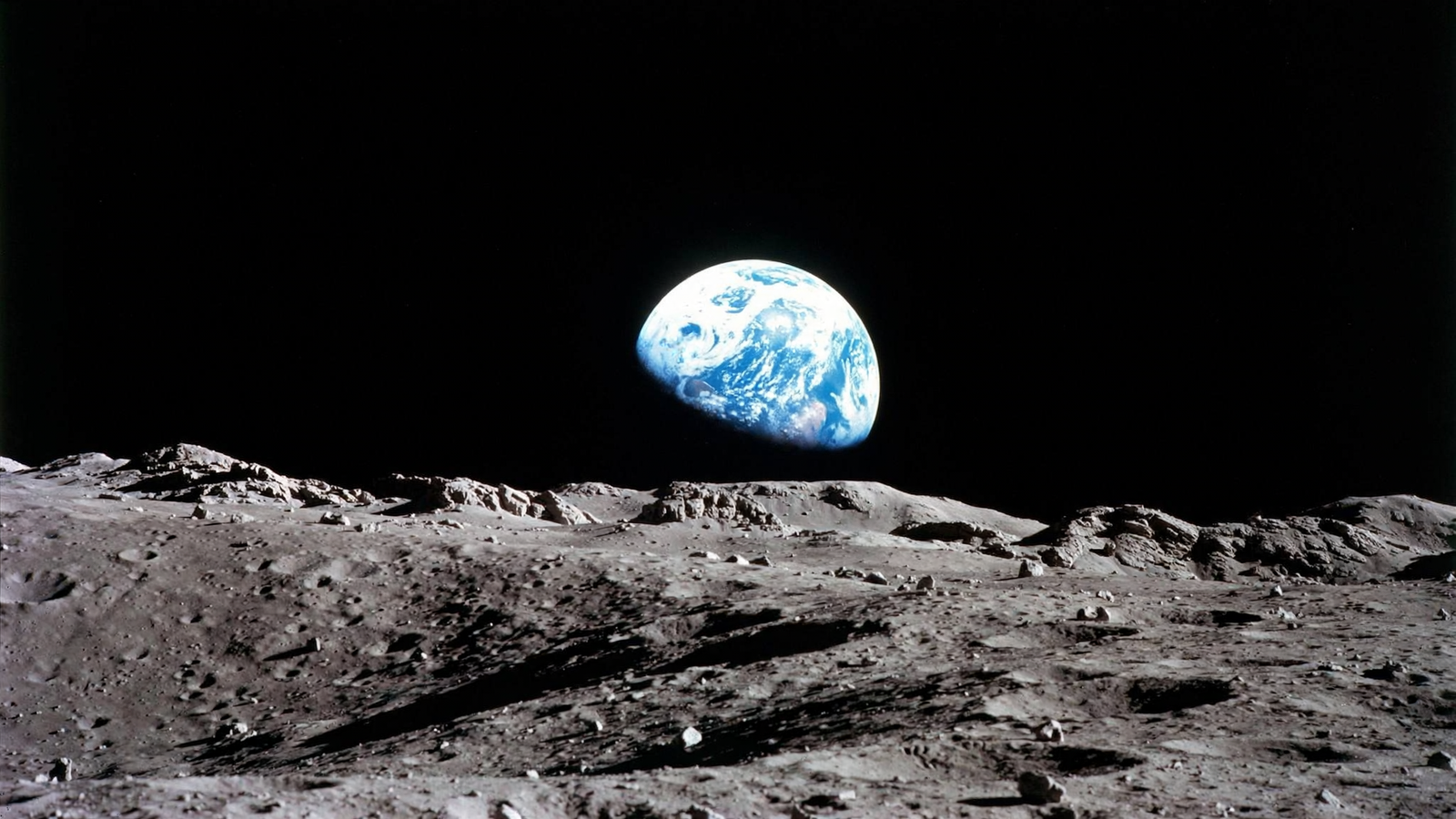
On Christmas Eve in 1968, three astronauts were farther from home than any human beings had ever been. Below them, the Moon’s gray surface slid past the windows of their spacecraft. Beyond it hung a small, bright Earth—blue, white, and visibly fragile against the darkness.
Frank Borman, James Lovell, and William Anders had not originally been assigned to make that journey. Apollo 8 was first planned as a test flight in Earth orbit. But a rapidly changing space program, an unfinished lunar module, and the pressure to move ahead led NASA to make a daring decision: send the crew all the way to the Moon.
The result was one of the most consequential missions in American history. Apollo 8 did not land astronauts on the lunar surface. It did something that came first: It carried human beings out of Earth orbit, around another world, and safely home again. Along the way, it gave the public the photograph known as “Earthrise,” an image that helped change how people imagined the planet they shared.
A mission that changed shape
When Apollo 8 entered planning, NASA’s immediate goal was more limited. The mission was intended to test the command and service modules in Earth orbit, while a later flight would practice operations nearer the Moon. The Apollo program was still recovering from the 1967 cabin fire that killed astronauts Gus Grissom, Ed White, and Roger Chaffee during a ground test.
NASA had also not yet flown a crewed Saturn V, the enormous rocket needed for a lunar mission. The agency’s first crewed Saturn V launch would be Apollo 8. That alone made the flight a major test of a machine whose scale and power had never been proven with astronauts aboard.
Then the schedule began to tighten. The lunar module planned for Apollo 8 was delayed, while the Soviet Union appeared to be preparing its own circumlunar mission. In August 1968, NASA managers proposed sending Apollo 8 to lunar orbit instead. The plan was approved in September, giving the crew only a few months to prepare for a mission far more demanding than the one they had expected.
The change carried serious risks. Apollo 8 would have to cross the 240,000-mile distance to the Moon, enter lunar orbit, navigate without the normal landmarks of Earth, and fire its engine at exactly the right time to return. If the service-module engine failed during the departure or return maneuvers, the crew could be stranded or miss Earth entirely.
There would also be no lunar module to serve as a backup spacecraft. The command module was the crew’s only way home.
The first crewed Saturn V flight
Apollo 8 lifted off from Kennedy Space Center in Florida on December 21, 1968. The Saturn V rose above the launch complex in a column of fire, carrying Borman, Lovell, and Anders inside the command module Columbia.
The first hours were a test of the rocket and the crew’s ability to operate in deep space. Once Apollo 8 was safely in Earth orbit, NASA controllers gave the command for the spacecraft to leave Earth. The powerful third-stage engine fired, accelerating the astronauts toward the Moon.
For much of the trip, the crew had little to see beyond the blackness of space and the changing crescent of Earth. Their spacecraft was traveling through an environment no human crew had experienced before. Radio signals took time to cross the distance, and the astronauts’ decisions had to be made within a carefully designed plan rather than with immediate support from the ground.
On December 24, Apollo 8 passed behind the Moon. The spacecraft was temporarily out of radio contact with Earth, and the crew performed the engine burn that placed them in lunar orbit. When communication returned, their voices confirmed that the maneuver had worked.
Apollo 8 circled the Moon ten times. The astronauts photographed the surface, studied possible landing sites, and gathered information that would help later crews prepare for a lunar descent. But they were also seeing something no human eyes had witnessed from that position: Earth rising above the lunar horizon.
How “Earthrise” became a defining image
The famous photograph was not a carefully staged public-relations moment. It happened while the spacecraft was moving around the Moon and the crew was looking through its windows.
As Apollo 8 came around from the far side, the astronauts saw Earth appear above the stark lunar landscape. Anders reached for a camera and color film. Borman later recalled that he helped orient the spacecraft so the scene could be photographed. The crew took several images, including the color frame that became one of the most reproduced photographs in history.
The photograph’s power came from its contrast. The Moon filled the foreground as a barren, ancient surface. Earth, by comparison, looked small and alive—a blue sphere wrapped in clouds, suspended in a black sky. It was not a picture of a national border or a single city. It showed the entire human home as one object.
Photographs of Earth had already been taken from space, including images from earlier robotic and crewed missions. Apollo 8’s achievement was different: It showed the planet from the vicinity of another world, with the Moon’s surface establishing a stark frame of reference. The image made distance visible. It also made Earth’s isolation impossible to ignore.
Later environmental writers and conservation movements would embrace “Earthrise” as a symbol of planetary unity. It would be wrong to claim that one photograph created the modern environmental movement by itself. But the image became part of a broader change in public consciousness during the late 1960s, when many people were beginning to think more seriously about pollution, resource limits, and the consequences of human activity.
A Christmas Eve message from lunar orbit
Apollo 8 reached the Moon at the end of a difficult year in the United States and around the world. The year had brought war, political violence, assassinations, social upheaval, and protests. Millions of people were watching the mission not simply as a technical achievement, but as a rare shared event.
On Christmas Eve, the astronauts made a live broadcast from lunar orbit. They described the Moon’s surface and read passages from the Book of Genesis. Their words were heard by an enormous worldwide audience, although estimates of the number of listeners vary. The broadcast ended with Borman offering a Christmas greeting on behalf of the crew.
The message was simple, but its setting gave it unusual force. Three people were speaking from hundreds of thousands of miles away while looking back at the same world occupied by everyone listening. The broadcast connected advanced engineering with an old human tradition: pausing to reflect on home.
Not everyone experienced the reading in the same way, and the mission also reflected the public institutions and cultural assumptions of its time. But the broadcast became part of Apollo 8’s historical meaning because it turned a dangerous test flight into a moment of collective attention.
The journey home
After completing its lunar orbits, Apollo 8 fired its engine again to leave the Moon. The maneuver placed the spacecraft on a return path to Earth. On December 27, the command module reentered the atmosphere and splashed down in the Pacific Ocean, where the crew was recovered by the aircraft carrier USS Yorktown.
The mission had lasted just over six days. No one had landed on the Moon, but the most difficult unknowns of a crewed lunar journey had been confronted: the Saturn V had carried astronauts beyond Earth orbit, the crew had entered and left lunar orbit, and a spacecraft had brought them safely back.
Apollo 8 did not make the landing possible by itself. Apollo 9 still had to test the lunar module in Earth orbit, and Apollo 10 would rehearse the landing approach near the Moon. Apollo 11 would finally put Neil Armstrong and Buzz Aldrin on the surface in July 1969. But Apollo 8 changed the sequence of what seemed possible. It transformed the Moon from a distant destination into a place humans were demonstrably capable of reaching.
Why Apollo 8 still matters
The mission is remembered for engineering, courage, and timing. It was a triumph of propulsion, navigation, communications, life-support systems, and thousands of decisions made by people on the ground and in space. It was also a reminder that history can turn on a change of plan.
Most of all, Apollo 8 changed the scale of the human story. The astronauts went to the Moon to gather information for a landing, but the image they brought back focused attention on Earth. The planet was no longer merely the place from which exploration began. It was the destination to which every explorer had to return.
More than half a century later, “Earthrise” remains recognizable because it compresses a vast idea into one frame: humanity is capable of traveling across space, yet every person, community, and country remains tied to the same small world. Apollo 8 made history by reaching the Moon. It endured in memory because, from there, it showed Earth in a new light.