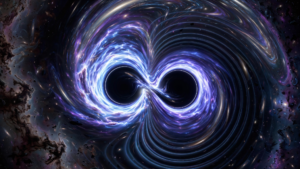
At first glance, the image looks like a glowing orange ring around a black center. But the first image of a black hole was not made by pointing one camera at the sky and pressing a shutter. It was reconstructed from radio signals recorded by observatories scattered across the planet.
The target was M87*, the supermassive black hole at the center of the galaxy Messier 87. In 2019, the Event Horizon Telescope (EHT) collaboration released the image, made from observations taken in April 2017. The result was a milestone in astronomy—and a striking example of how modern image-making can turn incomplete measurements into a picture.
A telescope the size of Earth, in a particular sense
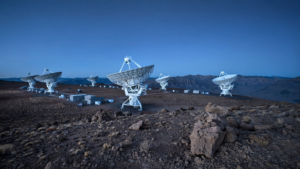
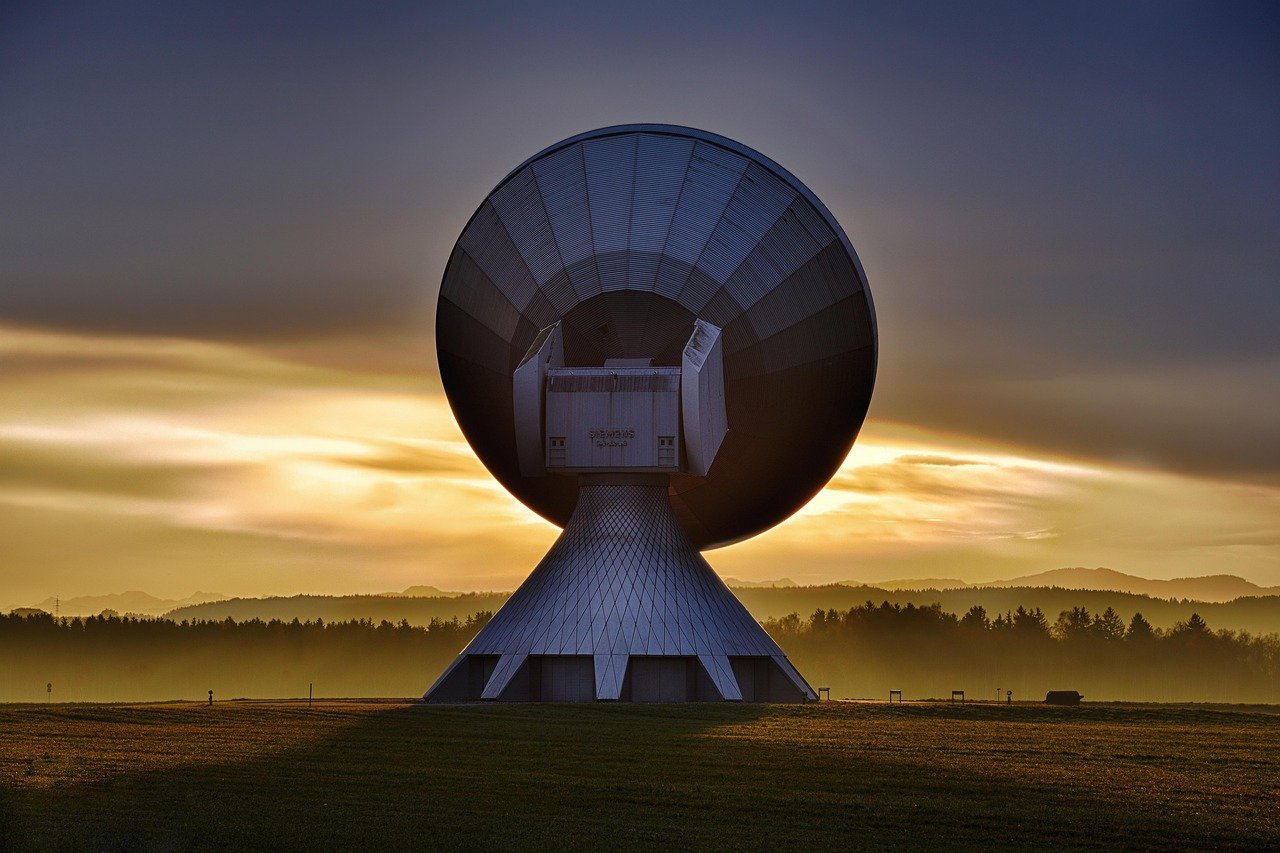
The EHT is a network of radio observatories, not a single instrument with a giant mirror. Its telescopes observed M87* at a radio wavelength of about 1.3 millimeters. By coordinating their observations and comparing the signals each site received, the researchers used a technique called very-long-baseline interferometry, or VLBI.
In interferometry, signals from separated telescopes are combined to gain detail that a single dish could not resolve. The greater the separation between observing sites, the finer the detail the network can potentially distinguish. Because the EHT’s stations span much of the globe, it can achieve resolution comparable to that of a telescope with an Earth-scale diameter. That is a useful shorthand, not a claim that the network acts like a solid, fully covered mirror: the sites are separated, and their measurements leave gaps.
Making the observations required precise timing. Atomic clocks recorded when the signals arrived, and large volumes of data were stored at the observatories. Since the data were too large to send over the internet at the time, hard drives were physically transported to processing centers. There, researchers used the timing information to align and correlate the recordings from different locations.
From measurements to an image
A radio telescope does not capture the familiar visible-light colors our eyes see. The EHT measured radio waves emitted by hot material around the black hole. Researchers then had to infer an image from the observations—a process more like solving a difficult reconstruction problem than developing a roll of film.
The network could not measure every detail of the target directly. The team therefore tested ways to turn its data into plausible images, using multiple independent groups and methods. The researchers compared the resulting reconstructions and checked whether different approaches produced the same broad structure. Their agreement gave the collaboration confidence that the ring-like feature was supported by the measurements, rather than being an artifact of one team’s choices.
That does not mean every pixel is a direct, unprocessed record of light. The final image is a scientific reconstruction, shaped by the observations and by methods designed to fill in what the telescope network could not measure. In this respect, it has more in common with other forms of computational imaging than with a simple snapshot. The image is not arbitrary, though: it is constrained by the recorded signals and tested against independent reconstructions.
What the orange ring shows—and what it doesn’t
The dark center is often described as the black hole’s “shadow.” A black hole itself does not shine like a lamp. The surrounding ring comes from hot gas and other material emitting radio waves close to the black hole. The black hole’s gravity bends light, while light that crosses the event horizon cannot escape. Together, these effects produce a bright structure around a darker central region.
The image does not show the event horizon as a photographed outline. The event horizon is the boundary beyond which nothing can return to a distant observer; it is smaller than the surrounding structure visible in the image. Nor is the orange color a natural visible-light color captured by the EHT. It is a color representation used to display the strength of the radio signal, translated into a form people can see.
M87* lies roughly 55 million light-years away and has a mass about 6.5 billion times that of the Sun, according to the EHT team’s analysis. Its enormous size, combined with its distance, made it a suitable target for an instrument designed to resolve exceptionally small angles on the sky.
A new kind of astronomical photograph
The 2019 image mattered for more than its first-of-its-kind status. The collaboration reported that the observed ring and central shadow were consistent with predictions from general relativity for an object of M87*’s mass. The result gave astronomers a new way to study a black hole’s immediate surroundings—not by seeing the black hole directly, but by measuring how nearby matter and light behave.
It also changed what “taking a picture” can mean. In conventional photography, a lens gathers light onto a sensor. The EHT’s image emerged from a global observing campaign, synchronized clocks, transported data, mathematical reconstruction and careful comparison among research teams. Its orange ring is not a snapshot in the everyday sense. It is a visual account built from measurements—and a reminder that some of the most revealing pictures in science are made by combining what no single instrument can see alone.