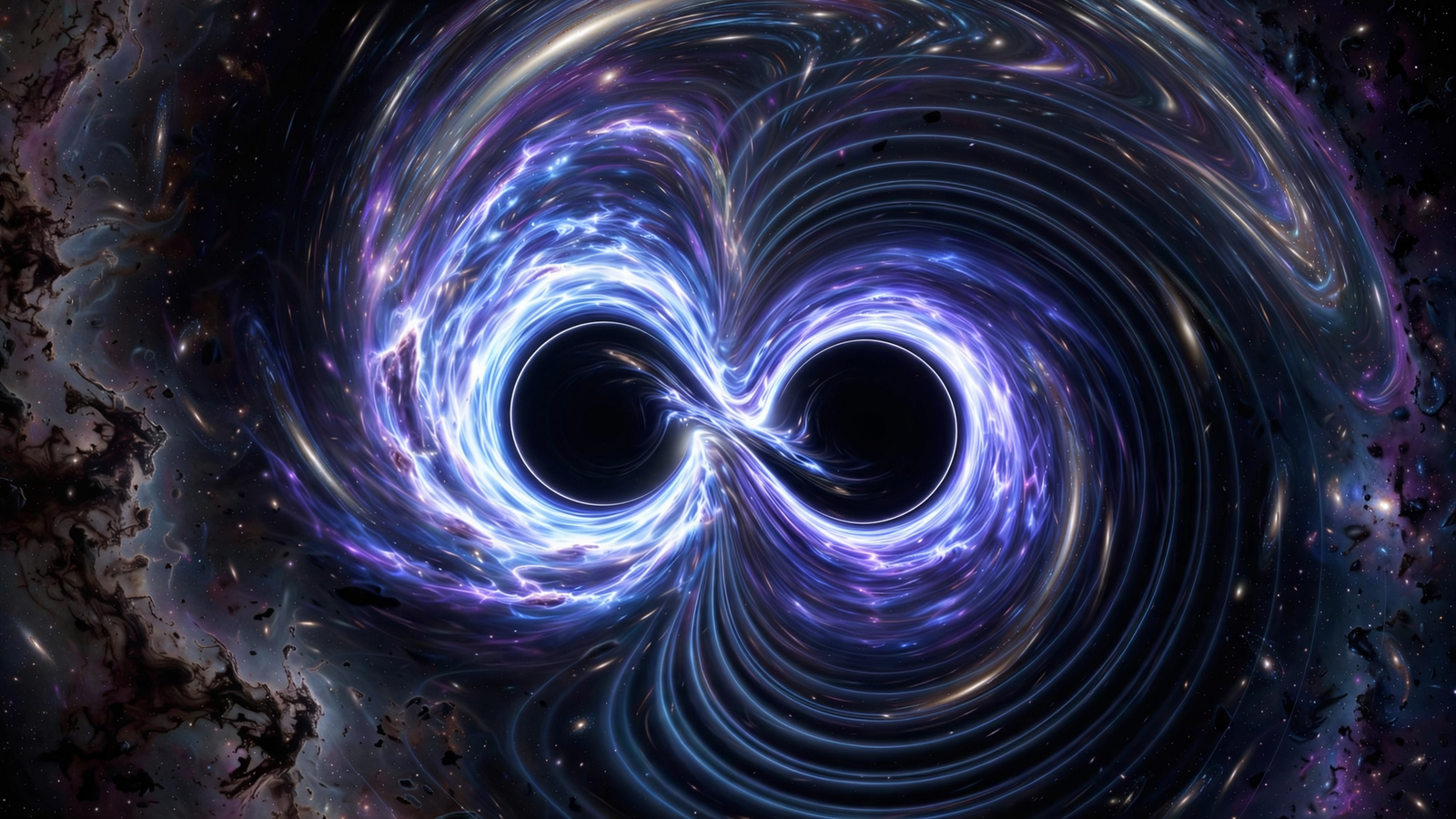
For a fraction of a second on September 14, 2015, two instruments in the United States registered a signal that had crossed the cosmos for more than a billion years. It was not light, radio or any other form of electromagnetic radiation. It was a minute stretching and squeezing of spacetime: a gravitational wave produced by two black holes spiraling together.
The event, named GW150914, marked the first direct detection of gravitational waves and the first observation of a pair of black holes merging. The finding, announced in February 2016, gave astronomers a new way to study the universe—not by collecting light, but by measuring the motion gravitational waves leave in their wake.
A prediction that took a century to test
Albert Einstein’s general theory of relativity describes gravity not as an invisible pulling force, but as a consequence of the shape of spacetime. Massive objects change that shape. When objects accelerate dramatically—such as two black holes orbiting each other—they can send ripples outward through spacetime. Einstein’s theory predicted these waves in 1916.
The prediction was difficult to test because the ripples reaching Earth are extraordinarily faint. A passing wave slightly changes the distance between objects, but by an amount far smaller than the width of an atomic nucleus across the length of a detector. Scientists needed a way to measure that change without mistaking it for the many vibrations and disturbances of everyday life.
The Laser Interferometer Gravitational-Wave Observatory, or LIGO, was built to do that. Its two observatories—one in Louisiana and one in Washington state—each use a laser interferometer with two four-kilometer-long arms. Laser light travels down the arms, reflects from mirrors, and returns to meet again. If a gravitational wave changes the arms’ lengths by different amounts, the returning light shifts in a measurable way.
That measurement is delicate. Ground motion, equipment noise and other disturbances can all affect the instruments. Having two observatories, separated by thousands of kilometers, helps researchers check whether a signal appears at both sites with a timing difference consistent with a wave traveling across Earth. GW150914 reached the Louisiana detector first and the Washington detector about seven milliseconds later.
The signal of a merger
The recorded signal rose and fell in frequency and strength in a pattern scientists call a “chirp.” That shape was a clue to what had happened. As two orbiting black holes lose energy through gravitational waves, their orbit shrinks and they circle one another faster. The waves grow stronger and higher in frequency until the black holes merge. The signal then fades as the newly formed black hole settles.
By comparing the data with predictions from general relativity, the research team concluded that the source was a pair of black holes. One was estimated to have about 36 times the Sun’s mass and the other about 29 times the Sun’s mass. Their merger formed a black hole of about 62 solar masses. The difference—roughly three solar masses—was released as gravitational-wave energy.
The signal was not a sound traveling through space; gravitational waves are changes in spacetime, not pressure waves moving through air. But scientists can convert the measured signal into audio. Played that way, the rising chirp gives people a direct, if transformed, impression of what the instruments detected.
A new kind of astronomy
Before LIGO’s discovery, astronomers had strong indirect evidence for gravitational waves. Observations of a pair of orbiting neutron stars showed that their orbit was shrinking in the way general relativity predicted, a result recognized with the 1993 Nobel Prize in Physics. GW150914 went further: it was the first time researchers directly measured a gravitational wave passing through Earth.
It also demonstrated that black-hole mergers could be observed with this approach. Black holes do not ordinarily shine like stars, so gravitational waves can reveal events that are difficult to study through visible light alone. The new method does not replace telescopes. Instead, it adds another way to investigate cosmic events, one that can detect the motion of massive objects even when their light offers little or no direct view.
The discovery depended on more than a single striking trace. Researchers tested how well the signal matched physical models, examined possible sources of noise and used the two detectors to confirm that the event appeared at both sites in the expected sequence. The collaboration’s published analysis reported that the signal was strong enough to meet the demanding standard used for a discovery.
GW150914 turned a century-old prediction into an observation. Its importance was not only that Einstein’s theory passed another test. The event showed that the universe carries information in gravitational waves—and that carefully tuned instruments on Earth can read it. A brief disturbance too small to see directly had announced the collision of two black holes, and made a previously inaccessible part of the cosmos observable.