For most of human history, the universe arrived as a narrow band of visible light: the glow of stars, the pale shape of planets, and the faint smudges of distant galaxies. Telescopes made that view sharper, but they did not make it complete.
The James Webb Space Telescope is changing the picture by observing a different part of the electromagnetic spectrum. Webb is built primarily for infrared astronomy, allowing it to see through some of the dust that hides stellar nurseries and to detect light stretched by cosmic expansion from the universe’s early history.
Launched on December 25, 2021, after decades of engineering and international cooperation, the telescope has become more than a successor to Hubble. It is a new kind of observatory, designed to investigate how the first galaxies formed, how stars and planetary systems take shape, and whether the atmospheres of distant worlds contain clues about their chemistry.
A telescope built to see what visible light misses
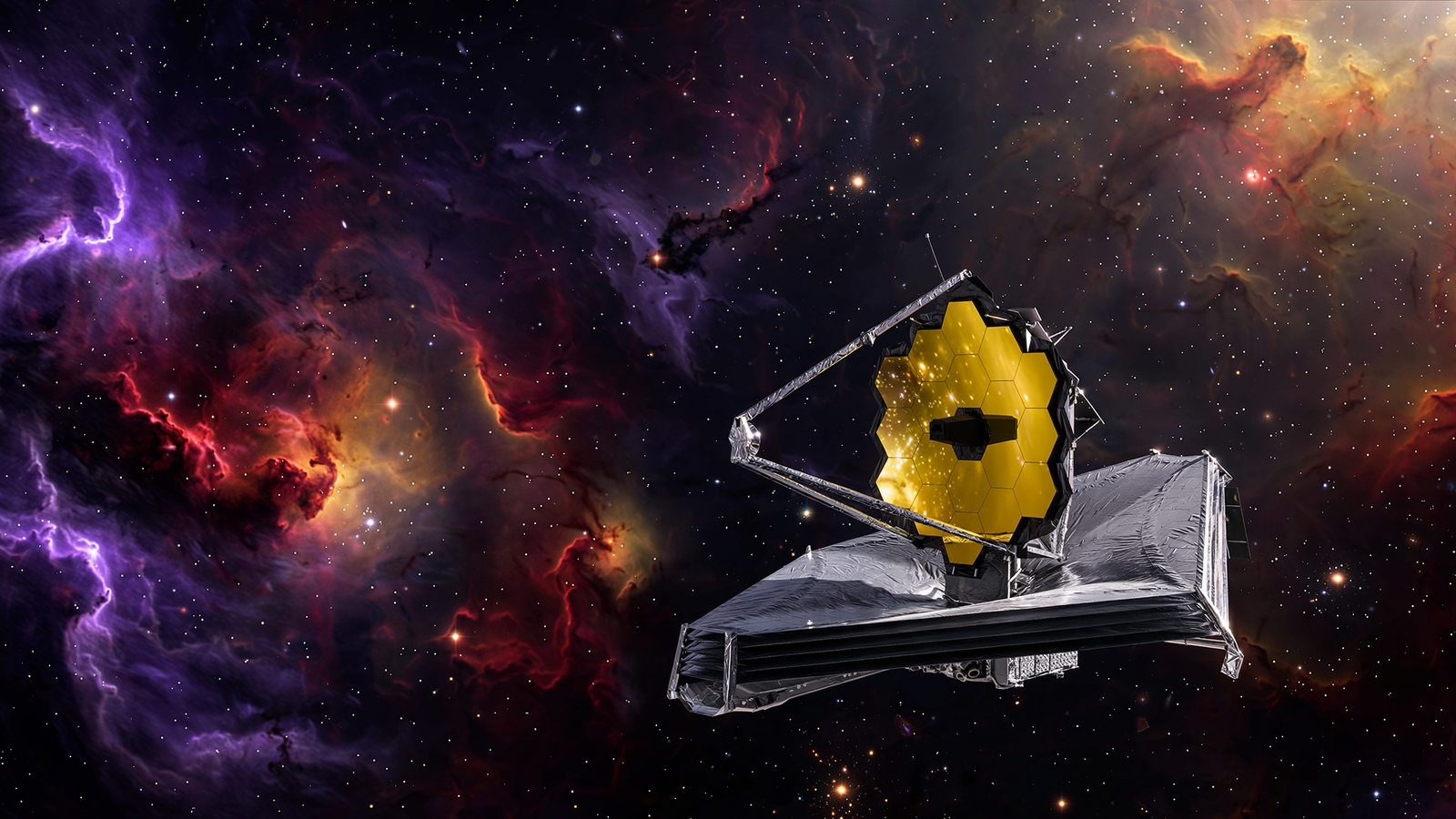
Webb’s scientific ambition required a different design from the one used by visible-light telescopes. Its primary mirror is made from 18 hexagonal segments coated in gold, a material chosen because it reflects infrared light efficiently. Together, the segments form a mirror about 6.5 meters across—far larger than Hubble’s primary mirror.
That size matters because a larger mirror can collect more light and distinguish finer detail. But Webb also had to remain extremely cold. Heat from the spacecraft itself would glow in infrared wavelengths and overwhelm the faint signals coming from space.
The solution was a five-layer sunshield roughly the size of a tennis court. It blocks light and heat from the Sun, Earth, and Moon while allowing the telescope’s instruments to cool to the temperatures required for sensitive observations. Webb operates near the second Sun-Earth Lagrange point, about 1.5 million kilometers from Earth, where it can keep the Sun and Earth on the same side of its sunshield. For related reading, see Bennu’s Dust: How NASA’s Asteroid Sample Is Rewriting the Recipe for Life.
Getting the observatory there was only the beginning. After launch, the telescope unfolded its sunshield, mirror, and other systems in a sequence involving hundreds of release mechanisms and many individual steps. Engineers then aligned the mirror segments so they could function as one precise optical surface.
Seeing the universe’s first chapters
One of Webb’s central questions is how quickly structure appeared after the Big Bang. The early universe was not filled with mature spiral galaxies like the Milky Way. It began as a hot, expanding mixture that gradually cooled, allowing the first stars and galaxies to emerge.
Light from those ancient objects has traveled for billions of years. As the universe expanded, the light’s wavelengths stretched toward the infrared. That phenomenon, called redshift, makes infrared observing essential for studying the distant universe.
Webb’s deep observations have identified galaxies from remarkably early cosmic times and given astronomers a more detailed look at their brightness, size, and chemical content. Some early galaxies appear brighter or more developed than many models had anticipated. That does not mean the basic story of cosmic evolution has been discarded, but it does show that scientists must refine their explanations of how the first stars formed and how efficiently young galaxies assembled.
The telescope is especially valuable because it does more than count distant points of light. Its spectrographs separate light into colors, or wavelengths, producing a chemical fingerprint. From those patterns, researchers can estimate the presence of elements and understand how stars changed their surroundings.
That evidence connects the earliest galaxies to the later universe. The heavier elements found in stars, planets, and living things were produced through generations of stellar activity. Webb is helping researchers examine the beginning of that process rather than studying only its finished results.
A clearer look at stellar nurseries
Stars are born inside enormous clouds of gas and dust. In visible light, the dust can appear opaque, hiding the young objects forming within it. Infrared light passes through some of that material, giving Webb access to regions that earlier images could show only as dark silhouettes.
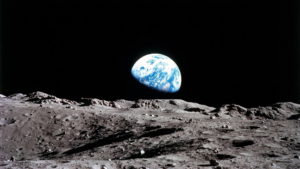
The result is not simply a prettier picture. Webb’s instruments can detect faint protostars, jets of material, disks around young stars, and the complex interactions between radiation and dust. These details help astronomers test ideas about how a cloud collapses, how a star gathers material, and how planets may emerge from the disk left around it. For related reading, see Apollo 8: How Three Astronauts Changed Humanity’s View of Earth.
Images of stellar nurseries have also shown how a star can shape its neighborhood. Powerful radiation and outflows can carve cavities through surrounding gas, compress some regions, and disperse material from others. Star formation is therefore not an isolated event. It is a cycle in which young stars alter the raw material available to the next generation.
Webb’s infrared vision is useful closer to home as well. Within our own galaxy, it can examine dusty regions and objects in the outer Solar System. Its observations of planets, moons, comets, and asteroids add another layer to the record of how the Solar System formed and changed.
Reading the air around distant worlds
Webb is also an observatory for exoplanets—planets orbiting other stars. It usually does not photograph these worlds directly. Instead, it studies the small changes in starlight that occur when a planet passes in front of its star or when the planet and star move through different parts of their orbit.
During a transit, some starlight filters through the planet’s atmosphere. Molecules in that atmosphere absorb particular wavelengths, leaving patterns that can be measured with a spectrograph. The patterns can reveal gases such as water vapor, carbon dioxide, methane, or other compounds, although interpretation depends on the planet’s temperature, clouds, chemistry, and the behavior of its host star.
These measurements are difficult. A planet’s atmosphere is tiny compared with its star, and stellar activity can imitate or obscure atmospheric signals. Webb does not provide a simple life detector. Instead, it gives scientists better tools to understand the physical and chemical conditions on worlds beyond the Solar System.
That distinction is important. The search for life requires multiple lines of evidence and careful study of how nonbiological processes can create similar gases. Webb’s contribution is to make the atmospheres of some distant planets measurable at a level that was previously out of reach. For related reading, see Webb Finds a Galaxy From the Universe’s First 300 Million Years.
An observatory designed for many questions
Although the telescope is famous for dramatic images, much of its scientific work produces data that looks less familiar: spectra, time series, calibrated measurements, and long exposures assembled from numerous observations. The images are a doorway into the science, but the deeper achievement is the ability to turn faint infrared light into evidence.
Webb’s program is shared among researchers around the world. Astronomers propose observations, and selected projects use the observatory’s limited time to investigate questions ranging from black holes and galaxy growth to star formation and planetary atmospheres. The data are eventually made available through scientific archives, allowing other researchers to analyze observations beyond the original projects.
That open archive gives the mission a long afterlife. A single observation can be reexamined as new methods are developed, or combined with data from Hubble, major ground-based telescopes, radio observatories, and future missions. Webb is not replacing every other kind of telescope; it is adding a powerful new sense to a larger astronomical network.
What Webb has changed
The James Webb Space Telescope has not delivered one final answer about the universe. Its importance lies in making previously hidden questions observable.
It has shown that the early cosmos contains more variety than a simple progression from darkness to mature galaxies would suggest. It has opened dusty stellar nurseries to closer inspection. It has made the chemistry of some exoplanet atmospheres a practical research subject. And it has connected engineering on Earth with events unfolding billions of light-years away.
Every major telescope changes astronomy by revealing that nature is more complicated than its earlier portraits. Webb is doing that across several scales at once—from molecules in a planet’s atmosphere to the first generations of galaxies. Its greatest discovery may not be a single object, but a new ability to see how the universe becomes the universe we know.
Use: Mission purpose, launch, observatory design, infrared astronomy, and scientific goals.
Use: Background on the telescope’s first publicly released science images and observing capabilities.
Use: Technical and operational background on Webb, its instruments, mirror, sunshield, and science programs.
Use: Independent mission background and explanations of Webb’s international partnership and scientific investigations.