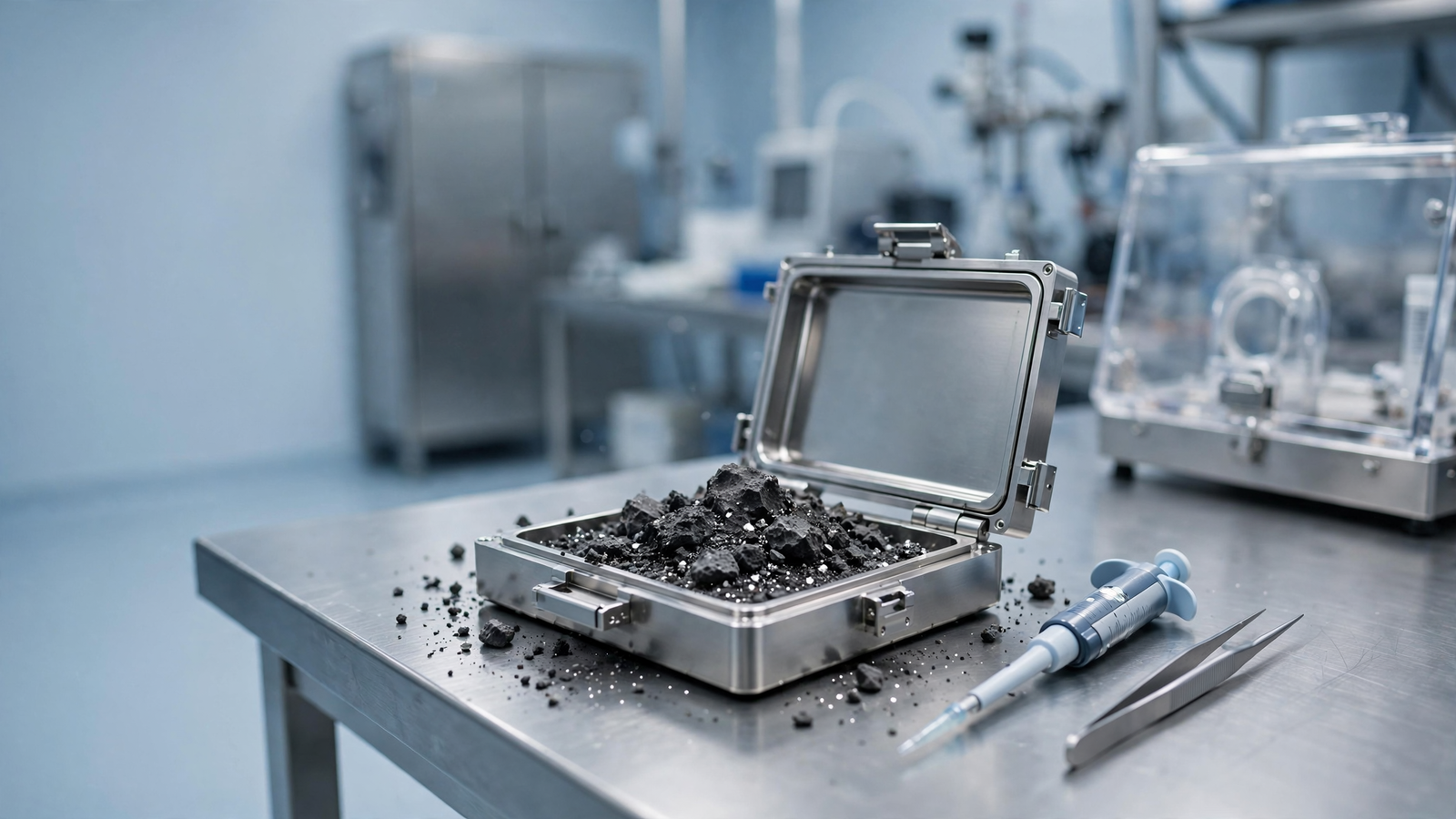
On a clear September morning in 2023, a small capsule crossed the Utah desert beneath a parachute. Inside was material collected from an asteroid nearly 200 million miles away—a dark, loose pile of rock called Bennu. For related reading, see DART: How NASA Turned an Asteroid Impact Into a Planetary Defense Test.
The return of that material marked the end of NASA’s OSIRIS-REx mission and the beginning of a different kind of exploration. For the first time, scientists had a substantial sample from a carbon-rich asteroid that had spent most of its existence traveling through space. They could handle it, divide it, test it with instruments around the world, and preserve portions for researchers who have not yet been born. For related reading, see NASA’s DART Mission Proved an Asteroid Can Be Nudged Off Course.
The result is more than a successful spaceflight. Bennu is becoming a natural archive of the early solar system, and its dust is helping scientists investigate one of the oldest questions in science: how did the chemical ingredients for life become available on Earth? For related reading, see NASA’s X-66A Is Redesigning the Airliner Wing for a Lower-Carbon Future.
A mission built around a handful of rock
OSIRIS-REx launched from Cape Canaveral in September 2016. Its destination, asteroid 101955 Bennu, is only about 500 meters wide, but reaching and studying it required years of navigation. The spacecraft arrived in 2018 and spent months mapping the asteroid’s surface before selecting a landing site.
Bennu was not a smooth, solid boulder. Images showed a rugged “rubble-pile” world covered with rocks, ridges, and unexpectedly rough terrain. The spacecraft’s team originally expected a relatively open surface. Instead, they had to search for a safe patch small enough for the spacecraft’s sampling arm to reach.
On October 20, 2020, OSIRIS-REx briefly touched the surface at a location named Nightingale. Its sampling mechanism released a burst of nitrogen gas, stirring up loose material and pushing some of it into a collection chamber. The spacecraft then began its journey home.
The capsule returned to Earth on September 24, 2023. NASA had set a minimum collection goal of 60 grams. The mission ultimately delivered 121.6 grams—more than twice the target and the largest asteroid sample ever brought to Earth.
Why Bennu matters
Asteroids are leftovers. When the solar system formed about 4.6 billion years ago, dust and rock gathered into larger bodies. Planets, moons, and asteroids emerged from that process, but many asteroids remained relatively small and geologically simple. They did not undergo the same extensive melting and reshaping that transformed Earth.
Bennu is especially valuable because it is rich in carbon and contains minerals that formed or changed in the presence of water. It is also a near-Earth asteroid, which made it reachable by spacecraft and allowed scientists to study it in detail before the sample was collected.
Researchers are not treating Bennu as a time capsule that has remained perfectly untouched. Sunlight, radiation, impacts, and the asteroid’s own history have altered its surface. But a returned sample still provides a far more precise record than remote observation alone. In a laboratory, scientists can examine individual grains, map their chemistry, identify their crystal structures, and compare separate particles that may have formed in different places or at different times.
Water left its signature
One of the first broad findings was that Bennu’s material contains evidence of water-related chemistry. That does not mean the asteroid held rivers or oceans. Instead, water appears to have interacted with minerals in the larger parent body from which Bennu’s rubble eventually formed.
That distinction is important. Water is not itself proof of life, but it is central to the chemical pathways that can make complex molecules and move them through an environment. On Earth, water helps transport elements, reshape minerals, and bring chemical ingredients together.
Scientists also identified phosphate-bearing material in the returned sample. Phosphorus is essential to biology: it helps form DNA and RNA, contributes to cell membranes, and participates in the molecule systems that store and transfer energy. The presence of phosphate minerals does not explain how life began, but it gives researchers another piece of the environmental puzzle.
The chemistry suggests that Bennu’s parent body experienced conditions in which water and rock interacted for a period of time. That finding connects the asteroid to a broader question about the young solar system: whether small bodies helped distribute water and chemically useful material among the planets.
The ingredients are not life
Analyses of Bennu samples have also found a wide range of organic compounds. Scientists reported amino acids, which are used by living organisms to build proteins, along with the five nucleobases used in DNA and RNA. Other studies have identified compounds such as ammonia and formaldehyde that can participate in prebiotic chemistry.
These discoveries are exciting precisely because they stop short of claiming that life was found. Amino acids and nucleobases can be produced by nonliving chemical processes. Their presence on Bennu shows that the raw materials of biology were available in parts of the early solar system; it does not show that organisms existed there.
That careful boundary is one of the strengths of the mission. Scientists can now study how complex chemistry emerges without confusing complexity with biology. The question becomes more precise: under what conditions do simple molecules become more organized, more abundant, or more capable of supporting further chemical change?
A sample designed to outlast the mission
Returning the material was only half the job. The sample must also be protected from contamination and made available for generations of research.
NASA’s curation team at Johnson Space Center began opening the capsule in a controlled environment filled with nitrogen. The inert gas helps prevent Earth’s oxygen and moisture from reacting with the material. Scientists also track where each grain goes, creating a detailed inventory that allows results from different laboratories to be compared.
Some material has been distributed to research teams, while portions remain preserved. That long-term approach matters because scientific instruments continue to improve. A particle that can answer one question today may reveal something entirely different when examined with a more sensitive technique decades from now.
The mission also established a practical model for future sample returns. Researchers have learned how to collect material from a weak, uneven surface, how to handle a sample with many different grain types, and how to coordinate analysis across institutions and countries.
What comes next
OSIRIS-REx did not end when the capsule landed. After releasing its sample return capsule, the spacecraft continued into a new mission called OSIRIS-APEX. It is traveling toward the asteroid Apophis, which will make a close approach to Earth in 2029. The spacecraft is expected to study Apophis after the encounter, although it was not designed to collect another sample there.
Meanwhile, Bennu research will continue on Earth. Scientists are examining the sample’s organic molecules, minerals, isotopes, and microscopic structures. Each line of evidence can help distinguish what formed in Bennu’s parent body from what happened later as the asteroid traveled through space.
The broader significance is easy to miss amid the technical details. NASA spent years sending a spacecraft to a small, dark object, touching it for seconds, and bringing home a quantity of material that could fit in a coffee mug. That modest-looking payload is now opening a laboratory window onto the solar system before Earth had settled into its present form.
Bennu cannot tell scientists exactly how life began. But it can show what ingredients were present, how water altered them, and how far chemistry can go before biology enters the story. In that sense, the asteroid sample is not a final answer. It is a better beginning.
Use: Mission history, Bennu rendezvous, sample collection, and return to Earth.
Use: Initial findings on carbon-rich material, water-related minerals, and the scientific importance of the Bennu sample.
Use: Sample handling, contamination control, cataloging, and distribution.
Use: Mission science background and the role of the University of Arizona team.
Use: Peer-reviewed research on phosphate-bearing material and water-related alteration in Bennu’s returned sample.
NASA — OSIRIS-REx Mission — https://science.nasa.gov/mission/osiris-rex/ — Mission history, Bennu rendezvous, sample collection, and return to Earth.
NASA — NASA Releases First Analysis of Asteroid Sample — https://www.nasa.gov/missions/osiris-rex/nasa-releases-first-analysis-of-asteroid-sample/ — Initial findings on carbon-rich material, water-related minerals, and the scientific importance of the Bennu sample.
NASA Johnson Space Center — OSIRIS-REx Curation — https://curator.jsc.nasa.gov/osirisrex/ — Sample handling, contamination control, cataloging, and distribution.
University of Arizona — OSIRIS-REx Mission — https://www.lpl.arizona.edu/osirisrex — Mission science background and the role of the University of Arizona team.
Nature — Phosphate in the asteroid (101955) Bennu — https://doi.org/10.1038/s41586-024-07353-1 — Peer-reviewed research on phosphate-bearing material and water-related alteration in Bennu’s returned sample.