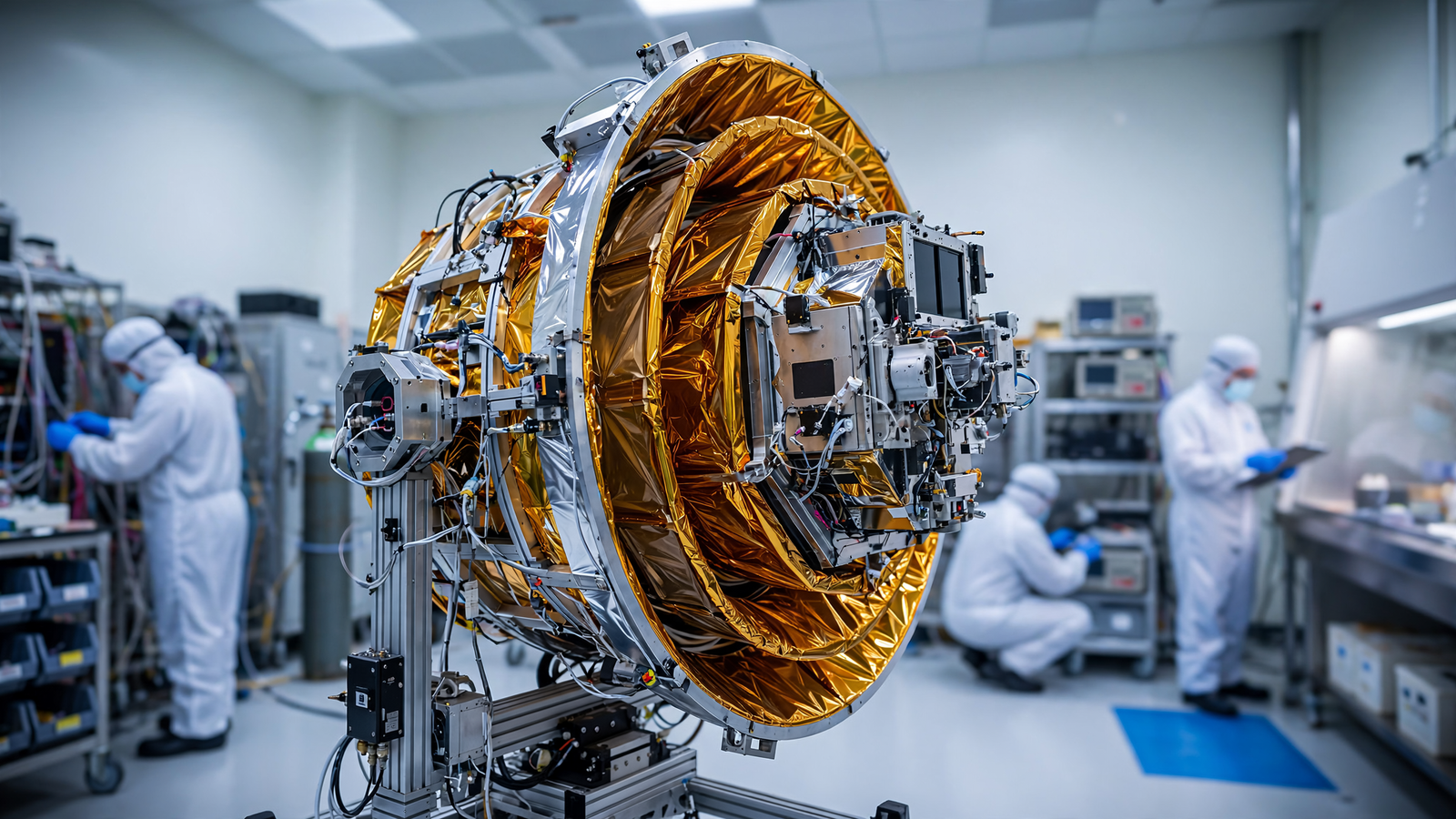
For centuries, maps of the night sky have helped people understand their place in the universe. NASA’s newest space telescope is attempting something far more ambitious: a complete map of the sky that records not only where objects are, but also what they are made of.
SPHEREx, short for the Spectro-Photometer for the History of the Universe, Epoch of Reionization and Ices Explorer, began its scientific mission in 2025 after launching from California. Over roughly two years, it is expected to scan the entire sky several times.
A map made from light
Unlike a conventional camera, SPHEREx does not collect images in just a few visible colors. Its instrument divides infrared light into 102 separate wavelengths. That gives researchers a kind of chemical fingerprint for objects across the sky.
The telescope’s wide field of view is central to its mission. Rather than focusing on one distant galaxy or a small region of space, SPHEREx will build a broad survey containing hundreds of millions of galaxies and many objects within the Milky Way. The result will be a large public scientific dataset that other researchers can use for years.
NASA describes the mission as the first all-sky map in this range of near-infrared colors. Because infrared light can reveal information hidden from ordinary optical telescopes, the survey will provide a new way to compare galaxies across cosmic time.
Looking back to the universe’s beginning
One of SPHEREx’s major goals is to investigate a very early phase of cosmic history called inflation. Scientists think the universe expanded extraordinarily rapidly immediately after the Big Bang. Tiny variations produced during that expansion may have influenced the large-scale pattern of galaxies seen today.
By measuring the positions of vast numbers of galaxies, researchers hope to test models of how those early fluctuations developed into the cosmic structure that surrounds us. SPHEREx will not make a single dramatic photograph of inflation. Instead, its power will come from the scale and consistency of the survey.
Searching for the ingredients of life
The mission also has a closer-to-home objective. In the cold clouds where stars and planets form, water and carbon-based molecules can freeze onto grains of dust. SPHEREx will study those icy materials across the Milky Way, helping scientists learn how common they are and how they may be incorporated into new planetary systems.
That research connects distant astronomy with a familiar question: how did the ingredients needed for life become available on Earth? SPHEREx cannot answer that question by itself, but its inventory of icy compounds will give scientists a wider view of the environments in which planets are born.
A survey designed for discovery
Because SPHEREx is creating a map rather than pursuing only a few targets, its data may lead to findings beyond the mission’s original questions. Astronomers could use the survey to identify unusual galaxies, locate promising objects for more detailed follow-up, or compare its results with observations from telescopes such as NASA’s James Webb Space Telescope.
The telescope’s achievement is therefore not just that it is looking farther. It is creating a new reference map—one that combines the reach of a space observatory with the broad coverage of a sky survey. As the data accumulate, the universe may begin to look less like a collection of isolated discoveries and more like a connected story written in light.