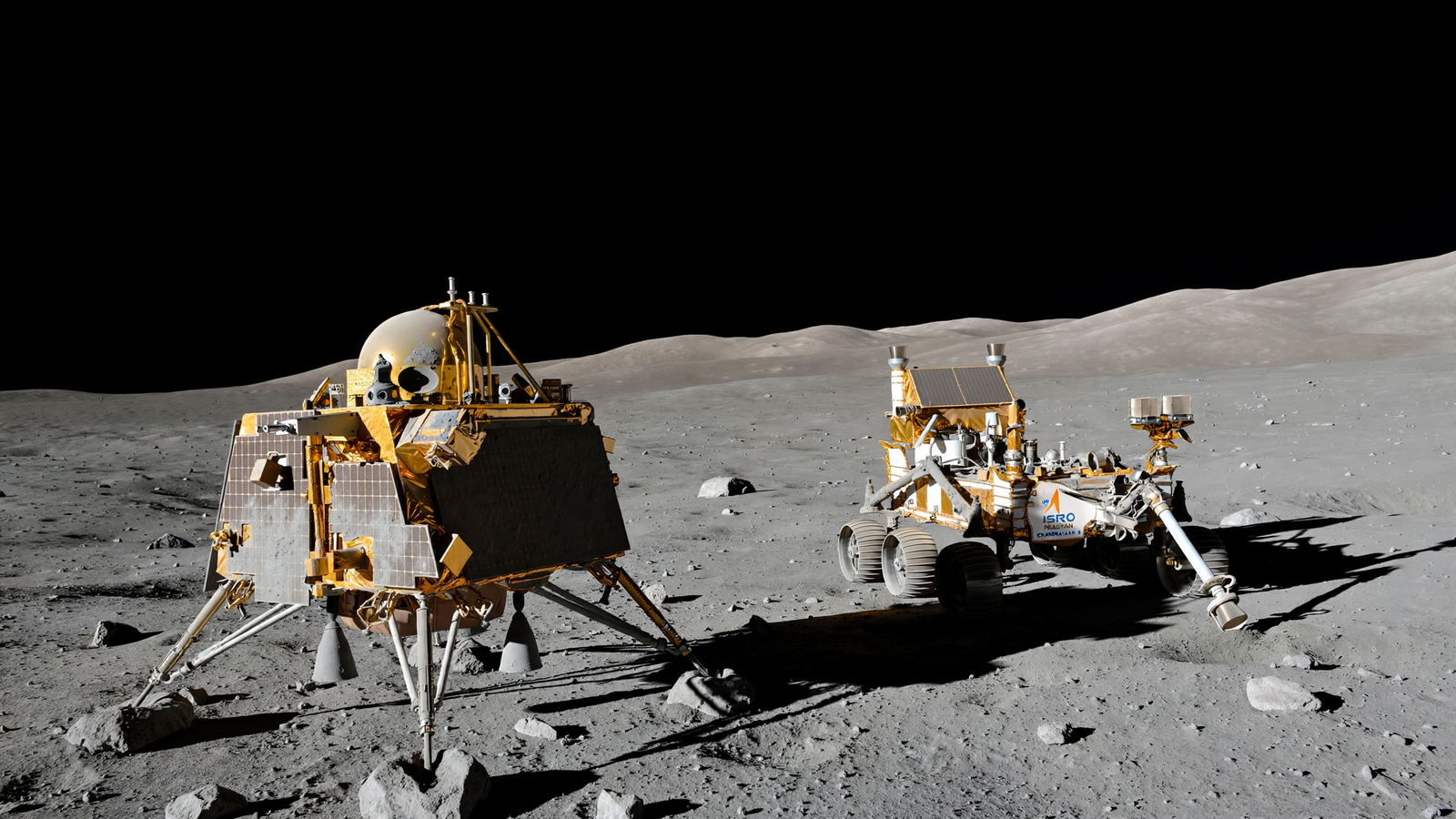
On August 23, 2023, a small lander named Vikram touched down on the Moon. The landing was more than a national milestone: it demonstrated that carefully engineered missions can reach one of the most challenging areas of the lunar surface and begin useful science almost immediately.
Chandrayaan-3, developed by the Indian Space Research Organisation (ISRO), became the first mission to make a successful soft landing in the Moon’s southern high-latitude region. The achievement followed an earlier Indian lunar landing attempt that ended before the spacecraft could complete its descent. Engineers redesigned parts of the landing system, expanded testing and added stronger safeguards for the final approach.
A landing built for a difficult landscape
The Moon’s south polar region is scientifically important because permanently shadowed areas may preserve water ice and other materials. It is also a demanding place to land. The terrain is uneven, sunlight is limited in some locations and communications and navigation must work reliably across millions of kilometres of space.
Vikram carried instruments to examine the ground and the extremely thin lunar environment. It also released Pragyan, a six-wheeled rover designed to travel across the surface, photograph its surroundings and analyze the composition of lunar soil and rocks.
Within its short operating window—roughly one lunar day, or about 14 Earth days—the mission met its primary landing and surface objectives. The rover moved across the landing area, while the lander collected measurements of temperature and seismic activity. Together, the two vehicles provided a close-up view of a region that had previously been observed mainly from orbit.
What the rover found
One of the mission’s clearest results came from Pragyan’s laser-induced breakdown spectroscope. The instrument identified sulfur in the lunar soil near the landing site. It also detected elements including aluminum, calcium, iron, chromium, titanium, manganese, silicon and oxygen.
These measurements do not, by themselves, prove that usable water or other resources are available at the site. They do, however, give scientists new ground-level evidence about the Moon’s surface chemistry. That distinction matters: exploration advances not only through dramatic discoveries, but also through reliable measurements that help researchers refine the next set of questions.
A success larger than a single landing
Chandrayaan-3’s achievement belongs to India’s space program, but its scientific value reaches beyond one country. Lunar missions build a shared base of knowledge for future robotic exploration and, eventually, human activity near the lunar south pole. The mission also showed how a program can respond to failure with analysis, redesign and persistence rather than abandoning an ambitious goal.
After completing its planned work, the lander and rover were placed into sleep mode as the lunar night approached. Their primary mission had already succeeded. Chandrayaan-3 left behind something lasting: evidence that a difficult landing can become the beginning of discovery, and that progress in space is often made one carefully tested step at a time.