For the first time, humanity deliberately changed the motion of another celestial body. NASA’s Double Asteroid Redirection Test, or DART, showed that a spacecraft can alter an asteroid’s path—and gave planetary defense its most important practical demonstration yet.
DART reached its target on September 26, 2022, when the spacecraft struck Dimorphos, a small asteroid orbiting the larger Didymos. The mission was not designed to destroy the asteroid. Instead, engineers wanted to see whether a high-speed impact could slightly change its orbit.
A small change with a big meaning
Before the collision, Dimorphos completed one orbit around Didymos in roughly 11 hours and 55 minutes. After DART’s impact, that period became about 32 minutes shorter. NASA had set a minimum success threshold of 73 seconds, so the result exceeded the mission’s basic goal by a wide margin.
That change may sound modest, but planetary defense works through advance planning rather than last-minute heroics. If astronomers identify a potentially hazardous asteroid decades before a possible encounter with Earth, even a small push can gradually move the object away from a dangerous intersection with our planet.
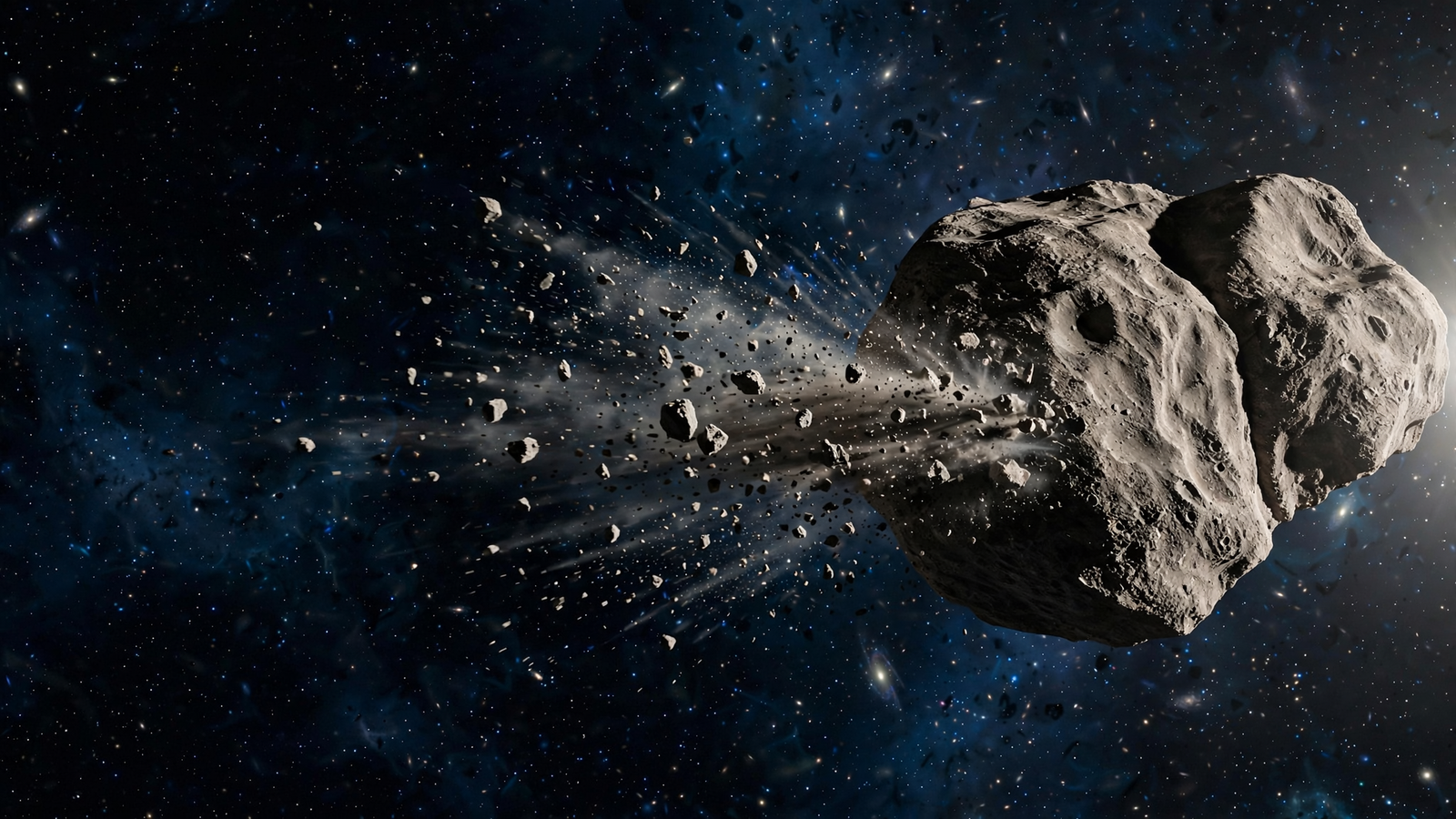
The result also confirmed that the impact’s effect was not limited to the spacecraft’s own momentum. When DART hit, it blasted debris from Dimorphos’s surface. That escaping material acted like a temporary exhaust plume, adding extra force to the collision and increasing the change in the asteroid’s motion.
A test carried out in the open sky
DART’s target was chosen because the Didymos system offered a natural way to measure the outcome. Dimorphos passes in front of and behind Didymos from Earth’s perspective, causing small changes in the system’s brightness. By tracking those changes before and after impact, scientists could calculate how long Dimorphos took to complete each orbit.
The spacecraft itself was small compared with its target, but it arrived at approximately 14,000 miles per hour. Its final images showed an increasingly detailed view of Dimorphos before contact, ending with a close look at a rocky, irregular world that had never previously been seen.
Scientists later used observations from telescopes around the world, along with data from the impact and its debris cloud, to study how the asteroid responded. Those measurements are helping researchers understand which properties—such as surface texture, density and the amount of material ejected—make an asteroid easier or harder to deflect.
From one demonstration to a planetary strategy
DART did not prove that every asteroid can be redirected, and it was not a test on an object threatening Earth. Its target was carefully selected, and the mission team knew the system’s orbit could be observed from the ground. That controlled setting was a strength: it allowed scientists to measure the result without putting communities or spacecraft at risk.
The next step is closer examination. The European Space Agency’s Hera mission is scheduled to study the impact site and Dimorphos in detail, helping turn DART’s successful experiment into a better engineering model for future missions.
Asteroid defense remains a long-term effort involving discovery, tracking, international cooperation and, if needed, carefully chosen technology. But DART supplied something the field had never possessed before: direct evidence that a human-built spacecraft can change an asteroid’s movement.
That is the encouraging part of the story. Earth’s protection does not depend only on luck. With enough warning and reliable observation, humanity now has a tested way to begin moving a dangerous object out of harm’s way.