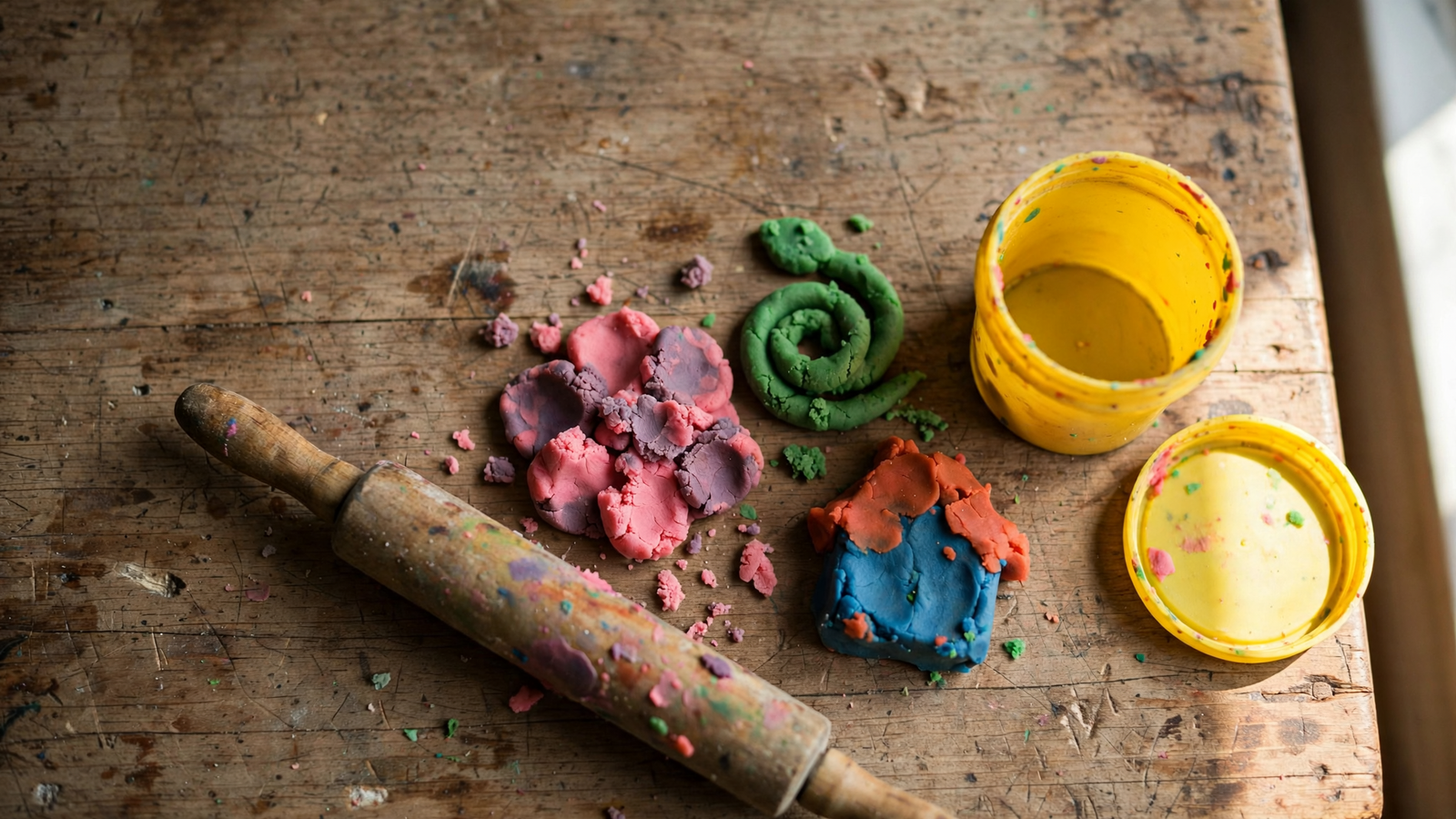
Before it became a rainbow-colored staple of childhood, Play-Doh was meant to disappear.
In the 1930s, the Cincinnati-based Kutol Products Company made a soft compound that could be rolled across wallpaper to lift away soot. At the time, many homes were heated with coal, and the residue could darken walls. The product offered a practical solution: press, roll and peel the cleaner away.
But household technology changed. As cleaner-burning heating systems became more common, demand for wallpaper cleaner declined. Kutol’s once-useful product was becoming a leftover from an earlier domestic life.
A practical compound gets a second chance
The turning point came in the 1950s through an unexpected observation. Kay Zufall, a nursery-school teacher and the sister-in-law of Kutol executive Joe McVicker, had been using the compound with children as a modeling material. It was pliable, inexpensive and easy for small hands to shape.
That classroom use suggested a new future. McVicker and Zufall worked with the company to remove the cleaning identity from the product and present it as a creative material for children. The name Play-Doh captured the change: this was no longer something for restoring a wall, but something for making almost anything a child could imagine.
The product entered the toy market in 1956 through Rainbow Crafts. Its earliest packaging reportedly featured a single off-white color, a practical choice that reflected its previous life as wallpaper cleaner. Later, bright colors helped make the compound feel less like a household material and more like a toybox invitation.
Why the idea worked
Play-Doh did not require batteries, instructions or a correct answer. Children could flatten it, twist it, press it into shapes or start over. A lump could become food, an animal, a person or an abstract sculpture within minutes.
That open-ended quality made the toy useful in classrooms as well as homes. It gave children a way to practice fine-motor skills while also engaging in pretend play and visual expression. The material’s softness lowered the stakes: unlike clay that hardens or a drawing that remains on the page, Play-Doh could be reshaped again and again.
The story also helps explain why certain American toys endure. Play-Doh was not built around a complicated machine or a single prescribed game. Its central feature was possibility. The child supplied the story, the object and the rules.
From utility product to cultural landmark
Play-Doh eventually became part of Hasbro’s brand portfolio and expanded into a familiar range of colors, tools and themed playsets. Yet the basic experience has remained remarkably stable: open a container, take out a soft mass and begin making.
Its journey from obsolete cleaning product to classic toy is a distinctly American piece of everyday ingenuity. A change in home heating nearly ended the product’s first life. A teacher’s classroom experiment revealed its second. The result was a toy that turned a problem-solving material into a durable form of creative freedom.