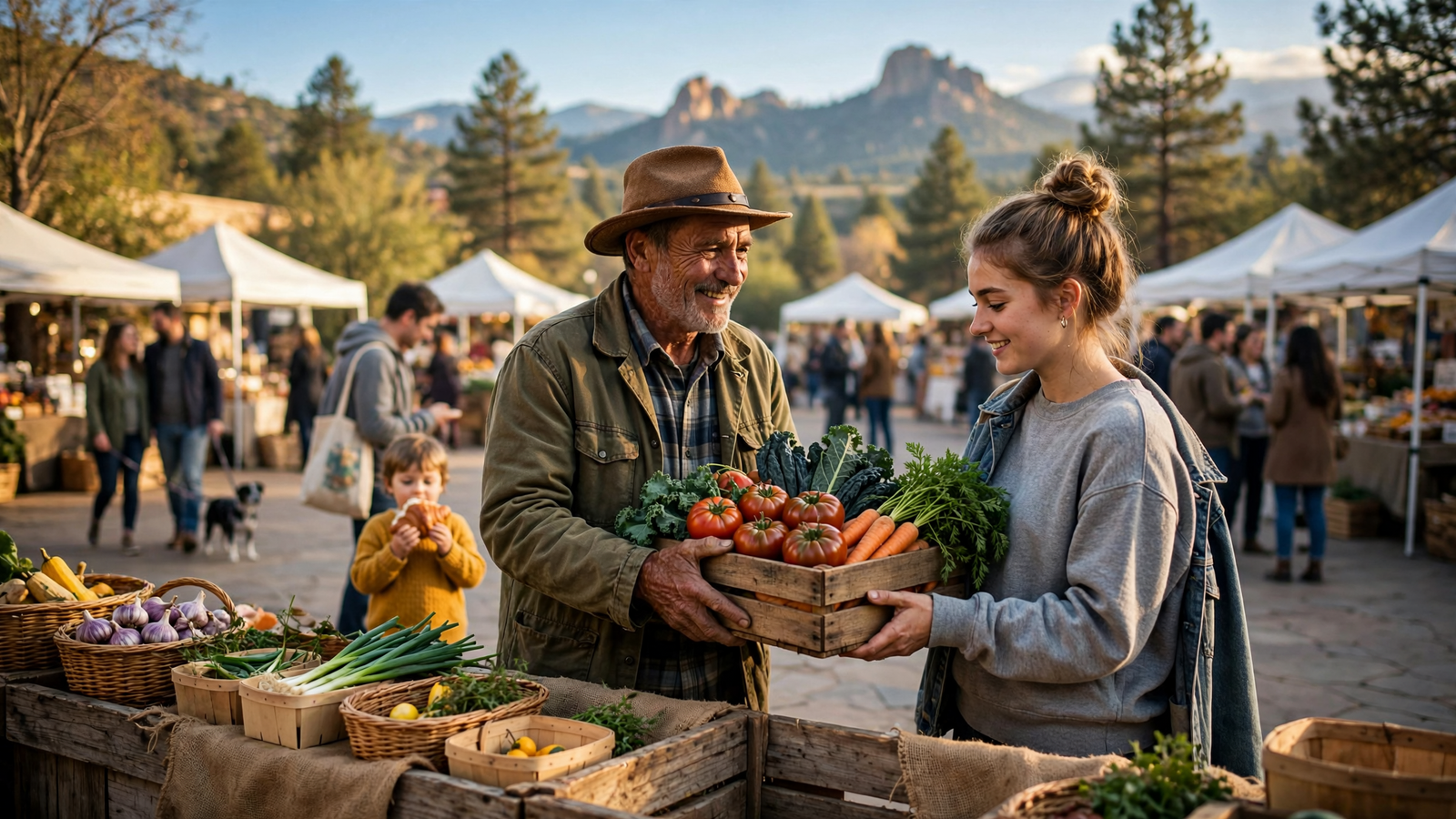
On market day in Prescott, the most important part of shopping is often not the purchase. It is the pause.
A customer stops to ask how a tomato was grown at high elevation. A farmer explains when the season’s first peaches will arrive. Someone carries a loaf of bread past a table of greens, while another shopper recognizes a neighbor across the crowd. The Prescott Farmers Market works because it turns those small exchanges into a dependable part of the week.
That makes the market more than a place to buy food. It is one of Prescott’s recurring civic spaces: a setting where agriculture, local business and community life meet in person.
A market built around the people who make what they sell
The Prescott Farmers Market describes itself as a producer-only market. In practical terms, that means vendors are expected to sell products they grow, raise, bake, prepare or make themselves, rather than simply purchasing wholesale goods and reselling them. The policy gives the market a particular character. Customers are not only choosing between products; they are meeting the people connected to their production.
That direct relationship is especially meaningful in Yavapai County, where the landscape changes quickly between high-country forests, mountain valleys and lower desert terrain. Farming in and around the region is shaped by elevation, water, temperature and a relatively short growing season. A market table can therefore become a small lesson in place: what grows well here, when it appears and how local producers adapt.
The market’s offerings vary with the calendar. Fresh vegetables and fruit share space with eggs, meat, baked goods, prepared foods, plants, preserves and locally made crafts. Not every vendor is present every week, and the selection changes as the seasons move through the region. That variability is part of the experience. The market does not promise the same shelves year-round; it reflects what local producers can offer now.
Why a weekly market matters in a mountain town
Farmers markets are sometimes described only as shopping destinations, but their public value is broader. They shorten the distance between producer and customer, create low-barrier exposure for small businesses and give residents a regular reason to spend time downtown or in another shared community setting.
For producers, a market can provide a direct sales channel without requiring a permanent storefront. For customers, it offers something that ordinary retail rarely can: a chance to ask questions at the point of purchase. How should a particular squash be cooked? When was the honey harvested? Which greens tolerate the local climate? The answers come from the people who know the products most closely.
That exchange also makes the market educational without feeling like a classroom. Children can see that food has a season and a source. Adults can discover varieties they might not encounter at a conventional grocery store. A shopper who comes for one item may leave with a better understanding of the region’s food system.
The USDA identifies farmers markets as one part of the broader local-food economy, connecting consumers with farms and food businesses in their own communities. The Prescott market gives that national idea a distinctly local form: informal, face-to-face and shaped by the realities of northern Arizona.
The rhythm of the seasons is part of the appeal
A farmers market is a different kind of calendar. Instead of dividing the year into holidays or retail sales, it marks time through harvests.
Early-season tables may emphasize greens, herbs, seedlings and other crops that can handle cooler conditions. As the weather warms, the market’s colors and aromas change. Summer brings a wider range of produce, while later months introduce storage crops, baked goods and products suited to the colder part of the year. The transition is gradual rather than neatly scheduled, and that is precisely what makes returning worthwhile.
Prescott’s elevation adds another dimension. The city sits at roughly 5,300 feet, and its climate is not identical to the agricultural conditions found elsewhere in Arizona. Local growers must work within a high-desert environment that can include cool nights, dry air and abrupt weather shifts. The result is a market that can teach visitors to pay attention to regional growing patterns rather than assuming that every crop arrives on the same timetable.
Seasonality also encourages a less disposable relationship with food. When a favorite item is available for only part of the year, people notice it. They may buy more carefully, learn preservation techniques or adjust a recipe around what is actually available. A market can make those habits feel natural because the limits are visible at every table.
A gathering place as much as a marketplace
The Prescott Farmers Market’s significance is not measured only by the number of vendors or the value of its sales. Its deeper contribution is social. It creates a recurring occasion when people who might otherwise pass one another in cars or stores can share the same physical space.
That role is easy to underestimate because it is made from ordinary actions: walking, browsing, talking, tasting and carrying groceries home. Yet those repeated actions help give a community continuity. Residents know where to find the market, recognize familiar vendors and build routines around the visit. Newcomers can use it as an approachable introduction to Prescott, while longtime residents can keep discovering the people and products around them.
The setting matters, too. A market held in a public area does not divide people into customers and spectators as sharply as a conventional store can. Some visitors come with a shopping list. Others arrive for breakfast, conversation or a look at what is in season. The same space accommodates all of them.
That openness is one reason markets often become informal community notice boards. Conversations extend beyond food to local events, gardening, small business and neighborhood life. The market does not need to announce itself as a civic institution to perform some of the work of one.
Local food without the fantasy
There is a temptation to romanticize farmers markets, but the Prescott Farmers Market is most interesting when viewed realistically. Local food does not mean every item comes from immediately nearby, nor does a market remove the challenges faced by small producers. Growing in Arizona requires careful attention to water, weather, labor and transportation. Operating a small food business can be demanding even when customers are supportive.
The market’s producer-only structure helps make its promise more specific. It does not suggest that every product is grown within the city limits. Instead, it offers a clearer connection between vendor and product, allowing shoppers to learn more about where their purchases come from. That transparency is valuable in itself.
It also encourages customers to think of local food as a relationship rather than a label. The most meaningful question may not be whether an item is marketed as “local,” but who produced it, under what conditions and during which season. At a market, those questions can be asked directly.
Why Prescott keeps making room for it
Prescott has no shortage of historic landmarks, outdoor destinations and established community traditions. The farmers market belongs to a different category of place. It is not a monument or a landscape feature. Its identity is renewed each time vendors arrive, tables are arranged and shoppers begin moving through the rows.
That temporary quality is part of its strength. The market does not need to remain unchanged to remain recognizable. Its vendors, products and layout can shift while its basic purpose stays steady: give local producers a public platform and give residents a shared place to meet them.
In that sense, the market represents a useful kind of continuity. It is dependable without being static. It belongs to Prescott not because it preserves one fixed version of the town, but because it reflects the community as it is being made—through work, food, conversation and repeated encounters.
For visitors, the market offers an easy way to experience Prescott beyond its better-known attractions. For residents, it offers something more lasting: a weekly reminder that the region’s food has people behind it, and that a town becomes more connected when those people have somewhere to gather.
The best farmers markets leave shoppers with more than a bag of groceries. They leave them with a sense of the season, a few new names and a stronger feeling for the place they are in. In Prescott, that may be the market’s most important harvest.