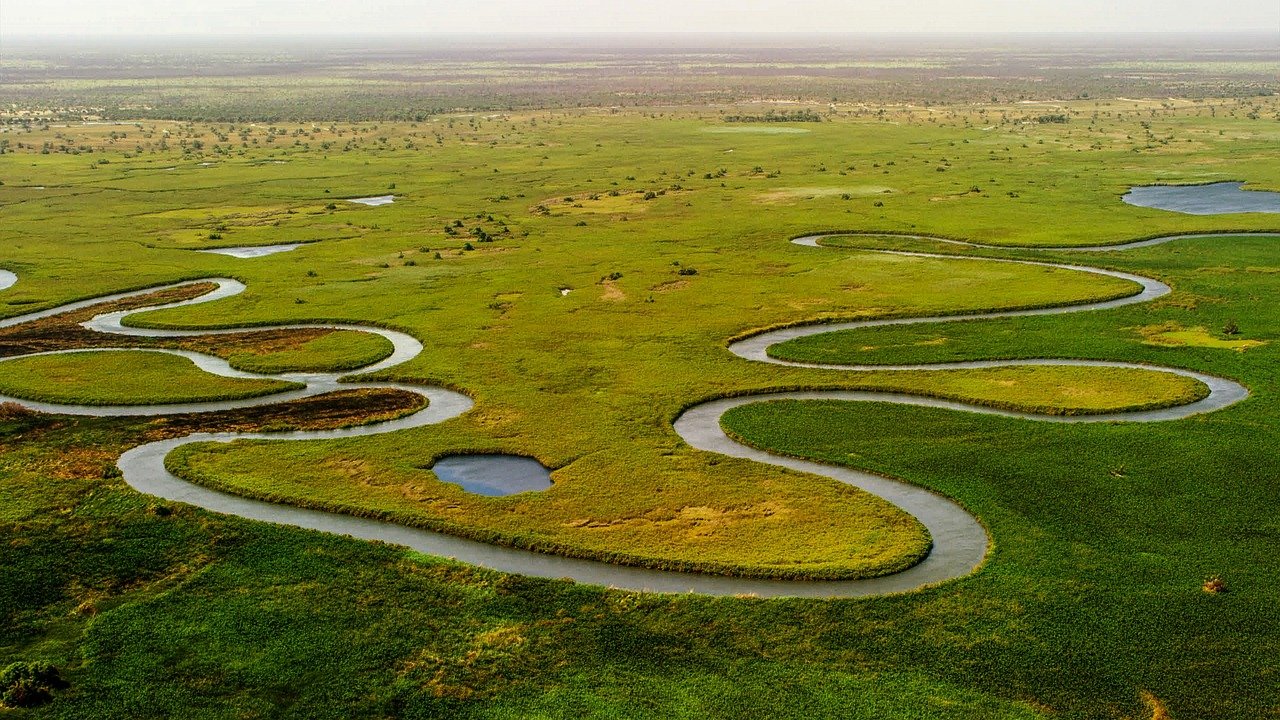
In much of Botswana, the dry season brings a familiar change: grasses fade, shallow pools shrink and water becomes harder for wildlife to find. Yet in the Okavango Delta, the dry months can bring a striking expansion of water. Floods arrive from far to the north, spreading across the delta just as the surrounding landscape is drying out.
This seasonal reversal is one of the natural wonder’s defining features. The Okavango is a vast inland wetland in northwestern Botswana, where the river does not reach the sea. Instead, its water fans out into a low, sandy basin and gradually disappears into the Kalahari—through evaporation, plant use and seepage into the ground.
A flood with a long journey
The water begins its journey in rainfall over the Angolan highlands, where the Okavango River’s upstream waters gather. From there, the river flows south through a river system that crosses national borders before reaching Botswana. The journey takes time. By the time the flood pulse arrives in the delta, conditions at its destination are often very different from those where the rain fell.
The flood’s high-water period typically falls during Botswana’s dry winter, rather than its rainy season. Water moves through channels and lagoons, then spills onto floodplains and around islands. The wetland’s footprint changes from year to year and from season to season: a channel that is full in one period may become a grass-covered plain in another.
That delayed arrival is not a contradiction in the delta’s climate. It is a reminder that a river carries conditions from one place into another. Rain falling upstream can shape the landscape hundreds of kilometres away, long after the clouds have passed.
Why the water spreads instead of reaching the ocean
The Okavango Delta is an alluvial fan: a broad, gently sloping landscape built as a river deposits sediment and branches into smaller channels. The land is so flat that water can spread over a wide area rather than staying in one deep, fast-flowing course. The delta’s seasonal wetlands include permanent marshes as well as floodplains that are inundated only part of the year.
There is no river outlet carrying the floodwater to a coast. Instead, the water gradually loses its volume to the atmosphere, to plants and to the sandy ground. The result is a wetland system set within a much drier region—one recognized by UNESCO as an unusually intact example of a large inland delta.
Its varied habitats are part of what makes the landscape so rich. Permanent water, seasonally flooded grassland, islands and drier woodland offer different conditions for plants and animals. As the waterline shifts, those habitats shift too. Some areas provide refuge when the land dries; others become accessible as floodwaters recede.
A changing map for wildlife
For animals, the delta is not a fixed patch of green. It is a changing network of water and land. Fish and aquatic life occupy waterways and pools; birds use wetlands and open ground; and large mammals move through the mosaic in response to water, vegetation and the season. The flood can open routes into places that were dry, while falling water exposes new feeding grounds.
That movement helps explain why the Okavango is better understood as a process than as a single watery landmark. Its annual cycle links distant rainfall to local water levels, plant growth and animal movement. The exact reach of the flood varies, so the landscape does not follow a perfectly identical script every year.
UNESCO’s World Heritage listing describes the delta as a meeting point for natural processes, including flooding, climate and biological life. The Ramsar Convention also recognizes the area’s international importance as a wetland. Those designations reflect more than scenic beauty: the delta is a functioning system whose ecological character depends on the movement of water.
Why its inland setting matters
Many great river deltas meet the sea. The Okavango instead ends in an arid interior basin. That setting makes its seasonal flood pulse especially visible: water arriving from outside the local dry landscape temporarily transforms the conditions on the ground.
It also means the delta cannot be separated from its upstream catchment. The flood depends on rainfall and river flow beyond Botswana, while conditions within the delta determine how that water spreads and fades. Protecting the wetland’s character therefore involves understanding the wider river system, not just the places where water is easiest to see.
The Okavango’s most remarkable moment may come when the surrounding land looks least likely to support a wetland. A distant rainy season sends its delayed signal south, and the delta responds by expanding—turning a dry-season landscape into a shifting world of channels, islands and floodplains.
That is the wonder: not simply that water appears in the desert, but that a river’s slow, cross-border journey keeps changing where life can find it.