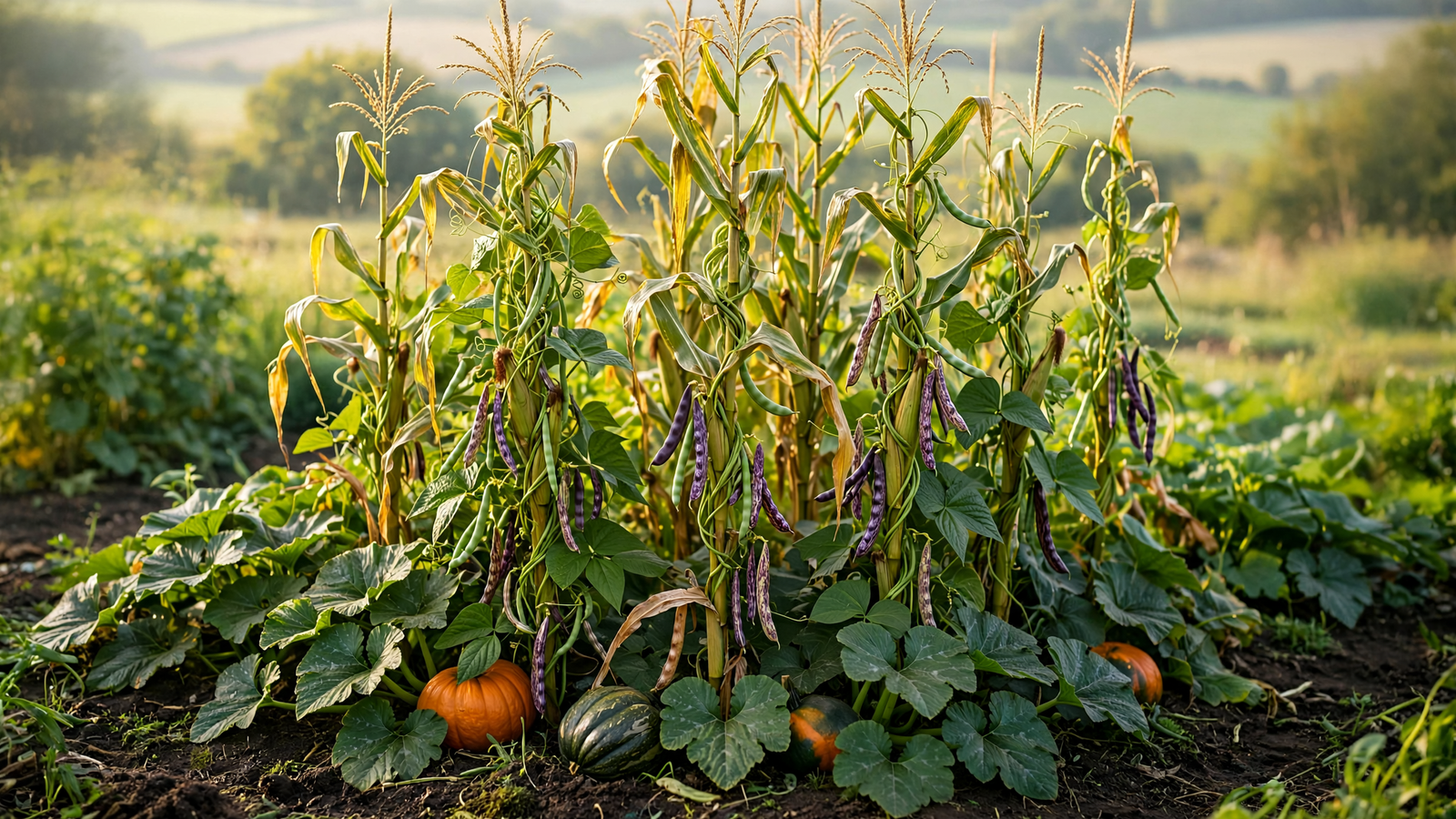
In a garden bed, corn rises first. Beans climb its stalks. Squash spreads below, its broad leaves shading the ground.
It can look almost too orderly to be accidental, but the Three Sisters garden is not simply a clever arrangement of vegetables. It is an agricultural system with deep Indigenous roots across North America, shaped by generations of observation, adaptation, ceremony, and care.
The three crops—corn, beans, and squash—are often described as companions because each contributes something useful to the others. Corn provides a natural trellis. Beans climb toward the sunlight and, as legumes, can contribute nitrogen to the soil through their relationship with soil bacteria. Squash leaves cover the ground, helping shade it, slow evaporation, and limit space for competing plants.
Together, they produce more than a garden of separate crops. They create a food landscape that can support nourishment, biodiversity, and resilience.
A system with many Indigenous histories
The phrase “Three Sisters” is widely used today, but Indigenous nations have their own names, stories, planting traditions, and relationships with these crops. The system is especially associated with Haudenosaunee agriculture, while related forms of intercropping have been practiced by Indigenous peoples in many regions of the Americas.
That distinction matters. There is no single, universal Three Sisters recipe or one origin story that explains every Indigenous community’s practice. Corn, beans, and squash were cultivated in different varieties and combinations, according to local climates, soils, cultural traditions, and dietary needs.
The National Museum of the American Indian describes the crops as relatives in a living system rather than merely ingredients in a meal. In Haudenosaunee tradition, the Three Sisters are connected to teachings about cooperation and mutual support. The garden is productive, but it is also a reminder that food carries memory and responsibility.
Modern gardening advice sometimes reduces the practice to a list of benefits: corn supports beans, beans add nitrogen, and squash acts as mulch. Those observations are useful, but they do not tell the whole story. The Three Sisters garden is also an example of Indigenous agricultural knowledge—knowledge developed through close attention to place and passed between generations.
Why these crops work together
Each sister occupies a different layer of the garden.
Corn grows vertically. Its sturdy stalks can support climbing beans, although gardeners must choose varieties and spacing carefully. Corn also forms the tallest canopy, capturing sunlight above the other crops.
Beans grow upward and outward. As legumes, they form partnerships with bacteria in root nodules that help convert atmospheric nitrogen into forms plants can use. The benefits are most important over time and depend on the species, soil, and conditions; beans are not a magical fertilizer that instantly feeds every neighboring plant. Still, their presence can contribute to soil fertility, especially when plant material is returned to the ground.
Squash spreads horizontally. Its leaves shade the soil, which can help retain moisture during warm weather. The vines and leaves also make it harder for some weeds to establish themselves. In many traditional plantings, the dense ground cover helped protect the soil from drying and erosion.
The arrangement also distributes risk. If one crop performs poorly, the others may still provide food. Corn offers carbohydrates, beans provide protein and other nutrients, and squash contributes vitamins, minerals, and additional energy. In combination, they form the foundation of many nourishing meals.
From field to winter storehouse
One reason the Three Sisters became so important was not just what the crops produced in summer, but how they could sustain households beyond the growing season.
Different varieties of corn could be eaten fresh, dried, ground into meal, or processed in ways that improved its nutritional value. Beans could be dried and stored for months. Winter squash, with its hard outer skin, could also be kept for long periods under suitable conditions.
That storage capacity transformed the garden from a source of daily produce into part of a year-round food system. A harvest could be preserved, divided, traded, served at gatherings, or carried into the colder months.
Many Three Sisters meals are therefore adaptable rather than fixed. Corn, beans, and squash may be cooked together in a stew, prepared separately as side dishes, dried for later use, or combined with other local foods. The exact preparation depends on the community and the ingredients available.
It is also important not to treat the three crops as an isolated “ancient superfood” package. Indigenous cuisines have always included far more than these plants: wild greens, berries, nuts, fish, game, maple, roots, herbs, and many other cultivated and gathered foods. The Three Sisters are one important agricultural relationship within much larger food cultures.
What modern gardens often miss
The Three Sisters garden has become popular in school gardens, backyard plots, and sustainability programs. That interest can introduce useful ideas about polyculture, soil protection, and growing food in layers. But simplified versions sometimes fail because they copy the appearance of the system without understanding its timing.
For example, corn must be tall and established enough to support beans before the beans become vigorous. Squash needs room to spread. A gardener who plants everything too closely may create competition for light, water, and nutrients rather than cooperation.
Traditional growers also worked with locally adapted seed, regional weather patterns, and knowledge of when to plant. There is no universal spacing formula that works equally well in a dry Southwest garden, a humid Great Lakes plot, and a short-season northern field.
The best modern approach begins with respect and observation: learn from Indigenous educators, select varieties suited to the region, prepare the soil, and understand that the system is more than a decorative pattern. It is a method of working with relationships.
A lesson in abundance without waste
The Three Sisters offer a different definition of agricultural efficiency. Instead of measuring success only by the yield of a single crop, the system invites a broader view: How much food can a piece of land provide? How well does it protect the soil? Can it offer harvests at different times? Does it support storage, sharing, and cultural continuity?
Those questions are increasingly relevant as gardeners and farmers face heat, drought, depleted soil, and pressure to produce more with fewer resources. Intercropping is not a universal solution, and it cannot replace careful regional farming. But it demonstrates how diversity can make a growing system more flexible.
The garden also carries a social lesson. Corn, beans, and squash do not become useful by standing alone in identical rows. Their strength comes from difference: one climbs, one supports, and one covers the ground. Each has its own role, but the harvest depends on their connection.
Bringing the sisters to the table
A simple Three Sisters dish can be built from fresh or preserved ingredients. Simmer cooked beans with corn and cubed winter squash, then add onions, peppers, herbs, or stock according to taste. The result can be a soup, stew, filling, or side dish. In summer, fresh corn and tender squash can be cooked with beans and herbs; in winter, dried beans, frozen corn, and stored squash can bring the same agricultural relationship back to the table.
There is no single authentic bowl that represents every Indigenous community. The respectful lesson is not to claim ownership of a universal recipe, but to recognize the knowledge behind the ingredients and to seek out Indigenous-led foodways when learning more.
Today, the Three Sisters remain both practical and symbolic. They show how agriculture can be designed around cooperation rather than isolation, and how food traditions can hold ecological knowledge as well as flavor. In a world looking for new ways to protect soil and feed communities, this old relationship still has something to teach.