They look surprisingly familiar.
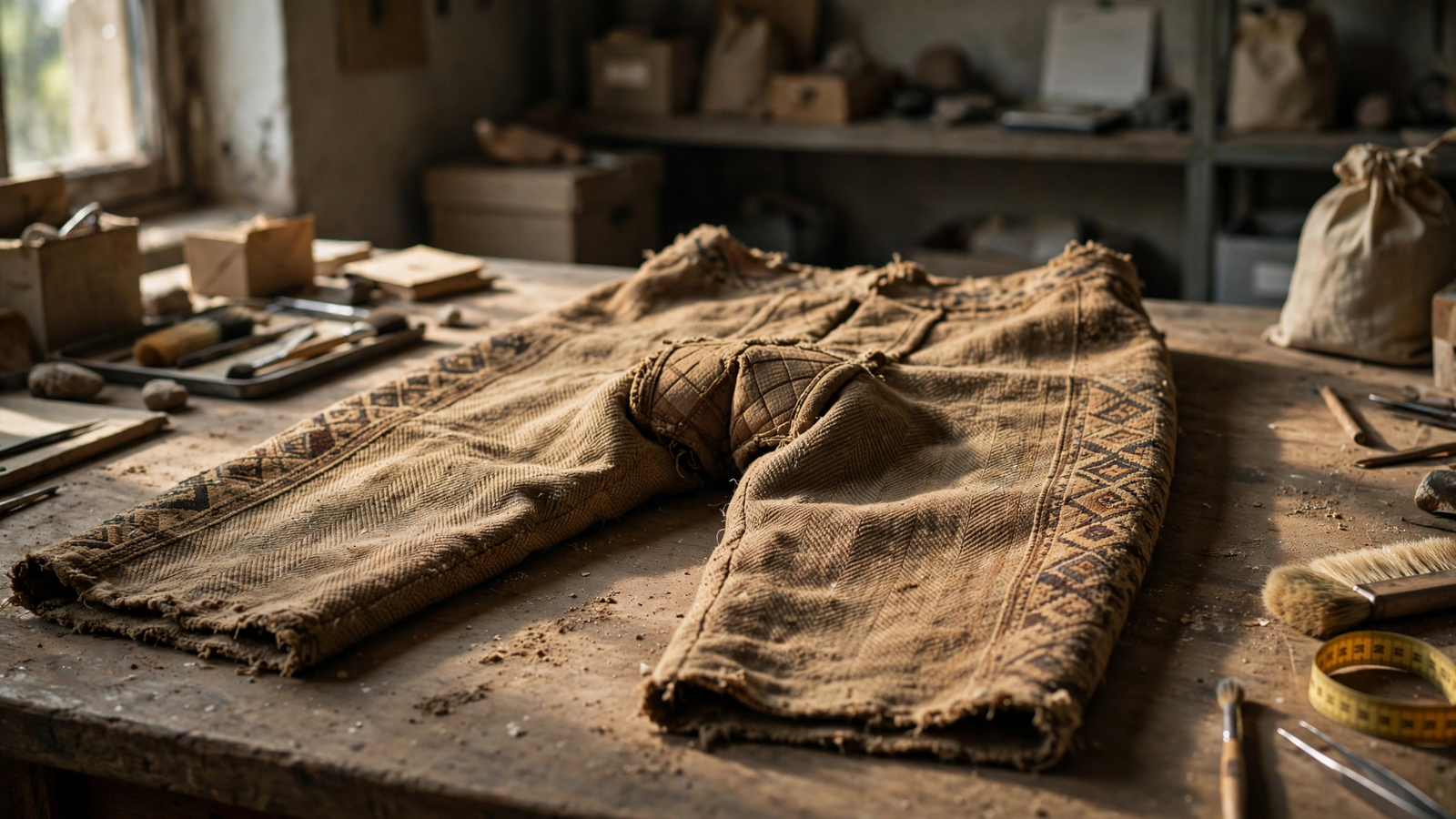
The trousers are made of brown wool, with two straight legs joined by a wide section of fabric at the crotch. The waist is shaped for movement. Decorative bands run along the legs. The cut is practical, but it is not crude. In fact, the design is sophisticated enough to resemble a distant ancestor of the jeans, riding pants and work trousers worn today.
What makes them extraordinary is their age. The trousers were found in the Yanghai cemetery in the Xinjiang region of Central Asia and date to roughly 3,200 years ago. They are widely considered the oldest known surviving trousers in the world.
Their discovery changed a long-standing assumption about ancient clothing. For centuries, historians often imagined trousers as a later invention—something that appeared after robes and tunics had already dominated the ancient world. The Yanghai garment suggests a more complicated story. Clothing evolved in response to movement, climate, work and technology, and people living on the grasslands of Central Asia were already solving those problems with remarkable skill.
A garment preserved by an unusual landscape
The trousers survived because the Yanghai cemetery is an unusually favorable place for preserving organic material. The site lies in the Turpan Basin, a dry region surrounded by mountains. Summers are extremely hot, while the surrounding landscape receives little rain. That combination helped protect wool, leather, wood and other materials that would normally disappear in wetter soil.
Archaeologists excavated the cemetery in the 1970s, but the importance of the trousers became clearer decades later. An international team examined the garment using radiocarbon dating, microscopic analysis and close study of its construction. Their findings were published in 2014 in the journal Archaeological Research in Asia.
The garment came from a tomb associated with a man who was buried with objects linked to riding and travel, including a whip, a decorated knife sheath and a bow. That combination does not prove exactly how he used the trousers every day, but it provides an important clue. The garment appears to have belonged to a mobile herder or warrior whose life involved horses, long journeys or both.
Researchers dated the trousers to approximately the 13th through 10th centuries BCE. That places them in the early Iron Age, a period when communities across the Eurasian steppe were becoming increasingly connected through migration, trade and mounted movement.
Why trousers were such a useful invention
A robe or tunic works well when a person is walking, farming or sitting. It can be loose, comfortable and easy to make. Riding a horse is different. A rider needs clothing that will not bunch awkwardly, expose the legs or chafe against the saddle. Separate leg coverings also make it easier to mount, dismount and control an animal.
The Yanghai trousers appear to address those problems directly. They have wide legs and a low crotch, giving the wearer room to move. Rather than being assembled from many small pieces, they were largely woven into shape. The main fabric was made using a twill technique, which creates a diagonal pattern in the weave and produces a strong, flexible textile.
The trousers also contained different kinds of weaving. Some areas were constructed with denser fabric, while decorative sections used more elaborate patterns. The result was not simply a protective garment. It combined comfort, durability and visual design.
That combination matters because it shows that ancient clothing was not just about survival. The person who wore these trousers needed protection from the environment, but the maker also cared about appearance. Even a garment designed for riding could carry signals of identity, skill or status.
Not quite a modern pair of pants
Although the trousers look familiar, they were made differently from most modern clothing. The Yanghai example has no obvious cut-and-sewn seams in the way a pair of contemporary trousers does. Instead, much of its shape was built into the weaving process.
The textile specialists who studied the garment identified several techniques, including twining, tapestry weaving and a form of weaving that created a thick, durable surface. The legs were woven as separate tubes, while the central section joined them. This design reduced the number of seams and created a flexible garment suited to riding.
The decorative elements are especially revealing. Bands near the knees and lower legs use contrasting patterns, giving the trousers a finished appearance. The design may have been partly practical, helping reinforce areas exposed to stress, but it was also clearly ornamental.
In other words, the trousers were engineered. They were also styled.
Did horse riding create trousers?
The Yanghai discovery cannot answer that question by itself. Trousers may have developed in several places and for several reasons. Cold weather, herding, warfare and horseback riding could all have encouraged people to abandon single-piece garments.
Still, the evidence from Central Asia supports a strong connection between trousers and life on horseback. The wearer’s burial objects point toward a riding culture, and the cut of the garment is particularly well suited to mounted movement.
Other ancient trousers have since been identified in Central and Eastern Asia, although many are younger or less complete. Archaeologists have also found evidence of early leg coverings in Europe and the Near East. These discoveries suggest that trousers were not the product of one sudden invention. They emerged as different communities adapted clothing to the demands of travel and work.
That makes the Yanghai pair important not simply because it is old. It captures a moment when clothing was becoming closely connected with mobility across the Eurasian landscape.
The people behind the textile
It is easy to focus on the surviving object and forget the labor required to make it. Someone raised or acquired the wool, cleaned and spun the fibers, prepared the loom and planned a complicated pattern. The garment needed to be measured, shaped and finished for a particular body.
Those skills were probably shared within a community. Textile production requires time and specialist knowledge, especially when a garment includes multiple weaving techniques. The trousers therefore offer evidence of a wider social world: herders who relied on animals, craftspeople who understood textiles and travelers who moved goods and ideas across long distances.
The fabric also hints at the relationship between local tradition and wider exchange. The trousers were found in a region where populations with different languages, technologies and customs met over many centuries. Clothing styles could travel with people, just as tools, horses and metalworking techniques did.
An ancient answer to a modern problem
The most striking thing about the Yanghai trousers may be how little their basic purpose has changed. People still choose trousers because they allow movement. Riders, workers, hikers and travelers still value strong fabric, a comfortable seat and reinforcement in high-stress areas.
Modern clothing is produced with machines, synthetic fibers and industrial patterns, but the design problem remains recognizable. How do you make a garment that protects the body without restricting it? How do you make it durable without making it too heavy? And how can an item built for hard use still look distinctive?
The ancient weaver who made the Yanghai trousers answered those questions with wool, a loom and a careful understanding of the human body.
The result survived for more than three millennia in a dry Central Asian cemetery. It now offers something rare in archaeology: not just a glimpse of what people wore, but a close look at how they moved through the world.
Why the discovery still matters
Clothing is often treated as a minor detail of history. Textiles are fragile, rarely survive intact and are easily overshadowed by weapons, monuments and written records. Yet garments can reveal habits that grander objects cannot.
These trousers show that ancient people were adapting technology to everyday movement long before modern fashion separated “sportswear,” “workwear” and “formal wear.” They also remind us that innovation is not always dramatic. Sometimes it is a better seam, a stronger weave or a new way to join two pieces of fabric.
The oldest known trousers are not merely an odd archaeological curiosity. They are evidence of practical intelligence—preserved in wool, shaped for a rider and recognizable across thousands of years.