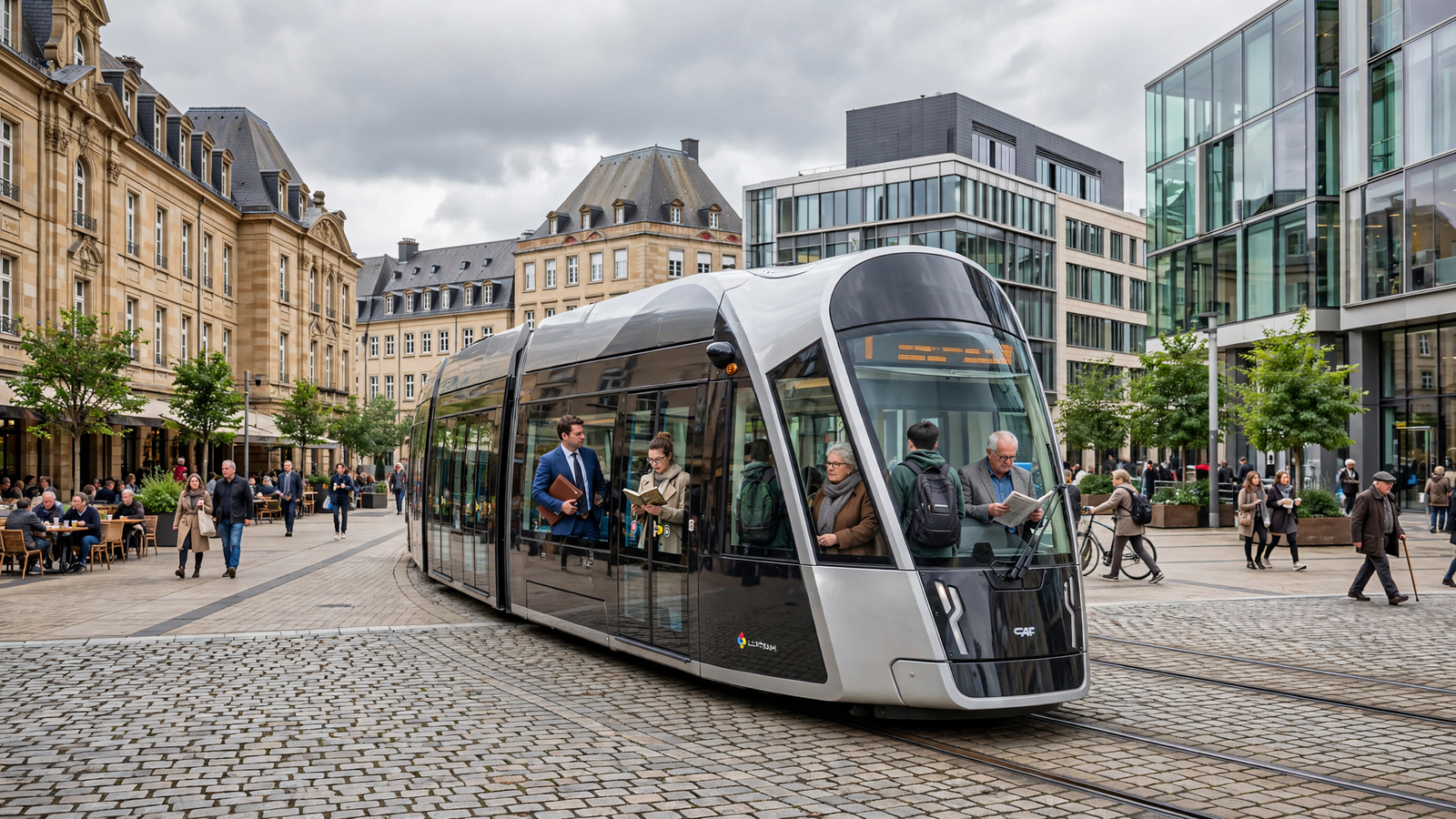
For many people, the cost of getting around is part of every daily decision. Is the bus cheaper than driving? Will a short train ride justify the ticket? Should a family take public transport or split the cost of fuel and parking?
Luxembourg removed much of that calculation in 2020. The small European country became the first in the world to make its nationwide public transportation system free for passengers.
Since February 29, 2020, passengers have been able to use Luxembourg’s buses, trams and second-class trains without buying a ticket. The policy applies to residents, commuters and tourists. There are limited exceptions: first-class rail travel still requires payment, as do portions of cross-border journeys outside Luxembourg.
A national network without a national fare
Luxembourg is compact, but its transportation system connects cities, villages, workplaces and neighboring countries. The country also has a large population of cross-border workers who travel daily from Belgium, France and Germany.
Before the change, passengers generally had to navigate a relatively inexpensive fare system. Afterward, the basic act of boarding became much simpler. A person catching a bus for one stop and someone traveling across the country could use the same public service without handling a payment.
That simplicity matters. Removing fares does not remove every barrier to public transportation—routes, schedules, accessibility and travel time still shape people’s choices—but it eliminates one immediate obstacle. For young people, lower-income households and visitors unfamiliar with the country, the system is easier to understand from the start.
More than a free ride
The policy was introduced as part of a broader effort to improve mobility and encourage alternatives to private cars. Luxembourg has invested in its tram network, rail infrastructure and bus connections alongside the fare change. Free transportation, in other words, is one part of a larger attempt to make shared travel more practical.
It is also a visible example of how a government can treat everyday movement as public infrastructure rather than only as an individual purchase. A worker going to a job, a student traveling to class or a family visiting another town is participating in ordinary civic life. When the fare disappears, that public service becomes more noticeable.
The results should be interpreted carefully. Free fares alone cannot guarantee fewer cars or eliminate congestion, and Luxembourg continues to face heavy traffic. The European Commission has described the measure as a significant experiment, not a complete solution to urban mobility. Passenger numbers are influenced by service frequency, convenience, housing patterns and the availability of destinations as well as price.
A small country with a large idea
Luxembourg’s approach is not automatically transferable everywhere. Its geography, income levels, tax base and cross-border workforce are unusual. Still, the experiment offers a useful reminder: public policy can improve daily life not only through dramatic breakthroughs, but also by removing a small point of friction repeated millions of times.
For passengers, the benefit is wonderfully ordinary. They can check a timetable, walk to a stop and get on board. No ticket machine, app or last-minute fare decision stands between them and the next part of the day.