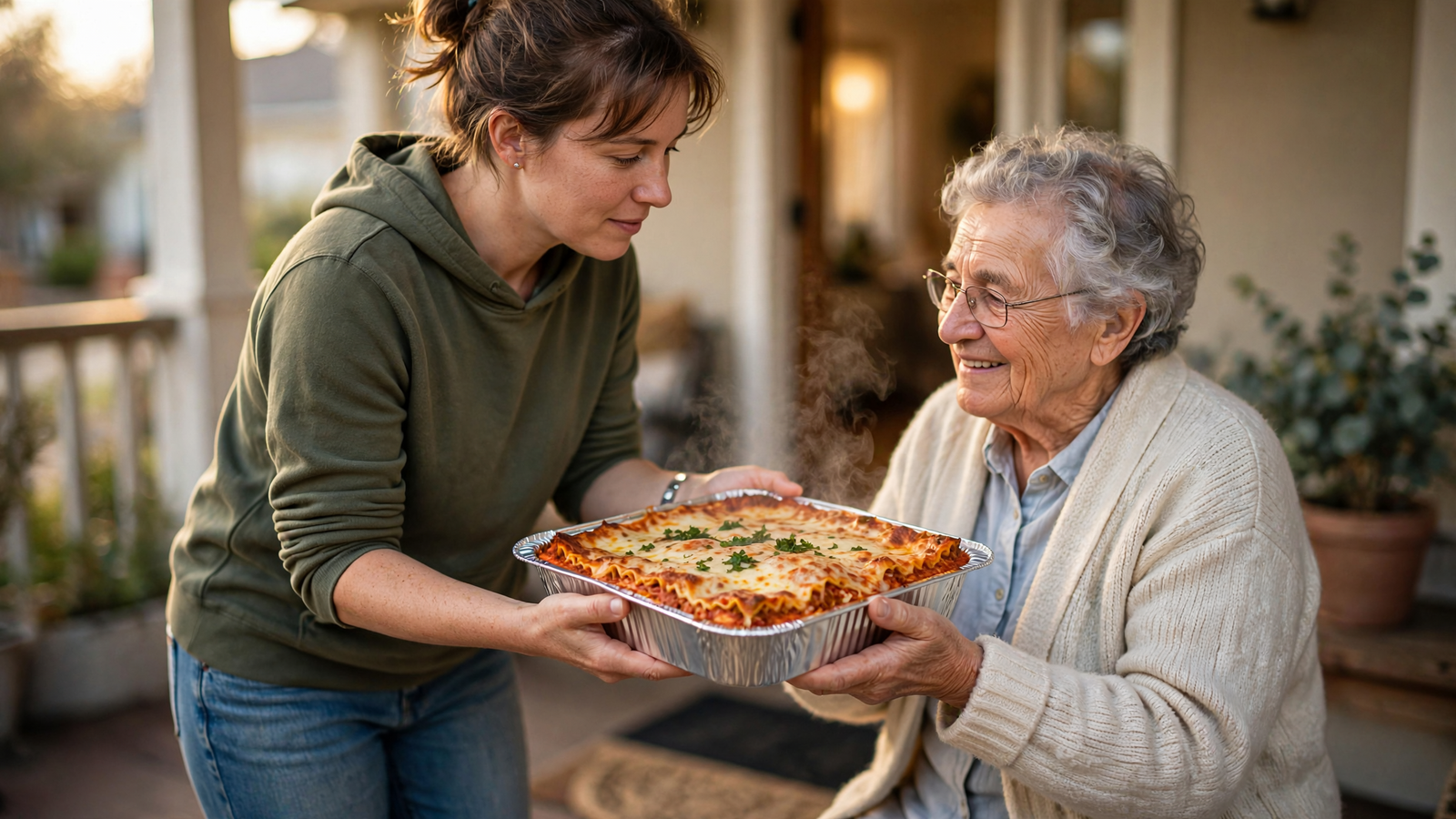
There is a particular kind of kindness that does not arrive with a ceremony. It comes in an ordinary baking dish, covered with foil and carried carefully through a front door.
That is the basic idea behind Lasagna Love, a volunteer-led network that connects people willing to cook with neighbors who could use a meal. The organization began in 2020, when founder Rhiannon Menn started making lasagnas for families in her community. What began as one person’s response to a difficult moment grew into a national effort built around food, trust and the belief that asking for help should not require a person to prove that they deserve it.
The result is a distinctly human form of mutual aid. A volunteer prepares a meal at home, arranges a delivery and offers a small measure of relief. The recipient does not have to navigate a complicated application, explain a financial crisis or commit to anything in return. The exchange is intentionally simple: one neighbor helps another.
A meal without a test attached
Lasagna Love’s model is different from many traditional assistance programs because it does not define need narrowly. People may request a meal because they are overwhelmed, caring for a newborn, recovering from an illness, facing a demanding work schedule or simply having a difficult season. The organization’s public materials emphasize that requests are not limited to one type of household or crisis.
That openness matters. Many people who need support do not identify with formal labels such as “food insecure” or “low income.” They may be working, caring for relatives, managing a health problem or trying to hold a household together after an unexpected change. A meal delivered by a neighbor can meet an immediate practical need without turning the recipient into a case file.
The arrangement also leaves room for dignity. A person can ask for help without having to tell a stranger the whole story of their life. Volunteers are not expected to investigate circumstances or decide whether someone is sufficiently needy. Their task is more straightforward: cook, communicate respectfully and deliver the meal safely.
Why lasagna?
Lasagna is an unusually useful food for this kind of project. It can be prepared in large portions, travels well and can be frozen or reheated. It is also adaptable. Cooks can make vegetarian versions, accommodate some dietary needs and prepare meals in different sizes depending on the household.
But the dish is more than a practical container for calories. It carries the unmistakable quality of something made by hand. A donated restaurant meal can be valuable, and a food pantry can provide essential groceries. A home-cooked lasagna adds another message: someone set aside time specifically for you.
That distinction helps explain why the program has resonated with volunteers. Cooking is familiar, concrete work. A person does not need professional training, specialized equipment or a large donation budget to participate. The contribution can begin with a grocery trip, a recipe and a willingness to coordinate a handoff.
From one kitchen to a network
Lasagna Love describes its work as a grassroots movement rather than a conventional delivery service. Volunteers and recipients are matched through the organization’s online system, with local participation shaped by the people available in each area. The network has expanded well beyond its original community, giving volunteers around the country a way to offer direct help close to home.
That local structure is important. Large charitable systems are often good at moving resources at scale, but neighbor-to-neighbor programs can respond to needs that are too personal, too small or too immediate to fit neatly into an institutional process. A volunteer may be delivering to someone just a few streets away, yet the exchange can still matter because it restores a sense of connection.
The approach also makes kindness repeatable. A single delivery may help one household for one evening. The larger effect comes from the number of people who learn that support can move in both directions. Someone who receives a meal today may volunteer later, recommend the program to a neighbor or find another way to help. The network is not built on the assumption that people remain permanently on one side of giving and receiving.
The quiet work behind a simple gesture
Homemade generosity still requires care. Volunteers need to communicate about allergies, ingredients, portions and delivery timing. They must handle food responsibly and respect a recipient’s privacy. Lasagna Love provides guidance for participants, but the quality of every exchange ultimately depends on ordinary people following through thoughtfully.
That is part of what makes the model encouraging. Kindness is often discussed as if it were a feeling, but this effort turns it into a sequence of practical decisions: buy the ingredients, prepare the food, answer the message, drive to the address and leave the meal with courtesy.
None of those steps is dramatic. Together, they form a dependable act of care.
Help that does not ask for a perfect story
Many public conversations about charitable assistance focus on measurement: how many meals were delivered, how many households were reached and how many volunteers participated. Those figures can be useful, but the strength of Lasagna Love lies in something harder to count.
The program recognizes that people often need encouragement before they need a long-term plan. A meal cannot solve housing costs, medical bills or loneliness. It can, however, make one night easier. It can give a tired parent one less task, offer a caregiver a pause or remind someone living alone that the wider community has not forgotten them.
That modesty is a virtue. The organization does not need to claim that a casserole fixes the problems that produced a request. Its contribution is narrower and more honest: a person has a need, another person has the ability to help, and a shared meal creates a bridge between them.
A practical invitation to be useful
Lasagna Love’s example points toward a broader lesson about community care. People do not always need to invent a new institution before they can make a difference. Sometimes they need a clear way to use a skill they already have.
For one volunteer, that skill may be cooking. For another, it may be organizing deliveries, translating messages, helping with outreach or making sure a neighbor knows how to submit a request. The network gives those contributions a structure while keeping the central exchange personal.
There is also an important emotional lesson in the organization’s design. Help does not have to be transactional. A recipient does not have to provide a service, make a donation or promise to repay the favor. The absence of an immediate exchange creates space for generosity to remain generosity.
In a culture that often measures worth by productivity, a homemade meal sends a gentler message. You do not have to perform, explain or earn this particular act of care. For tonight, someone is willing to make dinner.
The power of an ordinary dish
Lasagna Love is not a substitute for food assistance programs, health services or policies that address the causes of hardship. It is something smaller—and that is precisely why it is accessible. The program offers a way for people to act within reach of their own kitchens and neighborhoods.
Its story is hopeful not because one meal changes everything, but because it shows how a simple act can become a durable pattern. One person cooks. One household receives. Another volunteer notices the need. The circle widens.
In the end, the most important ingredient may not be pasta, sauce or cheese. It may be the decision to see a neighbor’s difficult day as a reason to move closer rather than look away.