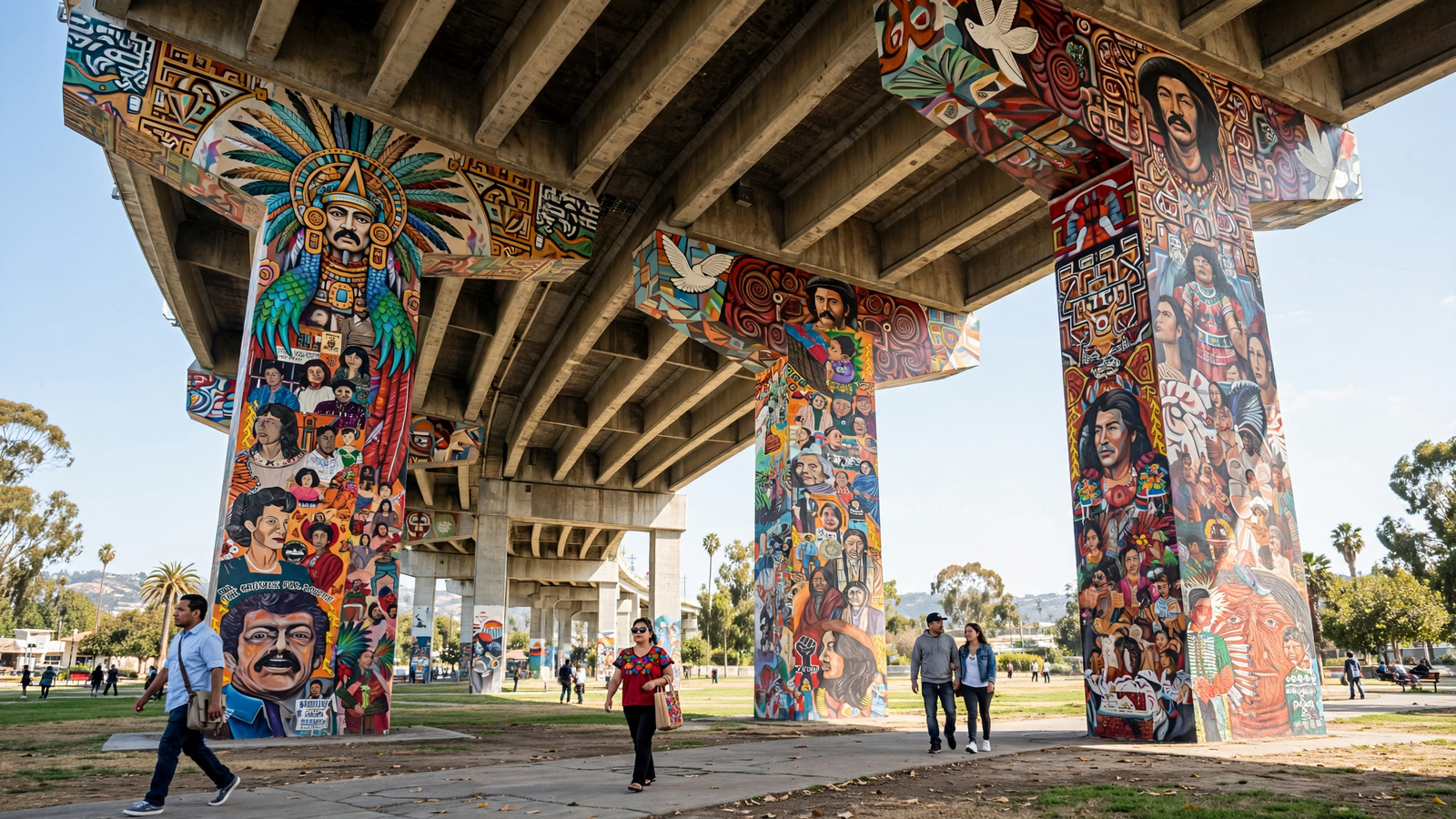
Under the elevated roadway in San Diego’s Barrio Logan, concrete supports rise like the walls of an enormous open-air gallery. They carry images of Indigenous history, Mexican and Mexican American life, labor, migration, family, resistance, celebration and hope. Cars pass above. Below, visitors walk through a public artwork that has been growing for more than half a century.
This is Chicano Park, a community-created cultural landscape in the heart of one of San Diego’s oldest Mexican American neighborhoods. Its murals are vivid, but the larger achievement is structural: residents claimed an overlooked piece of urban land and made it a place where art, memory and public life could meet.
Today, Chicano Park is recognized as a National Historic Landmark. It remains an active gathering place and an evolving gallery rather than a finished monument. New generations continue to care for the murals, interpret their history and use the park as a setting for festivals, education and creative work.
A park created by persistence
Barrio Logan developed as a Mexican American community close to San Diego Bay. Over time, highways, industrial development and other large infrastructure projects divided the neighborhood from the waterfront and altered its everyday geography. The construction of Interstate 5 and the Coronado Bay Bridge left land beneath and around the freeway that appeared to have little civic purpose.
In 1969, local residents learned that the city planned to use a section of that land for a highway patrol facility. The proposal galvanized neighborhood opposition. Residents occupied the site and held it until city officials agreed to create a park there instead.
The occupation lasted roughly twelve days, according to accounts preserved by the National Park Service and Chicano Park’s cultural organizations. What began as a demand for green space became an opportunity to build something far more distinctive: a park that would reflect the people who lived around it.
The first murals appeared in the early 1970s. Artists painted the highway columns and retaining walls, turning surfaces associated with traffic and division into a collective canvas. The work drew from the Mexican mural tradition, Chicano movement art and Indigenous visual language, while also responding to the specific history of Barrio Logan.
When infrastructure became a canvas
Chicano Park’s setting is part of its meaning. The murals do not sit in a quiet museum or a specially designed arts district. They occupy the underside of a freeway, a place shaped by engineering and traffic. Their scale answers the scale of the structure overhead.
Many works are large enough to be read from the roadway or from across the park. Together, they form a visual environment rather than a single exhibition. Some panels present historical figures and events. Others honor labor, family, faith, music and community organizing. Still others connect local experience to broader Indigenous and Mexican American histories.
The result is not one official story told in one style. It is a layered record made by many artists over many years. Styles change from mural to mural. Colors, symbols and subjects shift with the generations. The park’s identity comes partly from that variety.
Art historians often describe murals as public history because they make interpretation visible outside formal institutions. Chicano Park takes that idea further. Its history is not simply displayed; it is maintained through community use. The park is a place to look at art, but also a place to gather, perform, teach, celebrate and remember.
The artists made a local language
The early mural movement at Chicano Park included artists associated with San Diego’s Chicano art community, including members of the Centro Cultural de la Raza and other local cultural networks. The work was part of a broader national movement in which Mexican American artists used public walls to tell stories that were often missing from mainstream cultural institutions.
That history gives the park a connection to the wider Chicano art movement, but Chicano Park has always been specifically rooted in Barrio Logan. Its imagery comes back to the neighborhood’s families, streets and shared memories. The murals are not interchangeable decorations that could have been installed anywhere. Their subjects and placement depend on the community that fought for the land.
Over the years, the park has also become a place where younger artists can see public art as a living practice. A mural is not only something made by a famous painter and preserved behind glass. It can be collaborative, site-specific and accountable to the people who live nearby.
That model matters. It gives artists a public audience without requiring visitors to buy a ticket, understand museum etiquette or already know the language of contemporary art. People encounter the murals while walking, attending an event or simply passing through the neighborhood. The park makes artistic participation part of ordinary life.
A landmark without becoming a relic
The National Park Service recognized Chicano Park as a National Historic Landmark in 2016. The designation acknowledged the site’s importance in the history of Mexican American civil rights, community planning and public art.
Historic recognition can sometimes freeze a place in the past. Chicano Park has resisted that fate. Its cultural organizations and community supporters continue to treat it as an active place rather than a preserved scene from the 1970s. Murals require care. Paint fades. Concrete weathers. Meanings change as new generations encounter the images.
Maintenance is therefore part of the artistic story. Preserving a mural does not mean removing it from community life. It means making decisions about materials, restoration and interpretation while respecting the people and artists connected to the work. The park’s continued presence depends on that long-term attention.
The Chicano Park Museum and Cultural Center has helped broaden the site’s role as an educational and cultural resource. Its work connects the park’s murals to neighborhood history and to the artists who made them. The organization also supports efforts to ensure that visitors understand the park as a product of community action, not merely as a colorful backdrop.
Why the park still feels hopeful
The most hopeful fact about Chicano Park is not simply that its murals survived. It is that the park still demonstrates how a community can turn a difficult piece of infrastructure into a place of beauty and belonging.
The transformation did not require an empty canvas or an ideal setting. Artists worked with concrete columns, traffic noise and the complicated history of an urban neighborhood. They made those constraints part of the composition. The freeway remains overhead, but the space beneath it now carries a different kind of movement: people gathering, children learning, musicians performing and visitors following the murals from one pillar to the next.
That achievement offers a useful definition of public art. It is not only art placed in public. It is art that helps a public recognize itself.
Chicano Park also shows why cultural preservation is more than protecting old buildings. A neighborhood’s creative history may live in paint, oral memory, annual celebrations and the relationships between artists and residents. Preserving that history requires supporting the people who continue to use the place.
More than fifty years after the community occupied the proposed park site, the murals remain a visible argument for imagination in public life. Their message is carried not by one artist or one generation, but by the continued decision to make room for art where everyday life is already happening.
In Barrio Logan, the underside of a highway became a gallery because neighbors insisted that the space could belong to them. The paintings made that claim visible. Their survival has turned it into a lasting civic achievement.
Use: Background on Chicano Park’s history, community origins, murals and National Historic Landmark recognition.
Use: Context for the National Historic Landmark program and Chicano Park’s place within it.
Use: Information about the park’s cultural interpretation, preservation work and continuing community role.
Use: Municipal information about the park’s location, public use and facilities.
National Park Service — Chicano Park — https://www.nps.gov/places/chicano-park.htm — Background on Chicano Park’s history, community origins, murals and National Historic Landmark recognition.
National Park Service — National Historic Landmarks Program — https://www.nps.gov/subjects/nationalhistoriclandmarks/index.htm — Context for the National Historic Landmark program and Chicano Park’s place within it.
Chicano Park Museum and Cultural Center — https://chicanoparkmuseum.org/ — Information about the park’s cultural interpretation, preservation work and continuing community role.
City of San Diego — Chicano Park — https://www.sandiego.gov/park-and-recreation/parks/regional/chicano — Municipal information about the park’s location, public use and facilities.