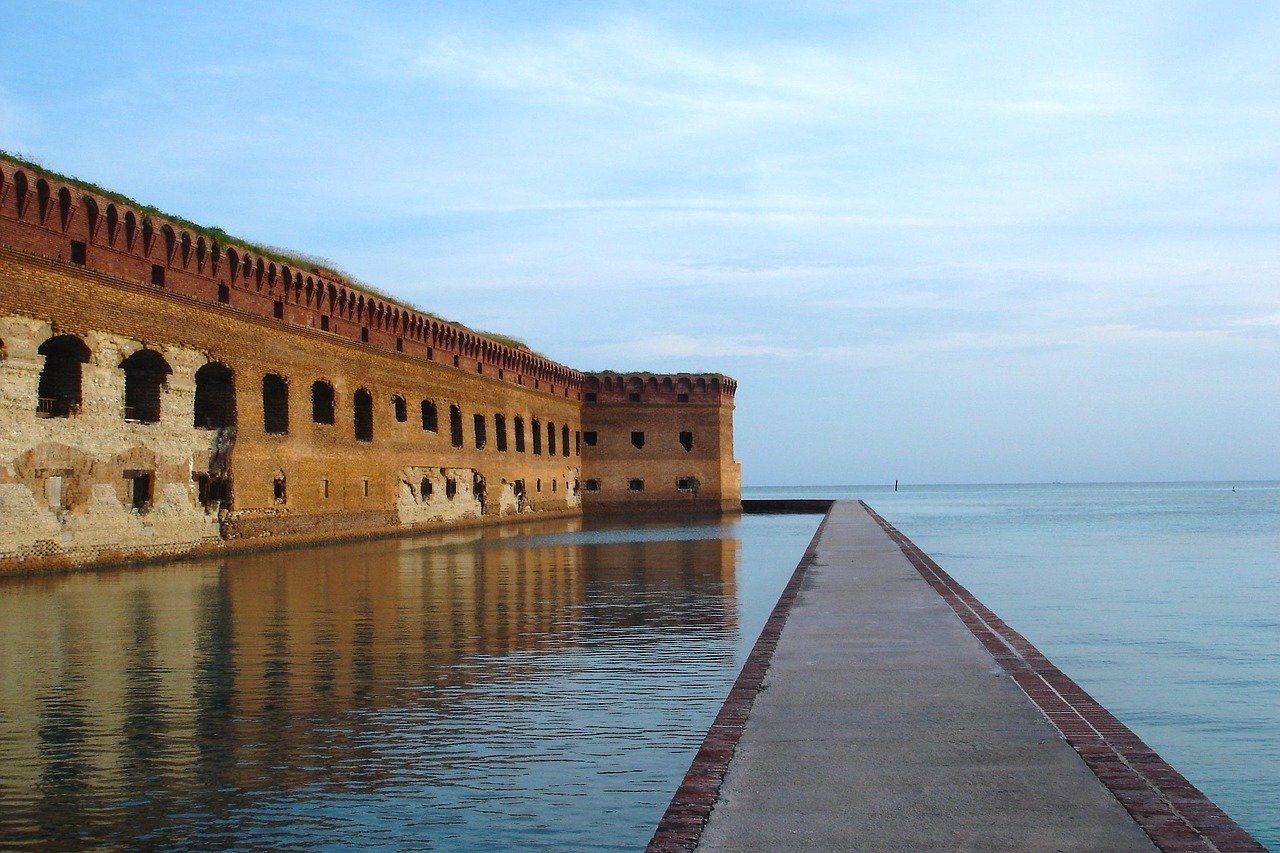
Far off the end of the Florida Keys, the sea seems to take over. Dry Tortugas National Park lies about 70 miles west of Key West, where seven small islands sit amid clear water, coral reefs and open sky. Its most conspicuous landmark is not a natural one: Fort Jefferson, a massive brick military structure on Garden Key.
The pairing makes the park unusual. It is at once a remote marine landscape and a record of an ambitious effort to control a strategic stretch of the Gulf of Mexico. Getting there requires a boat or seaplane, but the distance is more than a logistical detail. It helps explain why the islands feel so different from Florida’s better-known coastal destinations.
A name shaped by turtles and a lack of water
Spanish explorer Juan Ponce de León named the islands Las Tortugas—“the turtles”—in 1513, a reference to the sea turtles found in the area. Later mapmakers added “Dry” to warn sailors that the islands had no dependable source of fresh water. The name captures two defining facts: wildlife is abundant, but the islands are not an easy place to live.
The park covers roughly 100 square miles, and almost all of it is water. Its seven islands are small, low-lying pieces of coral and sand at the far western end of the Florida Keys. The surrounding marine environment is part of the experience, not merely the view from shore: reefs, seagrass beds and open-water habitats support a variety of marine life.
That setting also makes the islands important to birds. Their location in the Gulf puts them along routes used by migratory birds, and the islands provide places to rest. Sea turtles are another part of the park’s natural story. Visitors should keep wildlife at a distance and follow park rules, especially around nesting areas and fragile habitats.
Why build a fort so far offshore?
Work on Fort Jefferson began in 1846, when the United States sought to strengthen its presence in the region and protect important shipping routes. The location offered a deep-water harbor in a strategically placed part of the Gulf. The fort was designed as a six-sided coastal defense, with thick brick walls, gun positions and a moat separating it from the island.
Construction continued for decades, but the fort was never finished as planned. Its scale is still striking: the National Park Service describes it as one of the largest 19th-century forts in the United States. The bricks, arches and long, open casemates make the place feel like a city-sized project set down on a very small island.
Military technology changed while the work was under way. The fort’s defensive design was built for an era when ships might be challenged by coastal guns, but advances in weapons and the changing needs of the military diminished the value of completing such a vast masonry defense. Fort Jefferson was eventually used for purposes beyond its original military role, including as a federal prison during the Civil War era.
Walking through the structure, visitors can see both the ambition and the limits of the project. The walls and galleries were built to accommodate soldiers, supplies and artillery; the unfinished portions are reminders that plans on paper do not always survive changing technology, cost and circumstance. The surrounding water, meanwhile, underscores the logistical challenge of supplying a remote installation.
A national park of land and water
Fort Jefferson’s historical importance helped bring federal protection to the site. The area became Fort Jefferson National Monument in 1935 and was redesignated Dry Tortugas National Park in 1992. That change in status reflects the wider landscape: the fort is an essential landmark, but it is only one part of a protected area dominated by water and marine habitat.
The islands have little room for development, no road connection to the mainland and no source of fresh water. Those constraints shape a visit. The National Park Service advises travelers to plan ahead, check current transportation and park information, and bring what they need for the day. Conditions at sea and on small islands can change, so a trip is not the sort of outing to improvise at the last minute.
Visitors who arrive can explore the fort and take in the contrast between its geometry and the open landscape beyond it. From the ramparts, the view shifts quickly from brick corridors to blue water and low islands. Snorkeling and other water activities offer a different perspective, though reef environments are fragile and should be approached without touching or disturbing wildlife.
What makes Dry Tortugas stand out
Many historic forts were built beside busy ports or growing cities. Fort Jefferson is compelling partly because it was built in a place where nature still sets the terms: distance, weather, tides and the scarcity of fresh water. The massive walls show how people tried to make a remote position secure; the surrounding sea makes clear how difficult it was to sustain that effort.
Dry Tortugas is not simply a fortress with a pretty backdrop, nor just a reef destination with an old building on shore. Its story comes from the tension between the two. The fort records a period of military ambition, while the national park protects a broad marine setting that cannot be reduced to the human structure at its center.
That combination is what makes the journey memorable. In a place reached only across open water, a visitor can stand inside a monumental work of 19th-century engineering and, minutes later, look out over a landscape shaped by reefs, birds and sea. The islands remain small; the world around them is immense.