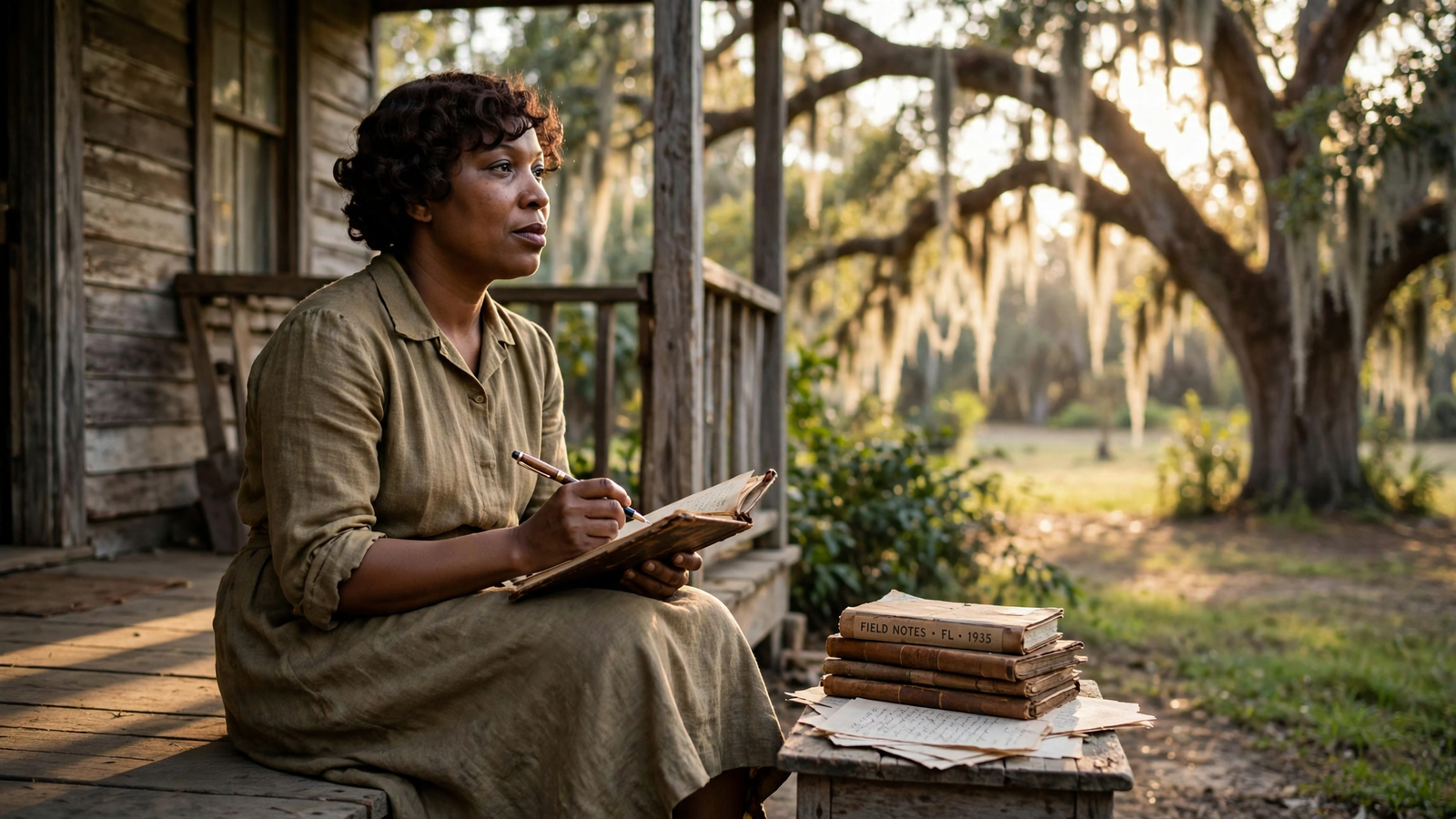
Zora Neale Hurston understood that history does not live only in official documents. It also survives in jokes, sermons, work songs, arguments, folktales, and the particular rhythms of ordinary conversation.
That idea shaped a career unlike almost any other in American letters. Hurston was a novelist, anthropologist, folklorist, and field researcher who treated spoken culture as serious knowledge. Her work offers a lasting lesson for writers and readers: a community’s everyday language can carry its history, humor, values, and imagination.
A childhood shaped by a remarkable town
Hurston was born in 1891 in Notasulga, Alabama, and grew up largely in Eatonville, Florida. Eatonville was one of the earliest incorporated Black municipalities in the United States. Its civic independence and strong community life became an important imaginative foundation for Hurston.
She later returned to the town in her writing, especially in Their Eyes Were Watching God, published in 1937. The novel follows Janie Crawford as she searches for independence, love, and a voice of her own. Rather than presenting Black life through the expectations of outsiders, Hurston built the story around the speech, relationships, conflicts, and ambitions of its characters.
When folklore became fieldwork
Hurston’s interest in storytelling was not merely literary. At Howard University and later Barnard College, where she studied anthropology under Franz Boas, she learned methods for documenting culture. She traveled through the American South and the Caribbean, recording folktales, songs, religious practices, and patterns of speech.
Her book Mules and Men, published in 1935, brought together folklore she collected in the South. The work occupies an unusual space between scholarship and literature: Hurston preserved the texture of spoken stories while also showing how they functioned within communities. She did not treat folklore as a quaint leftover from the past. She treated it as an active, changing form of knowledge.
That approach remains especially relevant in an age when people can record and publish their own histories more easily than ever. Hurston’s example encourages careful listening: document the language people actually use, identify who is speaking, and understand a story within the community that created it.
A reputation that outlasted neglect
Hurston’s work did not always receive the recognition it deserved during her lifetime. She died in 1960, and for years her books were difficult to find. Interest began to revive in the 1970s, when writers and scholars brought renewed attention to her fiction and research. Alice Walker’s influential 1975 essay about Hurston helped introduce her work to a new generation of readers.
Today, Their Eyes Were Watching God is widely taught, while Mules and Men remains important to readers interested in folklore, oral history, and the relationship between literature and anthropology. Hurston’s writing endures not because it simplifies the past, but because it allows many voices to remain vivid and complicated.
Her legacy is an invitation to notice what formal histories can miss. A memorable biography, novel, or community archive may begin with the same deceptively simple act that guided Hurston: listening closely enough to understand that everyday speech is already a record of who people are.