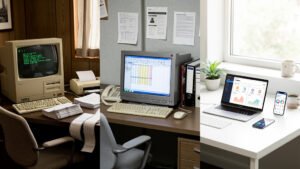
For much of computing’s early history, using a computer meant learning commands, codes, and specialized procedures. The machine could calculate astonishingly quickly, but it did not feel especially welcoming. Then a small pointing device began to change the relationship between people and screens.
The computer mouse did not create the graphical user interface by itself. But it gave ordinary users a simple physical way to move through one. Point, click, select, drag: these actions became a bridge between human gestures and digital instructions.
A wooden box with two wheels
The first widely recognized mouse was developed in the 1960s by engineer Bill English, working with computer researcher Douglas Engelbart at the Stanford Research Institute. Engelbart’s research focused on “augmenting” human intelligence: designing computer systems that could help people organize, connect, and work with information.
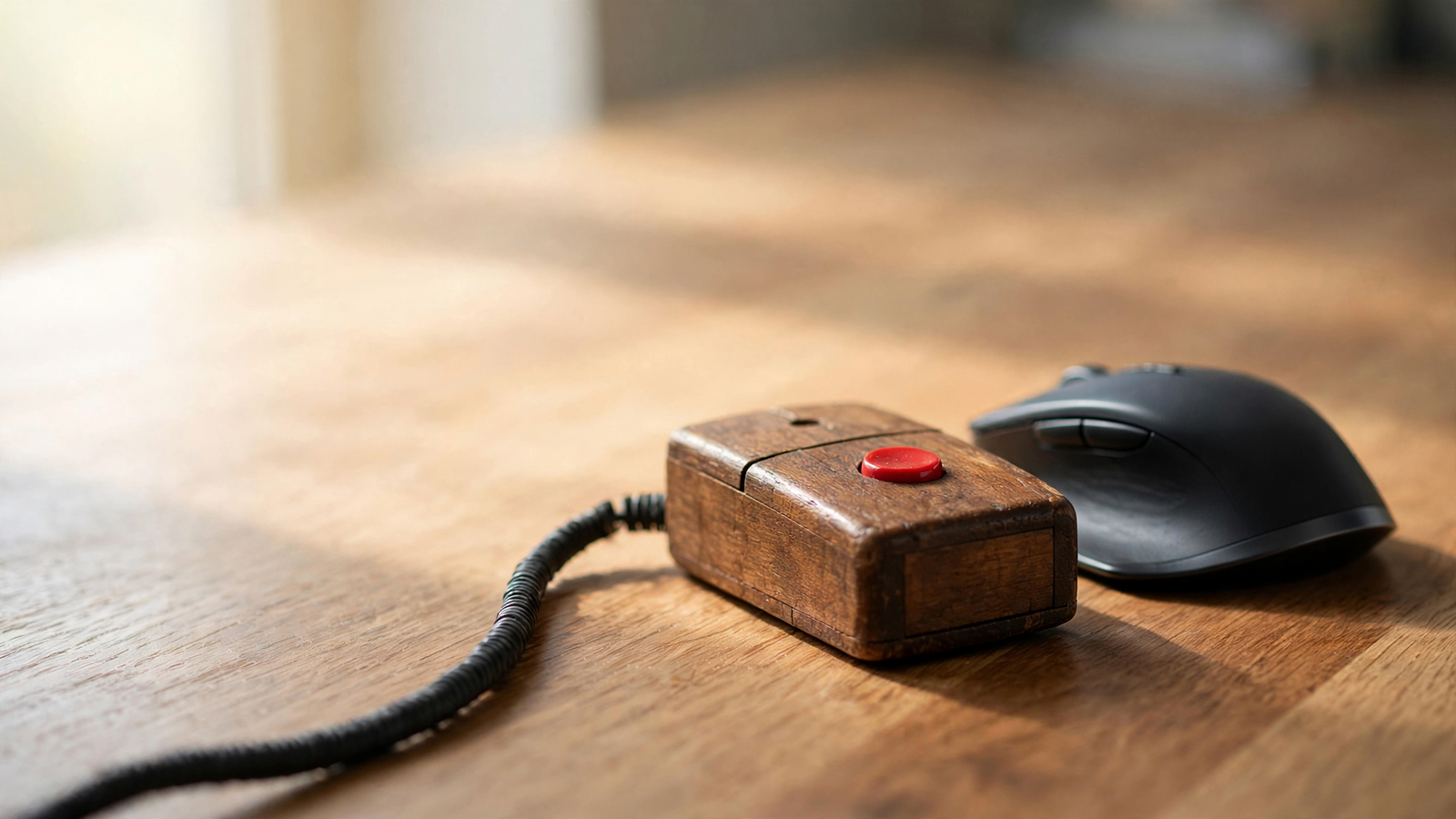
English built a prototype in a small wooden case. Inside were two wheels positioned at right angles. One recorded movement from side to side; the other recorded movement forward and backward. Together, they translated the device’s motion into the movement of a cursor on a display.
A cable extended from the back of the box, giving the prototype a tail-like appearance. The informal name “mouse” remained, even though the device’s original technical description was much less memorable: an X-Y position indicator for a display system.
Engelbart and English received a patent for the design, filed in 1967 and issued in 1970. The patent described a device that converted physical movement into screen-position data, an idea that would become central to personal computing.
The demonstration that showed the future
On December 9, 1968, Engelbart led a landmark public demonstration in San Francisco. In a presentation that later became known as “The Mother of All Demos,” his team showed a networked computer system with windows, hypertext links, collaborative editing, text search, and a mouse-driven pointer.
Seen from the present, the event can look like a preview of the modern desktop. At the time, however, many of the ideas were far outside everyday computing. The demonstration’s importance was not that it presented one finished product. It showed how several tools could work together to help people handle information more directly.
The mouse was especially effective because it reduced the distance between intention and action. Users did not have to remember a command for every operation. They could move a pointer toward an object and indicate what they wanted.
From research laboratory to office desk
The concept gained wider influence through systems developed at Xerox PARC, including the Alto, an experimental personal computer that used a graphical display and mouse. Xerox’s Star office system later brought related ideas into a commercial product.
Apple helped move the mouse toward mainstream personal computing with the Lisa in 1983 and the Macintosh in 1984. These systems made menus, icons, windows, and direct manipulation central parts of the user experience. Microsoft and other computer makers then helped spread mouse-based interaction across the growing PC market.
The hardware itself also evolved. Mechanical wheels gave way to a rolling ball, and later to optical sensors that tracked movement without exposed moving parts. Wireless connections removed the familiar cable. Laptops introduced touchpads, while phones and tablets made touchscreens the primary pointing surface.
A quiet lesson in computer design
The mouse endures because it solved a human problem, not just a technical one. Computers store and process abstract information; people often think spatially and physically. A pointer gave users a visible mark to move, a button to press, and a way to manipulate objects that otherwise existed only as patterns of data.
Today, many people reach first for a finger, stylus, keyboard, or voice command. Yet the mouse remains a reminder that important inventions do not always make computers more powerful. Sometimes they make powerful systems easier for people to approach.